HAL LEONARD

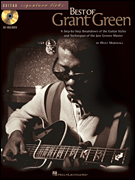
GREEN GRANT BEST OF SIGNATURE LICKS CD TABLATURE GUITAR STYLES TECHNIQUES OF THE JAZZ GROOVE MASTER

GREEN GRANT, BEST OF. A step-by-step breakdown of the guitar styles and techniques of the jazz groove master. SHEET MUSIC BOOK with CD & GUITAR TABLATURE .

Series: Signature Licks Guitar
Softcover with CD - TAB
Artist: Grant Green
Author: Wolf Marshall

Explore the many stylistic turns of one of the most influential guitarists in jazz! Renowned guitar educator Wolf Marshall takes you inside 13 of Grant Green's most popular tunes to examine his unique lines and musicality. Includes: Airegin - Born to Be Blue - Cool Blues - If I Should Lose You - My Favorite Things - Oleo - Sookie Sookie - Stella by Starlight - This Could Be the Start of Something Big - Tune Up , and more. The CD includes full demos. 88 pages

TiTLES :
Ain't It Funky Now, Pt. 2
Airegin
Born To Be Blue
Cool Blues
If I Should Lose You
Little Girl Blue
My Favorite Things
Oleo
Sookie Sookie
Stella By Starlight
This Could Be The Start Of Something Big
Tune Up
Wives And Lovers (Hey, Little Girl)


INTRODUCTION
Grant Green personifies the appellation "soul jazz." He is one of the most colorful
and exciting guitarists to have emerged from the genre, and his work remains the yardstick
by which subsequent practitioners are measured to the present day. In the early and
mid 1960s, Grant Green was a leading exponent of the burgeoning hard bop movement
and a studio stalwart of countless recording sessions that chronicled the rise of the art
form. In these productive years Green lent his singular blue-tinged touch and talents to
groups led by luminaries like Jimmy Smith, Herbie Hancock, Lee Morgan, Larry Young,
Art Blakey, Lou Donaldson, Jack McDuff, Stanley Turrentine, Hank Mobley, Baby Face
Willette, Johnny Hodges, Ike Quebec, and many others. Green was one of the most prolific
recording artists in the prestigious Blue Note stable. He recorded an unheard-of seventeen
albums in 1961 alone, his first year with the company. Between 1961 and 1965,
his classic jazz years, Green made more records than any other artist at Blue Note.
During this time, in addition to his many sideman sessions, he established a formidable
legacy with a substantial catalog of his own albums as leader.
By decade's end, Green had expanded his artistic vision to include the new
rhythm and blues hybrid dubbed "funky jazz." As a result, in the late 1960s and 1970s he
enjoyed a second prominent and influential career as performer and innovator and was
hailed as the quintessential "groove master" of jazz. Green's contributions in the medium
affected countless players on both sides of the jazz-rock divide. You can put George
Benson, Pat Martino, Henry Johnson, Stevie Ray Vaughan, Carlos Santana, Mark
Whitfield, Eric Gale, John Scofield, Joshua Breakstone, Andy Summers, Melvin Sparks,
Dave Stryker, Kevin Eubanks, and Peter Bernstein on the top of the list.
This is the first Signature Licks book/CD to explore the music, style, and playing
techniques of Grant Green in depth. The note-for-note transcriptions will provide you with
countless hours of revelation, and the matching audio will invite you to step into his musical
world to put the theory into practice-the way Green himself did in his formative years.
The selections reflect the diversity of Green's approach and are drawn from his various
musical epochs. You will find material from the hard bop and soul jazz genres, straightahead
standards and blues, modal jazz outings, and funky rock-influenced sessions, all
attesting to the many shades of Green that have endured to become a vital piece of the
mosaic we know and love as the American musical experience.

Figure4-010
Green's two-chorus solo in "If I Should Lose You" is one of the finest of his early
years, a superb example of his hard-bop improvisation in a moderate swing tempo.
Throughout, he cultivates a relaxed soulful feeling distinguished by thoughtful melodic
invention and an ever-present rhythmic congruence.
Green plays unmistakable blues-based licks in Bb minor over the song's minormode
areas to begin each A section in measures 1-3, 17-19, 33-35, and 50-51.
Moreover, his cadential lines at the end of each sixteen-measure section, beginning with
the opening break, are harmonically active bop melodies that emphasize the movement
to and arrival in Bb minor. Green also imbues the crucial secondary dominant-seventh
sections of the song with related minor-mode sounds. In measures 13-14 and 45-46, he
applies characteristic Bb minor lines to Eb9, and approaches each phrase with an altered
dominant melody based on F, the V chord of Bb minor, in measures 12 and 44.
Green favors swing-oriented ideas and generally simpler, more diatonic bop lines
during the contrasting but tonally related major-mode portions (in Gb and Dbmajor) of the
tune. Check out measures 4-11,21-27,36-43, and 53-58. These measures contain a
mixture of scalar and arpeggiated patterns shaped into memorable solo phrases. A case
in point is the voice-leading figure in measures 8-10, a well-known and favorite Green
cliche. This trademark phrase implies an Ebm7-Ab7-Dbmaj7 progression with a descending
minor-seventh arpeggio (Db-Bb-Gb-Eb), disguised chromatic motion arranged in a
familiar zigzagging pattern of Eb-Bb-D-Bb-Db-Bb-C, a rising 9th chord arpeggio
(C-Eb-Gb-Bb), stepwise descent (Bb-Ab-Gb), and a resolving target figure (Gb-E-F).
Green pursues and develops a simple motive in measures 37-39 with an
inescapable logic. Note the melodic expansion and rotation in this three-part phrase.
Green was a master of this sort of melodic invention, and was able, on the fly, to harness
the same elements and procedures used by great classical composers to produce similar
thematically coherent results in improvisation.
Green plays signature raked arpeggio patterns in measures 20, 57, 60, and
62. These short, crammed figures are articulated with sweep picking in both ascending
and descending motion. Green applies side-slipping (in this instance "slipping" a half step
higher) in measures 46-47 to momentarily suggest the remote key center of A minor over
Eb7 and Ebm7. The phrase is made more striking with his barrage of crammed triplet
rhythms. Green's prevalent use of eighth-note triplet rhythm patterns in the solo further
energizes important phrases throughout, most notably in measures 27-28, 32, 43-44,
47-48, and 63-64. Another ear-catching highlight is the funky double-stop figure in measures
51-52. Here Green combines an anchoring pedal tone (Db)with a descending chromatic line.
 

Prezzo: €39,99
€39,99

AL DI MEOLA MUSIC WORD PICTURES Artist Transcriptions LIBRO Guitar TABLATURE CHITARRA PACO

DI MEOLA AL, MUSIC, WORD, PICTURES. SHEET MUSIC BOOK wirh GUITAR TABLATURE .

LIBRO DI MUSICA LATIN JAZZ FUSION .

SPARTITI PER BASSO E CHITARRA .

ACCORDI E PENTAGRAMMA.


Series: Transcribed
Artist: Al Di Meola

A collection of Al's greatest, complete with biography, discography, and complete description of Al's special techniques. 144 pages.


AL DI MEOLA

EDITORIAL NOTES
The music in this book contains transcriptions taken directly from scores and recordings of Al Di Meola. The transcriptions include the guitar lines, bass lines, and chord progressions. The tunes were chosen by Al himself, and although he would have wished to have included more music, this was impossible due to space limitation. Unfortunately, it does not contain all of AI's lengthly solo breaks written out again due to space limitation. Each tune consists of the main thematic sections fully written out, with the solo break sections being indicated by showing the basic background" riff," with repeats included.
The order of the music, as it appears in this book, has nothing to do with the level of difficulty of the music, but rather the ordet shows the chronological progression of AI's music from his first solo album to his most recent one.

Al plays most of his music very up tempo, and it sounds incredibly hard to play. But one very important discovery I made while we worked on transcribing the music to print was that once you see the music written out, it is not very hard to read. Just work on the following practice suggestions, as well as those Al gives in the section of this book entitled "Technical Talk". An added help would be to use "AI Di Meola's Picking Techniques" book available.

As everyone knows, the main elements in AI's guitar playing are speed and accuracy. Al suggests that anyone attempting to play his music practice it slowly with accuracy in both the left and right hands, and you will in time be able to play his music. In addition, the main musical element in AI's writing is the use of scales in both his thematic and solo break structures. AI's suggestion is to study the scales in all positions as an aid. Addressing yourself to these above mentioned elements of AI's playing and writing styles will help you tremendously not only in playing AI's music, but also in the writing and playing of your own music, as the elements of speed, accuracy, and scale work will broaden your musical creativity.
It is important to note that the playing positions and fingerings contained in these transcriptions are the choosing of the editor, and are not necessarily those that Al uses himself. They are those that seem most comfortable to me.
You should feel free to play the music in any position you feel comfortable with. As Al has stated many times, you should know your fretboard so well that you can play the given music in any position feasible. But for those of you who don't know your fretboard well, I felt it necessary to include one way you could play these tunes.
You should also note that the bass lines contain no fingerings or position markings, since I felt it better to leave it up to the player. Of course, keyboard players can use both lines, or play the chord changes along with the guitar line.
I do hope that you get many things from this book, but most of all I hope you have fun and enjoy it.
Music Editor


... Do you have any suggestions for how to learn these things?
I would recommend books that show the positions and ways to play them. Check out Berklee's books (Berklee Press Publications), because I know their advanced stuff to be very good; it's probably the same with their beginning books, too. I would suggest starting your scale education with the major and minor scales, and,after that, diminished, augmented, and whole-tone. Then, depending on what kind of music you ant to play, the modes should be learned. My theory about this kind of thing is that you should never stop learning.
Once you've got it you can play whatever you want, and your playing will sound more advanced, thus achieving a better understanding of the instrument.

How does this apply to the way you play now?
ell, now I know where to play on the instrument and what to do to get the sound I want. And because it comes o easily, I can play more in terms of feelings. You can spend a lifetime playing with the "thinking" process of hat scale to put against what chord. If you were to analyze my playing, you would find elements of the phrygian, dorian, mixolydian, and locrian modes etc.


Would you describe your left-hand technique?
My left.hand position is one from which all four fingers have easy access to the fingerboard. It doesn't vary much from that, because it is natural for me to use all four fingers to play my ideas. I really find it frustrating to see so man rock players using just the first and third fingers. It isn't necessarily wrong, but it is impossible for almost an one to play any kind of scale with and fluidity.


What about your picking style?
It is just normal alternating picking. Because I was taught that way from the beginning, it is very natural for me, and I really don't think about it. Sometimes I have my wrist on the bridge, and sometimes it is free-floating. And although my pick hits the string flat most of the time, it will change, depending on what sound I want.


How do you come up with the rhythms in your playing?
I guess they come from a love of drumming and Latin music. My involvement with Return To Forever also helped. Unlike a lot of electric guitarists, who play mostly lagato, I tend toward playing rhythms like a drummer or percussionist would. I try to incorporate both rhythmic, percussive lines with the more legato phrasings. A lot of the trickiness of many of my scale runs is involved with the rhythms and where the accents fall.


How do you work on these tricky runs?
It depends, because sometimes one apparently tricky passage will flow really easily, while another passage will be alot more difficult. I'll then have to sit down and work out the fingering. I usually find it best to work on passages at a slow tempo with correct rhythm.


Is there a good way to work on alternate picking?
I would suggest picking three or four notes, and working on those. Too often, players who are trying to improve their right-hand dexterity get hung up by trying to play too many notes in the left hand. I hear a lot of players running whole scales from the sixth string to the first and playing them really sloppy. So, I say to make it very basic, ing only a few notes and play slowly with perfect rhythm in time. That, in itself, is a task.


Do you work on your own picking very much now?
ell, I want to get even better. There are a lot of lines in my music that are tricky for the right hand, and I only know that I've really got it when I don't have to think about it at all. I find that going over these runs before a performance serves as a good warm-up also. I practice tricky things with skips and jumps in them, but it's always omething that I am going to be playing in the music. One thing that makes some lines tricky is their rhythm. When I'm playing something very rhythmic, I use my left and right hands to enhance different parts of the passage. For example, I mute strings a lot.


How did muting become a part of your playing technique?
It was actually very natural. When I first started taking guitar lessons, I was very self-conscious in just playing around other people. I never really wanted anyone to hear what I was doing, because I was very conscious of their pace, too. I never wanted to have people say, "What's that noise?" In those days, electric guitar was not accepted like it is today. I was very shy, so I started muting the strings with my hand to cover up the volume. Years later, I ould mute the strings as a musical effect, but only then did I realize that it had become a part of my style. ...


TITOLI:
Al Di's Dream Theme FOR GUITAR AND BASS - SOLO IN PENTAGRAMMA, SENZA TABLATURE
Casino FOR GUITAR AND BASS - SOLO IN PENTAGRAMMA, SENZA TABLATURE
Dinner Music Of The Gods FOR GUITAR AND BASS - SOLO IN PENTAGRAMMA, SENZA TABLATURE
Egyptian Danza FOR GUITAR AND BASS - SOLO IN PENTAGRAMMA, SENZA TABLATURE
Electric Rendezvous FOR 2 GUITARS AND BASS - SOLO IN PENTAGRAMMA, SENZA TABLATURE
Elegant Gypsy Suite FOR GUITAR AND BASS - SOLO IN PENTAGRAMMA, SENZA TABLATURE
Lady Of Rome, Sister Of Brazil FOR 2 GUITARS  - SOLO IN PENTAGRAMMA, SENZA TABLATURE
Land Of The Midnight Sun FOR GUITAR AND BASS - SOLO IN PENTAGRAMMA, SENZA TABLATURE
Midnight Tango FOR GUITAR AND BASS - SOLO IN PENTAGRAMMA, SENZA TABLATURE
Morning Fire FOR GUITAR AND BASS - SOLO IN PENTAGRAMMA, SENZA TABLATURE
Race W/Devil On Spanish Highway FOR GUITAR AND BASS - SOLO IN PENTAGRAMMA, SENZA TABLATURE
Ritmo De La Noche FOR GUITAR AND BASS - SOLO IN PENTAGRAMMA, SENZA TABLATURE

Passion, Grace & Fire, con 2 TABLATURE, della chitarra di PACO de LUCIA e di AL DI MEOLA

Prezzo: €29,99
€29,99

AL DI MEOLA PICKING TECHNIQUES ELEGANT GYPSY-EGYPTIAN-PASSION GRACE & FIRE TABLATURE LIBRO

DI MEOLA AL, PICKING TECHNIQUES. Vari esempi di alternate picking. 32 pagine senza TABLATURE

LIBRO DI MUSICA,

SPARTITI PER CHITARRA:

ACCORDI, PENTAGRAMMA.  

Al Di Meola's Picking Techniques
Series: Instructional
Publisher: 21st Century Publications
Artist: Al Di Meola

An insightful and helpful book written by Di Meola on his own personal technique of guitar playing. Includes exercises and excerpts from his music, which act as a step-by-step guide to help the guitar student play better. 32 pages

Produced: John Cerullo
Inventory #HL 00604044
ISBN: 9780793510184
UPC: 073999040449
Width: 9.0"
Length: 12.0"
32 pages

My main purpose in writing this book on picking technique is to help guitar players develop speed and accuracy in their playing while developing their own musical goal. By doing this, the guitarist is better able to hear, play and write creatively for the guitar. Many of today's guitar players, particularly rock guitar players, are limiting themselves. By not learning speed, accuracy, and scale work, they have no chance to develop a variety of styles, tempos or other important musical elements. In order to be an effective and creative player today, a guitarist must learn the entire fretboard in a scale-wise fashion and be able to do it with speed and accuracy. An added help would be to listen to lots of different styles of music, not just top 40. This book has been simply structured for ease of use and accessibility to every guitarist who wishes to develop his picking technique. The real secret to it all is to practice a lot and to start slowly, gradually building speed, while always playing as clearly and accurately as possible. The main thing is to work hard on repetitive rhythms-it's the only way to improve. The outline of the book follows the development of alternate picking: first single string alternating, then work on repeated upstrokes, alternate picking on adjacent strings, and finally alternate picking skipping strings. These different elements of picking and some variations will all .be demonstrated by the use of exercises, scales, folk songs, and excerpts from my own tunes. An explanation of my muting technique is also covered. The excerpts from my own music include bass lines and chord changes for anyone who wishes to play with a friend or teacher. The left hand fingerings are those suggested by the editor and not necessarily my own. Full transcriptions of the tunes used in this book can be found along with other tunes of mine in my book, Al Di Meola, Music/Words/Pictures. I hope you wotk. hard and enjoy the book.

Al Di Meola

CONTENTS

Foreword
MutingTechnique
Alternate Picking
Right Hand Position
Articulation
Alternate Picking on Single String
Alternate Picking on Adjacent Strings
Alternate Picking on Single and Adjacent Strings
Alternate Picking on Easy Skips
Alternate Picking on Chords
Summary of Technique. Learned So Far
Alternate Picking on Melodic Skips
Alternate Picking on Scales, Skips, and Chord.
More Advanced Alternate Picking on Adjacent Strings
Further Skips with Step-WileBrew
Double Note Picking
"Tarantella" Revilited
Chordal Strumming
Excerpt from "PASSION, GRACE & FIRE" TABLATURE GUITAR I AL, GUITAR II PACO - TABLATURE

ESEMPI DA :

CASINO'
ELEGANT GYPSY SUITE
RACE WITH DEVIL ON SPANISH WIGHWAY
EGYPTIAN DANZA
ELECTRIC RENDEZVOUS

Prezzo: €15,99
€15,99

DI MEOLA AL CIELO E TERRA GUITAR SHEET MUSIC BOOK SPARTITI LIBRO CHITARRA HAL LEONARD

DI MEOLA AL, CIELO E TERRA. SHEET MUSIC BOOK FOR GUITAR.


LIBRO DI MUSICA JAZZ FUSION.

SPARTITI PER CHITARRA CON:

ACCORDI, PENTAGRAMMA.

TRANSCRIPTIONS FROM THE ALBUM CIELO E TERRA.
FOR ACOUSTIC, CLASSICAL, OR ELECTRIC GUITAR.

ANCHE PER DUE CHITARRE.


MUSIC TRANSCRIPTIONS BY BARRY ENNIS

TRANSCRIPTION OF ETUDE BY KEN NAVARRO.

TITOLI.

- TRACES OF A TEAR

- VERTIGO SHADOW

- CIELO E TERRA

- ENIGMA OF DESIRE

- WHEN YOU'RE GONE

- ATAVISM OF TWILIGHT

- ETUDE

- SOLACE
 

Prezzo: €99,99
€99,99

DI MEOLA AL McLAUGHLIN PACO DE LUCIA FRIDAY NIGHT SAN FRANCISCO Mediterranean Sundance BOOK

DI MEOLA AL, JOHN McLAUGHLIN, PACO DE LUCIA, FRIDAY NIGHT IN SAN FRANCISCO. SHEET MUSIC BOOK IN STANDARD NOTATION. 

LIBRO DI MUSICA JAZZ, FUSION,
SPARTITI PER CHITARRA CON PENTAGRAMMA E ACCORDI. 
TRASCRIZIONE DI OGNI CHITARRA.

Questo irripetibile concerto del 5 dicembre 1980, ha aperto le strade al genere spanish-jazz-acustico.

LIBRO DI MUSICA JAZZ FUSION, TRASCRITTO da AL DI MEOLA !

SPARTITI PER 2 E 3 CHITARRE CON:

ACCORDI E PENTAGRAMMA.

DISCO PIù FAMOSO DEL TRIO CHITARRISTICO PATRONIMICO ( Di, Mc, De ) .  


Al Di Meola, Paco De Lucia: Mediterranean Sundance/Rio Ancho;
Al Di Meola, John McLaughlin: Short Tales Of The Black Forest;
Paco De Lucia, John McLaughlin: Frevo Rasgado;
Al Di Meola, Paco De Lucia, John McLaughlin: Fantasia Suite; Paco De Lucia, Al Di Meola, John McLaughlin: Guardian Angel.

Trascrizione di ogni chitarra.


Al Di Meola, John McLaughlin and Paco DeLucia - Friday Night in San Francisco

Artist Transcriptions
Series: Guitar Book
Artist: Al Di Meola
Artist: John McLaughlin
Artist: Paco Delucia

This famous trio of acoustic guitarists is captured live in this matching folio to the Grammy Award-winning album from a live concert in San Francisco. The book contains full transcriptions of every tune including: Short Tales of the Black Forest - Mediterranean Sundance/Rio Ancho - Fantasia Suite - and more.
Inventory #HL 00660115
ISBN: 9780793512461
UPC: 073999601152
Width: 9.0"
Length: 12.0"
96 pages


Series: Guitar Book
Artist: Al Di Meola
Artist: John McLaughlin
Artist: Paco Delucia
Artist Transcriptions 21st Century Publications

"Latin rhythms are the most interesting rhythms in the world," opines Al Di Meola, "and to write them you have to be able to play them." And Di Meola can certainly play them. The master altenate-picker and fusion pioneer has carried on a multi-decade love affair with the music of Spain and Central and South America while simultaneously leaving his imprint on the jazz and rock worlds. His two latest releases are The Guitar Trio with Paco de Lucia and John McLaughlin, and Di Meola Plays Piazzolla, a tribute to the great Argentinean tango composer Astor Piazzolla. Both albums are rich in Latin influences, and Di Meola has devoted his musical life to absorbing the subtle stylistic nuances of the various genres within his own playing. "Almost everything I do I kind of analyze to be some kind of percussion or drum pattern," says Di Meola. "I'm particularly interested in what's known as the 'clavé' rhythm. That's essential in Latin music, and some people just can't do it. But you'll hear Latin musicians say, 'Oh, he plays good clavé.' clavé is sometimes referred to as a rhythm, hut mostly in salsa music. When you play against the clavé, you're playing against the time, and that's what I do a lot when 1 play rhythmically on a guitar. We refer to clavé as the quarter note." A great example of this can be found in Di Meola's song "Beyond The Mirage," from The Guitar Trio (see Ex. 1). The opening arpeggios are composed in a classic clavé rhythm. "All three guitars tune the 6th string down to a low D," says Di Meola. "I use a little bit of my Roland GR synth in there, so you can hear that real low tone of a fretless bass sound." 

The picking pattern is not strictly alternating, but designed to fit over the specific string spread. Di Meola composed the picking pattern as much as the notes themselves. You must perform the pick strokes a certain way to achieve the proper ,"hythm. "The first note you hit is on the 6th string, the second note is on the high E string, the third on the D string, and so on," explains Di Meola. "So there's a lot of skipping around. It's down, up, down, up, up, up. But you have to do it this way or the rhythm won't sound just right. And if it's off a hair, the feel is ruined."
At this brisk tempo (q=200), it's quite a challenge to execute pattens accurately. But that's not the most difficult aspect of the passage, according to Di Meola: "It's more the rhythm that's going to mess people up. And what people need to get into is experimenting more with different rhythms, and keeping all of that locked into the clavé time." The rhythm and the placement of the accents brings to mind anothe," Latin-jazz standard, "Spain," by Chick Corea. "The whole thing in 'Spain' is the way those accents fall," says Di Meola. "It's off of the clavé without the clavé moving that will determine whether it's working or not. What 1love about Chick is that he writes and plays with so much clavé. I'm really drawn to his ability to use that in composition and playing." As a fitting homage to Corea-who helped launch Di Meola's career by hiring ti,e teenage,' to play in his band Return To Forever -Paco, John, and Al perform "Spain" as an encore. Note how close the rhythm and accents are in the opening of "Spain" to Di Meola's own tune. The difference is that "Spain" is melodic and "Mirage" is rhythmic. Both carry the clavé rhythm within their notes, and both capture the essence of Latin music. "The important tiling is the rhythm," stresses Di Meola. "Withont that you have nothing. Whether it's 'Spain' or 'Beyond The Mirage' or whatever, the rhythm is everything."


 Quando nella seconda metà degli anni '70 comparve il primo album dal titolo "Land Of The Midnight Sun", di un giovane chitarrista il cui particolarissimo stile esecutivo era stato già notato sulle produzioni di Chick Corea "No Mytery" e "Romantic Warrior", si ebbe occasione di ascoltarlo esterefatto in cuffia in un negozio di dischi. Il disco avrebbe fatto furore tra gli "insiders" dell'epoca; i giovani cultural-rampanti di allora ascoltavano jazz-rock, fusion, Zappa e art-rock sul tipo dei "Gentle Giant". I successori del chitarrista di Chick Corea potevano solo sognare di una carriera incredibile come quella che iniziò allora AI Di Meola: mentre oggi Scott Henderson e Frank Gambale suonano in piccoli Clubs, AI Di Meola riempiva già allora grosse sale, senza problemi. La sua seconda produzione, "Elegant Gypsy" fu votata jazz-album dell'anno nella classifica di Guitar Player e AI Di Meola stesso salì sul trono di migliore chitarrista jazz dell'anno. Tutti i suoi dischi di quel tempo hanno sufficiente fuoco ritmico, ma, almeno allora, AI Di Meola sembrava evitare come il diavolo l'acqua santa, shuffle, swing e tutto quello che avesse a che fare con grooves a terzine. "Mediterranean Sundance", un duetto col gigante del flamenco Paco De Lucia, è stato pubblicato su "Elegant Gypsy".Nella notazione di questa rubrica si trova la parte di Al Di Meola, dal tema fino alla fine del suo assolo; qui c'è dentro tutto ciò che mandava in pappa il cervello dei giovani chitarristi (aspiranti e non) di oltre 16 anni fa. Ancora oggi ci sorprende la velocità e la precisione tecnica per quanto riguarda la scelta del suono ed il fraseggio; l'entusiasmo è un po' diminuito. Praticamente tutto il brano è composto solo da note in MI- naturale; in alcuni punti spunta un RE# sul MI- armonico. Le salve di staccato tipiche di AI, sono ottenute con una percussione energica vicino al ponte ed un deciso smorzamento delle corde con la mano (p.m. = Palm Mute, sordina col palmo della mano). I passaggi ad altissima velocità sono composti fondamentalmente da una serie di segmenti di scala; ne sono stati influenzati chitarristi come Steve Lukather, Vinnie Moore e una serie di esecutori da "competizione e gran turismo". AI allora suonava delle Les Paul, le sue chitarre acustiche erano della casa Ovation.


Spaventosa, questa musica vive della sua velocità, esattamente come anche la musica classica. Per suonare musica strumentale interessante occorre essere padroni di una tecnica fenomenale. E' importante che l'ascoltatore colga la complessità della musica: lento, rapido, triste, allegro - sono tanti gli stati d'animo e gli aspetti della musica; non è solo rapidità esecutiva. Come compositore e musicista improvvisatore voglio anche poter tradurre in note reali quello che mi gira per la mente; e a questo scopo non posso fare a meno di una determinata tecnica. Solo così può funzionare. Ma la rapidità esecutiva credo non sia più un punto di discussione ... almeno per gli ultimi 6 o 8 albums.

Ancora qualche osservazione sulla biografia di questo musicista: Larry Coryell è uno dei chitarristi che hanno influenzato inizialmente Al Di Meola: lui ha definito Coryell come il vero e proprio padre della fusion. Al si recava regolarmente ai concerti del suo idolo. I due musicisti si incontrarono e si conobbero: Coryell ha invitato il sedicenne Al nella sua fattoria dove senz'altro gli ha insegnato qualche trucco. AI volle approfondire l'argomento e nel '71 si iscrisse al Berklee College di Boston. In questo periodo ha seguito soprattutto la musica di John McLaughlin, Miles Davis e John Coltrane. Il suo studio sembra avere riscosso successo: infatti Chick Corea si accorse ben presto di lui. Stava cercando un sostituto per Bill Connors e così a 20 anni Al Di Meola divenne il nuovo chitarrista dei Return To Forever, sicuramente uno dei passi più importanti e decisivi della sua carriera. Dieci anni più tardi pensò di intraprendere la carriera di solista e divenne uno dei musicisti di jazz-rock più popolari degli anni '70, una star della chitarra sia elettrica che acustica. D'altro canto mai virtuosismo tecnico e perfezionismo esecutivo è stato tanto criticato e considerato fine a sè stesso come nel caso di questo musicista; ma la re ponsabilità non fu esclusivamente dei critici musicali.

di musica aggressiva e ad alto volume è calata uotevolmente: non rifiuto certo questo aspetto della musica, ma la mia sensibilità musicale è cambiata nel corso degli anni. John McLaugh-Iin è una persona diversa, lui viene da un'altro pianeta. Senza voler stare a criticare, avevamo molti punti in comune qualche anno fa: tutto doveva essere il più forte, il più rapido possibile, un'energia illimitata, ecco cosa volevamo esprimere. E' una tendenza comune alla maggior parte dei giovani musicisti. Pat Metheny si è sviluppato in un certo modo alla rovescia negli ultimi tempi. Ho sentito che ha pubblicato un disco solo con rumori (ridacchia). Ma devo dire che non l'ho ancora ascoltato. Forse ha solo voluto esprimere la sua frustrazione di essere cacciato sempre nello stesso cassetto ..• che ne so .... Avrà pure avuto i suoi motivi.


Come come avete lavorato in studio sul tuo ultimo album "Orange And Blue"?

AD M: Ho registrato una quantità di basi Iive col mio tastierista Mario Parmisano, per il resto è un album molto "prodotto". Le parti di chitarra le ho registrate successivamente da solo. Ma lavoro anche con una quantità di altri musicisti; a dire il vero, a parte alcuni passaggi improvvisati, è stato un lavoro molto ben pianificato. Ma non mi dispiace neppure l'altro sistema: andare in studio con un'intera band e registrare tutto più o meno dal vivo. In questo caso la possibilità di inserire dei guest-musicians è quasi impossibile in quanto il prodotto, una volta registrato, è bell'e finito così com'è. Nel mio nuovo album ho avuto la possibilità di lavorare con quei musicisti che volevo per le mie composizioni: Peter Erskine, Manu Katchè, Marc Johnson, Pino Palladino - tutta gente con cui volevo lavorare già da sempre. E poi c'era ancora Steve Gadd che non aveva più suonato da lO - 11 anni sui miei dischi; è stato meraviglioso averlo di nuovo su una mia produzione. E' gente che contribuisce in modo veramente speciale alla mia musica.


Hai altri progetti?

ADM: Attualmente sto suonando anche con Jean Luc Ponty e Stanley Clarke in trio, musica puramente acustica. Tra non molto registreremo anche un album che comparirà l'anno prossimo.


Esistono nuovi dischi che ascolti volentieri?

ADM: Vuoi dire dischi di altri artisti?


Immagino che ami ascoltare anche le tue produzioni.

ADM: Sì, il mio nuovo album lo ascolto molto volentieri. (Riflette) Mmmmh, ci ho lavorato talmente tanto e con tanto impegno che ho quasi ascoltato altra musica (riflette) ..•Enigma!


Stai parlando del progetto di Michael Cretu?

ADM: Esatto, quel tipo che vive ad Ibiza.


Molta gente che si considera importante ed intelligente non ama questo genere di musica. Ma Cretu fa degli ottimi dischi, ha un suono inconfondibile. Dove hai sentito la loro musica?

ADM: Sai, la Jazz-Radio negli Stati Uniti è terribile, tutto quello che suonano è "bullshit easy Iistening" – spaventoso! Ecco perché le stazioni rock hanno sempre maggiore successo: loro almeno non trasmettono tanta spazzatura. E' lì che ho sentito uno spot del nuovo album degli Enigma, un brano con una voce indiana, un pezzo fatto molto bene. Non è certo una rivoluzione musicale, ma il suono è molto individuale, creativo; ecco perchè mi piace. Apprezzo in ogni caso le produzioni intelligenti e creative. Non vorrei però che ti facessi un'impressione sbagliata: Enigma non rappresenta il mio gusto musicale; amo molti tipi di musica tutti diversi.


Atmosfera e ambiente mi sembranoimportanti sia per l'ascoltatore che per il musicista. Evidentemente vuoi lasciare al tuo ascoltatore la possibilità di interpretazione, la libertà di feeling; lasciare che scopra sempre nuovi aspetti della musica. Questo è quanto mi è capitato all'ascolto di alcuni brani del tuo disco.

ADM: Ottimo, se riesci a cogliere la musi~a in questo modo; una reazione di questo genere mi dice che il mio disco per te ha qualcosa di particolare. Quando un disco mi piace così di primo acchito, me ne stanco anche rapidamente. Quando invece ad ogni nuovo ascolto scopro qualcosa di nuovo è un ottimo segno. Mi è capitato per esempio con i dischi dei Weather Reporto La combinazione tra atmosfera e stato d'animo è importante quanto tutti gli altri ingredienti musicali.


Un ottimo esempio è "Secret Story" di Pat Metheny. Conosci questodisco?

ADM: L'ho sentito una volta e mi è sembrato molto riuscito; un album molto "prodotto", come il mio. Pat Metheny a quanto ho sentito, ci ha investito un milione di dollari. lo non ho avuto nemmeno un decimo. Se una casa discografica mi offrisse tanti soldi per una produzione .•. (riflette sorridendo) ... accetterei subito!


Oltre alla musica e i soldi ci sono altre cose che ti interessano? Fare a maglia, indossatrici, films, politica, religione ...?

AD M: Jessica Lange è la mia attrice preferita. Religione e politica mi annoiano; organizzazioni come la "Scientology Church" mi fanno venire i brividi. La mia religione è la mia musica, anche se può sembrare ridicolo. Ma la musica mi permette di concentrarmi, mi dà forza. Conosco una quantità di musicisti che stanno tutt'altro che bene... fanno una vita schifosa, ma quando hanno il loro strumento in mano stanno bene; è come una religione, quello in cui credo esiste veramente, non me l'ha raccontato nessuno, ma ne ho fatto esperienza diretta io stesso. Questo tavolo qui lo posso toccare, lo vedo, sta di f ronte a me. La stessa cosa succede con la musica ed ecco perchè ci credo. Tutto il resto non funziona! La gente deve poter fare quello che vuole, deve poter essere libera sempre che non faccia del male ad altri. Ma questa è solo la mia opinione.


Mediterranean Sundance / Rio Ancho
Fantasia Suite (Al Di Meola)
Frevo Rasgado
Guardian Angel
Short Tales Black Forest

Prezzo: €35,99
€35,99

CHRISTIAN CHARLIE THE BEST OF GUITAR SIGNATURE LICKS CD TABLATURE SPARTITI CHITARRA METODO

CHRISTIAN CHARLIE, THE BEST OF. LICKS. SHEET MUSIC BOOK WITH CD & GUITAR TABLATURE. 

A Step-by-Step Breakdown of the Styles and Techniques of the Father of Modern Jazz Guitar

 
LIBRO METODO DI MUSICA JAZZ CON CD. 
 
SPARTITI PER CHITARRA CON:
 
ACCORDI, PENTAGRAMMA, TABLATURE. 

TECNICA, 

Series: Signature Licks
Book & CD Package - TAB
Artist: Charlie Christian
Arranger: Wolf Marshall
Explore the riffs, solos and sounds of the original electric jazz guitar virtuoso with this comprehensive book/CD pack! Wolf Marshall uses excerpts from 15 of Christian's classics to demonstrate his groundbreaking techniques, including: Air Mail Special -Benny's Bugle -Good Enough to Keep (Air Mail Special) -Grand Slam -Honeysuckle Rose -I've Found a New Baby (I Found a New Baby) -Seven Come Eleven -Shivers - Solo Flight -Stardust -Wholly Cats, and more. Includes an introduction and foreword, and a Charlie Christian biography and axology. 64 pages.

LIBRO DI MUSICA JAZZ CON CD. 
 
SPARTITI PER CHITARRA CON:
 
ACCORDI, PENTAGRAMMA, TABLATURE. 


THE BENNY GOODMAN SEXTET, FEATURING CHARLIE CHRISTIAN (1939-1941)

(Columbia CK CK 45144) "Stardust," "A Smooth One”.


CHARLIE CHRISTlAN- THE GENIUS OF THE ELECTRIC GUITAR. (columbia CK 40846)

“Seven Come Eleven,” “Till Tom Special,” “Grand Slam,” “Six Appeal,” “Benny's Bugle,”

“I've Found a New Baby (I Found a New Baby),” ''Solo Flight,” “Air Mail Special.”


CHARLIE CHRISTIAN (The Best of Jazz 4032- The Swing Era). "Honeysuckle Rose,"

"Shivers," "Gone with 'What' Wind," "Wholly Cats."

Charles Henry (Charlie) Christian was born in Bonham, Texas on July 29, 1916, into a musical family. His father, Clarence James Christian, played trumpet in a silent movie theater, while his mother, Willie Mae, accompanied him on the piano. Christian had two older brothers-Edward and Clarence. Both were musically inclined, though to a lesser extent than Charlie. In 1918, the Christian family moved from the Dallas area to Oklahoma City, Oklahoma. There, during the early 1920s, he attended elementary grades in the Douglass School, which had an extensive music program. Interestingly, this coincided with the first known experiments of the amplified "electric" guitar. At this time, Christian took informal guitar lessons from his father, but dropped the instrument when his father died in 1926. A couple of years later, he briefly took up the trumpet to play in the school band. Christian's interest in the guitar was revived in 1928, and it is thought that his earliest jazz influence was instilled a year later when tenor saxophonist Lester Young arrived in Kansas City. Young's linear style had a strong effect on Christian, who remained a permanent "addict" to his music and was known to scat sing his solos throughout his life. Christian's first public performance as a guitarist was in 1930 at around age fourteen, when he sat in with the Don Redman Orchestra at Honey Murphy's Club in Oklahoma City. He took solos on "Sweet Georgia Brown," "Tea For Two," and "Rose Room"-most likely holding his guitar up to a microphone. In 1933, Christian began to study guitar with Ralph "Big-Foot Chuck" Hamilton. He learned to read music and some basic music theory. Christian introduced his friend T-Bone Walker to Hamilton, who taught them together. Hamilton played in the typical chordal style of the period, and it is doubtful that he had any influence on either Christian's or Walker's single-note solo approach. During this time, Walker and Christian, while learning together, played shows as a duo alternating on bass and guitar. In 1934, Christian secured his first professional music job with the Alphonso Trent band as a bassist. The group toured throughout the area, playing venues in Kansas City, Dallas, Fort Worth, Little Rock, and Tulsa. In the next three years, Christian also played with The Jolly Jugglers (with his brother Edward), toured the Southwest with the Anna Mae Winburn Orchestra, and worked with the Jeter-Pillars Orchestra in St. Louis. In his travels he probably encountered Delta blues players, as well as western swing bands, which were now regularly featuring amplified steel guitars and soloists who used a swingbased single-note styleA breakthrough occurred in 1937. Back in Oklahoma City, Christian was playing piano and met Count Basie's guitarist Eddie Durham, who is credited with having recorded one of the earliest amplified guitar solos. Christian was immediately enthralled with the electric guitar and sought Durham out for some basic pointers. Durham later remarked, "I never saw anyone learn so fast, nor have I seen anyone rise to the top so quickly." Soon after the meeting, Christian bought his first electric guitar and began to assemble the components of his horn-like approach. By 1938, he was touring as an electric guitarist with Alphonso Trent's Septet and worked at The Dome in Bismarck, North Dakota. There, he was heard by jazz guitarist Mary Osborne. She recalled that it was "the most startling thing" she ever heard, and that it sounded like a distorted saxophone. Osborne further recalled that Christian played Django Reinhardt's difficult "St. Louis Blues" note for note, and many of the figures he worked into his solos evolved later into Benny Goodman tunes like "Seven Come Eleven" and "Gone with 'What' Wind." At that time, a local music store displayed the Gibson ES- 150 with a sign reading "As featured by Charlie Christian." Christian was, by this point, a regional hero. In July 1939, jazz and blues impresario and producer John Hammond became aware of Charlie Christian. Acting on a tip from singer Mary Lou Williams, Hammond flew to Oklahoma to hear the guitarist. He then arranged an audition in Los Angeles for swing clarinetist Benny Goodman, who was becoming interested in the electric guitar as an ensemble instrument. Goodman was initially unimpressed when he heard Christian comp unamplified rhythm guitar behind "Tea For Two" and further dubbed him "an impossible rube." Later, Hammond sneaked Christian onto the bandstand for an impromptu jam session with the Benny Goodman Quintet at the Victor Hugo Restaurant. The group played an extended jam on "Rose Room," during which Christian matched Goodman riff for riff and improvised over twenty choruses. He was hired on the spot for $150 a week to play with the Benny Goodman Sextet and relocated to New York City. Christian's influential recordings began in late 1939. He recorded extensively with the Goodman Sextet, Septet, and Orchestra, as well as the Lionel Hampton Orchestra, and participated in the historic Carnegie Hall jazz concert Spirituals to Swing. These sessions marked the formal genesis of modern jazz guitar. Christian's stirring performances on pieces such as "Air Mail Special," "Seven Come Eleven," "Honeysuckle Rose," and the epic "Solo Flight" argue the case convincingly. During his association with Goodman, Christian became one of the biggest names of the swing era. Not content to rest on his laurels and enjoy the fruits of his newfound stardom and accolades, he pushed the envelope further. In 1940, Christian was part of the milieu at Minton's Playhouse in Harlem, and as such foreshadowed the arrival of the bebop idiom along with early luminaries of the genre Dizzy Gillespie, Thelonius Monk, and Kenny Clarke. Christian went so far as to purchase an amplifier to be kept on the premises for his regular after-hours jams. Plagued with respiratory problems his entire life and unwilling to scale down a demanding lifestyle, Christian succumbed to tuberculosis and died on March 2, 1942. In retrospect, his contributions are profound and inescapable. During a period of less than three years, Christian had emerged from total obscurity to produce a copious body of material that forever altered the course of music. Legendary jazz guitarist Barney Kessel is one of few guitarists to have actually played with Charlie Christian during his short career. On August 22,2001, I visited Barney at his home in San Diego, CA, and during our time together discussions naturally turned to Charlie. He graciously offered his memories...


Songlist:

Table of contents
A Smooth One
Air Mail Special
Benny's Bugle
Gone With 'What' Wind
Good Enough To Keep (Air Mail Special)
Grand Slam
Honeysuckle Rose
I've Found A New Baby (I Found A New Baby)
Seven Come Eleven
Shivers
Six Appeal
Solo Flight
Stardust
Till Tom Special
Wholly Cats

Prezzo: €29,99
€29,99

CLASSIC BLUES JAM SESSION CD GUITAR TABLATURE Riviera Paradise-STEVIE RAY VAUGHAN-Hide Away ERIC CLAPTON

CLASSIC BLUES JAM SESSION FOR GUITAR. CD TABLATURE

LIBRO PER CHITARRA CON CD DI BASI, E TABLATURE

INTRODUCTION
Each title in the Total Accuracy Jam Session series is a powerful learning
tool, that will not only help you to extend your stockpile of licks and fills, but
has been carefully designed to help develop the improvisational skills of the
individual. A combination of the professional quality backing tracks on the
CD,and the accurate printed transcriptions in the book, will provide a basis
for exciting play along.
Each track represents an important classic in this history of blues guitar.
Use the transcriptions in the book to play along with the band on the CD. For
songs containing multiple guitar parts, we have added rhythm guitar to
allow one guitarist to accurately recreate the track.
The backing tracks can also provide a basis for your own improvisation. Try
to change or adapt any of the licks or solos in some way to give them your
own musical identity. Extend these ideas by playing them in different keys
and positions; what you like you can keep, what you don't you can discard.
Use the Jam Sessions as a form of study, but most importantly have fun and
experiment with your own ideas.

TOTAL ACCURACY
Professional Guitar Workshops
PLAY-ALONG TRACKS 

YOUR TURN TO BURN with the hottest BAND IN TOWN!

Crank up your amp and go for it! Play lead guitar 'live' with our pro-session band! These book/CD packs include:
• 90 licks you can immediately plug in and play • Tips on solo construction, phrasing, scales, string bending, and vibrato
• CD includes over 60 minutes with full band backing tracks • Standard notation and tablature

TOTAL BLUES FOR GUITAR JAM SESSION
Features tracks in the style of Stevie Ray Vaughan,
Eric Clapton, Robben Ford, JiIni Hendrix, B.B. King
and more. 
00695151 Book/CD Pack 

ULTIMATE BLUES JAM SESSION FOR GUITAR
Features tracks in the style of Stevie Ray Vaughan,
Eric Clapton, Robben Ford, Jimi Hendrix, B.B. King
and more.
00695152 Book/CD Pack 

CLASSIC ROCK JAM SESSION FOR GUITAR
This book/CD pack includes full backing tracks with
stereo options for 11 complete songs, including:
Paranoid (Black Sabbath) • Sweet Home Alabama
(Lynyrd Skynyrd) • More Than a FeeliIlg (Boston) •
Black Magic Woman (Santana) • and more!
00695110 Book/CD Pack 

JAM WITH RITCHIE BLACKMORE
Includes superb quality, live recorded backing tracks
plus transcriptions to: Smoke on the Water • Black
Night • Highway Star • and more.
00695299 Book/CD Pack 

ACOUSTIC ROCK GUITAR JAM SESSION
Authentic transcriptions and jam tracks for 10 complete
songs, including: The Best of My Love (Eagles) •
Fire and Rain Oames Taylor) • Tears in Heaven (Eric
Clapton) • Yesterday (The Beatles) • and more.
00695112 Book/CD Pack 

CLASSIC BLUES JAM SESSION
Authentic transcriptions and jam tracks for 9 complete
songs: Riviera Paradise (Stevie Ray Vaughan) •
Rock Me Baby (B.B. King) • Still Got the Blues (Gary
Moore) • Hideaway (Eric Clapton) • and more.
00695111 Book/CD Pack 

JAM WITH GARY MOORE
Jam \vith a super band with these transcriptions and
excellent backing tracks to: Still Got the Blues •
Walking by Myself • The Loner • Oh Pretty Woman •
and more.
00695300 Book/CD Pack 

Prices, contents, and availability subject to change without notice.
Basi senza preascolto:
Series: Guitar Jams Series
Medium: Softcover with CD
Artist: Various
Play along with 9 of the greatest Blues guitar songs ever!!! This book and CD pack contains authentic transcriptions and jam tracks for nine complete songs. Each piece chosen to represent an important classic in blues history. 72 pages
Songs incl:

Confidence Man, JEFF HEALEY
Cross Road Blues (Crossroads), CREAM
Hide Away, ERIC CLAPTON
I'm Your Hoochie Coochie Man, ERIC CLAPTON
Life Without You, STEVIE RAY VAUGHAN
Riviera Paradise, STEVIE RAY VAUGHAN
Rock Me Baby, B.B. KING
Still Got The Blues, GARY MOORE
The Healer, JOHN LEE HOOKER

Prezzo: €19,99
€19,99

POP/ROCK GUITAR PLAY-ALONG VOL.4 CD TABLATURE CHITARRA LIBRO SPARTITI BASI BACKING TRACKS

POP/ROCK GUITAR PLAY-ALONG VOL.4 CD. SHEET MUSIC BOOK with GUITAR TABLATURE. 


LIBRO DI MUSICA ROCK POP, CON CD.  

CD DI BASI COMPLETE PER VOCE E, VOCE E CHITARRA. 

LIBRO PER VOCE E CHITARRA : 

PENTAGRAMMA, ACCORDI, TABLATURE. 


Serie Guitar Play-Along ti aiuterà a imparare a suonare le tue canzoni preferite in modo facile e veloce. Segui la tablature, ascolta il CD per capire come dovrebbe essere il suono della chitarra, per poi suonare seguendo le basi. Nel libro sono inclusi la melodia e le parole in caso volessi cantare. 

Contiene 8 canzoni:

TITLES: 
- Breakdown (Tom Petty)
- Crazy Little Thing Called Love (Queen)
- Hit Me with Your Best Shot (Pat Benatar)
- I Want You to Want Me
- Lights (Journey)
- R.O.C.K. in the U.S.A. (A Salute to 60's Rock)
- Summer of '69 (Bryan Adams)
- What I like About You (The Romantics)

Prezzo: €23,99
€23,99

ACOUSTIC ROCK GUITAR JAM SESSION LIBRO CD TABLATURE change the world-fire and rain-maggie may-tears in heaven-wanted dead or alive-yesterday-wonderwall

ACOUSTIC ROCK GUITAR JAM SESSION. TOTAL ACCURACY. Contiene 9 basi senza preascolto:

- the best of my love - EAGLES

-change the world - ERIC CLAPTON

-fire and rain - JAMES TAYLOR

-maggie may - ROD STEWART

-tears in heaven - ERIC CLAPTON

-wanted dead or alive - BON JOVI

-yesterday - BEATLES

-wonderwall - OASIS

-midnight rider - THE ALLMAN BROTHERS BAND


CD TABLATURE

Prezzo: €24,99
€24,99

HAL LEONARD COMPLETE HARMONICA CHROMATIC METHOD, Bobby Joe HOLMAN. CD TABLATURE

THE HAL LEONARD COMPLETE HARMONICA METHOD
CHROMATIC HARMONICA, Bobby Joe Holman. CD TABLATURE

14 Scales and Modes in all 12 keys.
over 20 songs and musical examples 

The Hal Leonard Complete Harmonica Method - Chromatic Harmonica
Series: Instructional
Format: Softcover with CD
Composer: Bobby Joe Holman

The only harmonica method to present the chromatic harmonica in 14 scales and modes in all 12 keys!

This book/CD pack will take beginners from the basics on through to the most advanced techniques available for the contemporary harmonica player. Each section contains appropriate songs and exercises (which are demonstrated on the CD) that enable the player to quickly learn the various concepts presented. Every aspect of this versatile musical instrument is explored and explained in easy-to-understand detail with illustrations. Covers: design and construction; correct breathing and hand positions; how to improvise; styles including traditional, blues, pop and rock; and more. Includes 14 songs to illustrate each scale, and a reference chart for all chromatic harmonicas. 64 pages.

Inventory #HL 00841286

ISBN: 9780793588534
UPC: 073999260519
Width: 9.0"
Length: 12.0"
64 pages


The Hal Leonard Complete Harmonica Method - The Chromatic Harmonica takes you from the basics on through to the most advanced techniques available for the contemporary harmonica player. Each section contains appropriate songs and exercises that e able you to quickly learn the various concepts presented. In addition, references are made to the numerous Hal Leonard songbooks, thereby giving you the widest selection of music expressly arranged for the chromatic harmonica. Every aspect of this versatile musical instrument is explored and explained in easy-tounderstand detail with illustrations, including:
Cross-referencing to Hal Leonard Publications Containing harmonica arrangements in all styles of music
Design and construction
Correct breathing and hand positions
Reference chart for all chromatic harmonicas
How to improvise with all the important scales and modes
14 songs to illustrate each scale
Playing traditional, blues, pop and rock songs


About the Author
Just for a moment, close your eyes and picture yourself listening to a sweet melodic sound. Listen as the sownd changes into a myriad of gutsy, soulful riffs, slowly easing out into a journey of new imaginative heights. You now have a clear impression of a seasoned, multi-talented musician. His name is Bobby Joe Holman. Those who are fortunate enough to hear him play his harmonica or who jam with him will say "... here is a regular kind of guy who makes you feel good inside and out, every time you see him perform."
While in his early teens, Bobby Joe first heard Paul Butterfield play the blues on the harmonica, and from that moment on, he knew he was destined to play. He began with a $1.25 harmonica, trying to imitate everything that he heard. It took him a few years, but he finally got to the point where he began to play in clubs and at parties.
He has built a career centered around the harmonica - his performances have spanned to albums, CDs, commercials, documentaries and movies. He has performed with various bands from Louisiana to California. He has endorsements with Fender, Hohner Harmonica and C.A.D. Technologies (an astatic harmonica microphone company). He has a publishing agreement with the worldwide sheet music giant, Hal Leonard Corporation.
Bobby Joe has shared his love for the harmonica with countless students over the years, many of whom have gone on to perform. His instructional video Playing Nothin' but the Blues has just been released, and is the next step for the harmonica student who wants to learn how to play "The Blues on the Electric Harp." Bobby Joe brings fun into the classroom and truly believes anyone can learn to play the harmonica.

Believe it or not it is very difficult to talk about myself, but I do want to give you an idea of my experience and background. My name is Bobby Joe Holman, and I am 61 years old. I have been Playing and teaching the "Art of Playing the Harmonica" for 38 years. I sing, play guitar and have been a Professional/Studio Musician for over 35 years. I have experience in Music Composition, Arrangement and Production as well as being an Internationally Published Music author. I enjoy performing but my Passion is Sharing my Love for Music with people while Unlocking their Creative Talent!


THE HAL LEONRD COMPLETE
HARMONICA

Introduction

Chapter 1
How the Chromatic Harmonica Works
Notation Chart
Producing a Sound
Playing the Blues on the Chromatic Harmonica
Harmonica Legend
Octaves

Chapter 2
Learning the Scales and Modes on the
Chromatic Harmonica
Ionian Mode Songs
Dorian Mode Songs
Phrygian Mode Songs
Lydian Mode Songs
Mixolydian Mode Songs
Aeolian Mode Songs
Locrian Mode Songs
Harmonic Minor Scale Songs
Jazz Melodic Minor Scale Songs
Major Pentatonic Scale Songs
Minor Pentatonic Scale Songs
Blues Scale Songs
Whole Tone Scale Songs
Chromatic Scale Songs
Octave Scale Song
Appendix
Scales and Modes in All Keys

Prezzo: €15,00
€15,00
Condividi contenuti