HAL LEONARD

MELODIC RHYTHMS FOR GUITAR WILLIAM G. LEVITT BOOK LIBRO METODO SPARTITI CHITARRA JAZZ

MELODIC RHYTHMS FOR GUITAR, WILLIAM G. LEAVITT, BERKLEE. SHEET MUSIC BOOK in CHORDS & STANDARD NOTATION . 

LIBRO METODO DI MUSICA JAZZ.

SPARTITI PER CHITARRA.

ACCORDI E PENTAGRAMMA. 

Melodic Rhythms for Guitar
Series: Guitar Method
Publisher: Berklee Press Publications
Author: William Leavitt

A thorough presentation of rhythms commonly found in contemporary music, including 68 harmonized melodies and 42 rhythm exercises. This highly respected and popular book is also an excellent source for duets, sight-reading and chord studies.

72 pages

Instrumentation 
Product Details
Inventory: #HL 50449450
ISBN: 9780634013324
UPC: 073999494501
Publisher Code: B28
Width: 9.0"
Length: 12.0"
Page Count: 72 Pages
Prezzo: €21,99
€21,99

A MODERN METHOD FOR GUITAR VOLUME 3 EDIZIONE ITALIANA William Leavitt Berklee Press Libro senza Tablature

A MODERN METHOD FOR GUITAR VOLUME 3. William Leavitt. Tecnica avanzata, arpeggi, ritmi, costruzione degli accordi e voicing, scale, pezzi, 160 pagine. In italiano.

LIBRO METODO DI MUSICA JAZZ.

SPARTITI PER CHITARRA CON:

ACCORDI E PENTAGRAMMA. 


Le diteggiature per scale ed arpeggi di due ottave sono sviluppate al massimo per cui qualunque altra diteggiatura possiate scoprire non sarà altro che la combinazione di due o più di quelle qui presentate. Per quanto riguarda accordi e armonia, vengono forniti tutti i diagrammi e tutto è ricavato da una conoscenza della nomenclatura e della costruzione delle voci. Il dominio delle pagine relative ai ritmi della mano destra vi metterà in grado di eseguire qualsiasi combinazione ritmica che vi si possa presentare in ogni momento.

Questo libro è la continuazione dei Volumi I e II del "Metodo Moderno per Chitarra". La maggior parte della terminologia e delle tecniche rappresenta una diretta evoluzione del materiale presentato in quelli. Le diteggiature per scale ed arpeggi di due ottave sono sviluppate al massimo per cui qualunque altra diteggiatura possiate scoprire non sarà altro che la combinazione di due o più di quelle qui presentate. Le formule di tre ottave saranno esposte in un volume successivo, ma molte si possono ricavare con l'aiuto delle diteggiature dei cambi di posizione alle pagine 76 e 77. Quanto agli accordi e all'armonia, vengono forniti tutti i diagrammi e tutto è ricavato da una conoscenza della nomenclatura e della costruzione delle voci. Seguirà più avanti uno sviluppo ulteriore in quest'area di studio. Il dominio delle pagine relative ai "ritmi della mano destra" vi metterà in grado di eseguire qualsiasi combinazione ritmica che vi si possa presentare in ogni momento ... dando per scontato, naturalmente, che siate portati per lo "swing" (se questa qualità è carente, è forse meglio che buttiate via il plettro). Se siete abbastanza fortunati da possedere un'anima creativa, le pagine dedicate alle relazioni scala-accordo saranno per voi di grande aiuto (ne sono convinto). In ogni caso, la loro conoscenza potrà sicuramente togliervi d'impaccio nel caso di un improvviso "vuoto" da riempire. Come nei precedenti volumi, tutta la musica è originale ed è stata composta espressamente per la spiegazione e il perfezionamento di ciascuna lezione . ...Ancora una volta, tanti auguri e buona fortuna William G. Leavitt

"Nei paesi di lingua anglosassone sono in uso sigle diverse dalle nostre per designare gli accordi. Potrà tornare utile conoscerne l'equivalenza:

A = La
B = Si
C = Do
D = Re
E = Mi
F = Fa
G = Sol

Per le varie specificazioni non vi sono differenze degne di nota.
Esempio: C7dim = DO7dim
Fm6 = Fam6
B5+ = Si5+
D9 = Re9

È importante che il seguente materiale di studio venga affrontato nell'ordine in cui è presentato. L'indice a pagina 158 ha una pura finalità di riferimento e sarà utile per i ripasso o per lo studio mirato su tecniche specifiche.

INDICE
Evoluzione delle (12) diteggiature della Scale Maggiore .
Definizione di Posizione .
Studio di velocità .
"Assolo in Bb" .
Chitarra ritmica - La mano destra - "RUMBA" .
Spiegazione delle "Voci" accordali. .
Studio sulle Triadi - Accordi in C Magg. Voci strette e late .
Corde vicine - Esercizi con dita comuni .
Scale Maggiori - Posizione II (12 Tonalità in progressione Cromatica ascendente) .
Principali Scale Real Melodie Minori - Poso II (9 diteggiature pratiche)
Studi sulle Triadi - Accordi in G maggiore (Voci strette e late)
Arpeggi su accordi di 3 note - Triadi maggiori :
Arpeggi su accordi di 3 note - Triadi minori :
Sui simboli accordali :
Mappa di riferimento per i tipi di diteggiatura delle scale maggiori
Scale maggiori - Poso III (12 Tonalità in progressione cromatica discendente) .
"Studio ritmo-melodico n.8" (duetto) .
Sul modo di studiare .
Studi sulle Triadi - Accordi in F maggiore (Voci strette e late) :
Studio tecnico
Sulla costruzione degli accordi
Scale maggiori - Posizione IV (12 Tonalità sul ciclo delle quinte) :
Principali Scale Minori Real Melodie – Pos. IV (9 diteggiature pratiche) .
Costruzione degli accordi - Armonia a 4 parti .
Lettura di accordi - Arpeggi su accordi di 4 note .
Chitarra ritmica - La mano destra - "TANGO"- "MERENGUE" .
Scala di C maggiore - 12 Posizioni .
Scale minori Naturali (Costruzione) .
Modi - Una breve analisi .
Trasposizione modale automatica .
Scale minori armoniche (Costruzione) .
A minore Armonico - 9 Posizioni .
"Studio in A minore" (assolo) .
Melodizzazione delle Triadi (spiegazione) .
Identificazione dei gradi melodici - Accordi Maggiori .
Identificazione dei gradi melodici - Alt.5 e #4 .
Sulle strutture accordali .
Lettura di accordi - Arpeggi su accordi di 4 note in F .
Lettura di accordi - Arpeggi su accordi di 4 note in G .
Relazioni Scala-Accordo - Accordi Dom7l!.(Spiegazione delle idee fondamentali) .
Scale Maggiori - Posizione V (12 Tonalità in progressione cromatica discendente) .
Principali Scale Real Melodie Minori – Pos. V .
Costruzione di accordi (3 voci). Melodizzazione degli accordi Magg. di Tonica .
Melodizzazione degli accordi minori di Tonica e Sottodominante .
Scale diminuite (con esempi di applicazione per l'improvvisazione) .
Costruzione di accordi (3 voci) - Accordi di Dom7" (Preparazione alle Voci Strette) 4
Identificazione dei gradi melodici - Accordi di Dom7a
Studio di velocità
Lettura di accordi - Arpeggi su accordi di 4 note in Bb .
Lettura di accordi - Arpeggi su accordi di 4 note in D .
"Studio Ritmo-Melodico n.9" (duetto nei Tempi 5/4, 4/4, 3/4, 2/4)
Chitarra Ritmica - La mano destra - "MAMBO" "BOLERO" "CONGA"
Legato-Staccato (Spiegazione del PORTATO)
Scala di F maggiore - 12 Posizioni
D Armonico Minore - 9 Posizioni,
"Studio in D minore" (assolo)
Abbellimento melodico (L'Appoggiatura)
Chitarra Ritmica - La mano destra - "SWING 5/ 4"
Sugli accordi alterati (e gradi accordali-spiegazione)
Lettura di accordi - Arpeggi su accordi di 4 note in Eb
Lettura di accordi - Arpeggi su accordi di 4 note in A
Costruzione di accordi (3 note) - Melodizzazione delle Dom 7a
Melodizzazione dell'accordo I con la scala minore armonica
Studio di arpeggi - Accordi di 7a
"Studio ritmo-melodico n. 10" (duetto)
Scale maggiori - Posizione VII (12 Tonalità in progressione cromatica ascendente)
Principali scale minori melodiche - Pos. VII
Accordi (3 note) - Melodizzazione delle Triadi diminuite (comprese le voci late)
Accordi (3 note) - Melodizzazione delle Triadi aumentate (comprese le voci late)
Lettura di accordi - Arpeggi su accordi di 4 note in Ab
Lettura di accordi - Arpeggi su accordi di 4 note in E,
Scala di G maggiore - 12 Posizioni
E minore armonico - 9 Posizioni
"Studio in E minore" (assolo)
Relazioni Scala-Accordo - Accordi di Dom7a
Diteggiature pratiche per i cambi di Posizione
Costruzione di accordi (3 note) - Accordi Dom7a - preparazione alle voci strette e late,
Lettura di accordi - Arpeggi su accordi di 4 note in Db
Lettura di accordi - Arpeggi su accordi di 4 note in B :
Chitarra Ritmica - La mano destra - "SAMBA"
"Polka Dot" (Duetto- Polka)
Scale Maggiori - Posizione VIII (12 Tonalità sul ciclo delle 5a )
Accordi (3 note) - Melodizzazione degli accordi maggiori di Tonica
Melodizzazionedegliaccordi Min71>come VIm7 (spiegazione della sostituzione diatonica)
Melodizzazione degli accordi maggiori di sottodominante
Melodizzazione degli accordi Min 7" come IIm 7
Lettura di accordi - Arpeggi su accordi di 4 note in F#
Lettura di accordi - Arpeggi su 4 note in Gb e C#
Lettura di accordi - Arpeggi su accordi di 4 note in Cb
Accordi (3 note) - Accordi di Dom 7a - Voci late - Tutti i rivolti
Scala di Bb maggiore - 12 Posizioni
G armonico minore - 9 Posizioni
"Studio in G minore" (assolo)
Arpeggi - Accordi di 7a Diminuita (nomenclatura più usata)
Arpeggi - Accordi Dom7a 5,
Teoria - Accordi di 7a Diatonica - Minore armonico (comprese le sottodom. diatoniche)
Studio Scala-Arpeggio
Accordi (3 note) - Melodizzazione degli accordi di Sottodom. Minore 6a
Melodizzazione degli accordi di Min7 b 5 come IIm7 Alterato
Melodizzazione degli accordi di Dom7a come IV7 e bVII7
Melodizzazione degli accordi Dom7a come VI7
Scale maggiori - Posizione X (12 Tonalità sul ciclo delle 5e )
Principali Scale Minori Real Melodic - Pos.X ,
Accordi (3 note) - Accordi Maj. 6a e Maj. 7a - Voci strette e late
Accordi Maj. 6a e 7a - Voci late - Tutti i rivolti
Costruzione degli accordi - Armonia a 5 parti le
Lettura di accordi - Arpeggi di 5 note sugli accordi Maj.7/9 e Dom9a
"DAYDREAMS" (duetto)
Lettura di accordi - Arpeggi di 5 note sugli accordi Min9 e Dim9
Scala di D Maggiore - 12 Posizioni
B Armonico Minore - 9 Posizioni
"Studio in B Minore" (assolo)
Accordi (3 note) - Studio dell'accordo Dom7a con b5 (approccio cromatico) al Basso
Sulle progressioni accordali (Ciclo delle 5e )
Teoria - Strutture accordali intercambiabili
Chitarra ritmica - La mano destra - "JOROPO" (e "NANIGO") l
Studio di arpeggio - Accordi di 7a
Accordi (3 note) - Melodizzazione degli accordi Minore 7a come IIIm7
Melodizzazione degli accordi Min 7b5 come VIIm7b5
Melodizzazione cromatica degli accordi Dom7a (Voci strette e late)
"Studio Ritmo-Melodico n.ll" (Duetto con chitarra ritmica opzionale)
Lettura di accordi - Arpeggi di 5 note su accordi Min 6/9 Dom9 sus4 e Dom7b9
Accordi (3 note) - Accordi Min 7a e Min6a - Voci strette e late
Accordi Min 7!l.- Voci late - Tutti i rivolti
Studio di accordi - IIm 7, V7 e I
Relazioni Scala-Accordo - Alterazioni speciali sugli accordi di Dom7a
"PRETTY PLEASE" (Duetto)
Lettura di accordi - Arpeggi di 5 note sugli accordi Dom7 (aug9)
Armonizzazione di una melodia data con accordi indicati
Scala di Eb maggiore - 12 Posizioni
C Armonico minore - 9 Posizioni
"Studio in C minore" (assolo)
Relazioni Scala-Accordo - Accordi maggiori - Accordi Min 7a
Accordi (3 note) - Accordi Min 7!l.e Min6!l.- Voci strette e late
Accordi Min6!l.e Min 7!l.- Voci late - Tutti i rivolti
Lettura di accordi - Arpeggi di 5 note - Accordi Dom7+5+9, Dom9+5 e Dom7+5b9
Accordi (3 note) - Melodizzazione degli accordi di I Minore con la Scala Arm. Min
Melodizzazione degli accordi IIm7~5 con la Scala Arm. Min
Melodizzazione degli accordi di Dom7!l.con la Scala Arm. Min.
"TEEAH - WANNA" (Duetto con chitarra ritmica opzionale.
Chitarra ritmica - La mano destra - "PASO DOBLE" ]
Studio di accordi - Min 7!l.con ~5 (Approccio cromatico) al Basso
Lettura di accordi - Arpeggi di 5 note su accordi Min (maj) 7/9 e Dom7 b5 b9
Relazioni Scala-Accordo - Accordi Min6a e Min 7b5
Scala di A maggiore - 12 Posizioni
F# Armonico Minore - 9 Posizioni
"Studio in F# Minore " (assolo)
Lettura di accordi - Arpeggi di 5 note sugli accordi Dom7b9 sus4 e Dom9b5
Accordi (3 note) - Studio in F maggiore e Studio in F Minore Armonico
Lettura di accordi - Arpeggi di 5 note sugli accordi Dom7+9 sus4 e Dom7b5+9
Ulteriori diteggiature per le Scale Minori
Relazioni Scala-Accordo - Accordi di 7a Diminuita - Triadi aumentate
Accordi - Preparazione degli accordi a 4 Voci late - Aggiunta del 5° grado
Preparazione degli accordi a 4 Voci late - Aggiunta della Tonica
Lettura di accordi - Arpeggi di 5 note sugli accordi Min9 b5
Sull'improvvisazione
"IT'S LATE" (Duetto)
Accordi - Preparazione degli accordi a 4 Voci late - Aggiunta del 3° grado
Preparazione degli accordi a 4 Voci late - Aggiunta del 7° grado
Relazioni Scala-Accordo - Scale Maggiori, Minori armoniche, Minori Real Melodic, a Toni Interi e Diminuite correlate agli accordi  


SUGLI ACCORDI ALTERATI (E GRADI ACCORDALI)
LA 4a SUS4 (4a sospesa)
Tutte le strutture maggiori e di dom.7a
La 3a è disponibile solo come nota melodica di passaggio.
Negli accordi minori sus4 può sostituire o venire usata con b3 (vedi 11a).

Quando la 5a reca espressamente l'indicazione di una alterazione (diesis o bemolle), si è portati a credere che essa sia realmente alterata, ma non è così. Più spesso il significato reale della scritta b5 è +11, e #5 è b13 (vedi +11 e b13).
Inoltre, il suonatore, nell'improvvisare, ha la facoltà di scegliere l'interpretazione di una 5lò innalzata o abbassata e se ciò può risultare alquanto imperfetto sul piano teorico, può risultare, alla fine, più musicale. Quando la 5a è diesizzata può essere trattata melodicamente come una b13 e la 5a normale viene usata come nota di passaggio. Quando la 5a è bemollizzata può essere trattata melodicamente come + Il e la 5lò normale viene usata come nota di passaggio. Con gli accordi minori (7a ) una 5a specificamente innalzata o abbassata rappresenta effettivamente un 5° grado alterato.

Quando la 9a è espressamente diesizzata o bemollizzata, va considerata realmente alterata melodicamente e armonicamente. (La #9 è talvolta trattata melodicamente come b3). La 9a alterata
compare unicamente con gli accordi di dom. 7a.

La 11a (nelle strutture dom.7a) è in effetti una enarmonica di sus4 ma indica la possibile presenza nell'accordo di un 9 e di un b7. Pertanto, un accordo di l P equivale a dom9 (sus4). La 11a negli accordi minori rappresenta l'aggiunta di un ulteriore grado alla struttura complessiva in quanto essa può essere impiegata con b3 e/o 5, b7 e 9.

La 11a aumentata (#11, + 11, 11 +) esiste solo negli accordi maggiori e dom.7a. È un grado aggiunto alla struttura complessiva (di l, 3,5,7,9) ed è impiegata con la 3a. Essa non deve necessariamente sostituire un altro grado accordale. Viene spesso chiamata erroneamente b5.

La 13a è in effetti una #5 enarmonica. Non può essere usata armonicamente con una 5a normale, ma non rappresenta una 5a alterata. Viene chiamata b13 per indicare che la 5a normale deve essere usata come nota melodica di passaggio. La bemolle 13 viene spesso indicata erroneamente come
#5. (Le 13e possono comparire soltanto negli accordi di dom7a ).
Nota: ogni volta che questo b13 sembri figurare in un accordo Min7a, si ha a che fare, in realtà, con una situazione I per IIIm7. La disposizione aperta dell'accordo I con la 3a nel basso, la tonica in alto e il suono ravvivato da una 9a interna, possono indurvi a pensare erroneamente in altro modo. Forse la migliore denominazione per questa struttura è Min 7 (add 6).


ARPEGGI
Accordi di 3 note Triadi Maggiori .
Triadi Minori .
Accordi di 4 note
Accordi di 5 note
Altri studi di Arpeggio
Vedere anche: Costruzione degli Accordi (Armonia a 4 e 5 Parti) .

ACCORDI
Studi sulle Triadi .
Altri studi sugli Accordi (a 3 voci)
Identificazione dei Gradi Melodici
Melodizzazione degli:
Costruzione degli:
Preparazione degli Accordi a 4 voci
Vedere anche .....
Spiegazione delle "Voci" negli Accordi .
Sulle sigle accordali .
Sulla costruzione degli Accordi .
Costruzione degli Accordi - Armonia a 4 e 5 Parti .
Sulle Voci degli Accordi .
Sugli Accordi alterati (e Gradi Accordali) .

DUETTI (Vedere anche: Studi Ritmo-Melodici)

NOZIONIFONDAMENTALI(Vedi anche: Teoria)
Definizione di posizione .
Legato-Staccato (Portato) .
Sul modo di studiare .

STUDI RITMO-MELODICI

CHITARRA RITMICA - LA MANO DESTRA
Rumba, Tango, Merengue .
Mambo, Bolero, Conga, 5/4 (Swing) .
Samba, Joropo (Nanigo), Paso Doble

SCALE
Evoluzione delle diteggiature della Scala Maggiore .
Scale Maggiori - 12 Tonalità, Stessa Posizione
Scale Maggiori - Stessa Tonalità, 12 Posizioni .
Scale Real Melodie Minori - 9 Scale, Stessa Posizione :
Scale Minori Naturali (Spiegazione) .
.Scale Minori Armoniche (Spiegazione) .
Scale Minori Armoniche - Stessa Tonalità, 9 Posizioni
Scale Diminuite
Vedere anche .
Definizione di Posizione .
Mappa di Riferimento per i Tipi di diteggiatura delle Scale Maggiori .

ASSOLI

STUDI DI VELOCITÀ .
Altri Studi Tecnici .

TEORIA
Costruzione degli Accordi ecc
Improvvisazione
Relazioni Scala-Accordo
Abbellimenti Melodici (Appoggiatura) .
Sull'Improvvisazione .
Scale Minori
Real Melodie .
Relative Naturali e Armoniche .
Accordi Diatonici di 7a - Minore Armonico .
Modi (Breve analisi) .
Sulle Progressioni Accordali (Ciclo delle Quinte) .
Strutture Accordali Intercambiabili. 

Prezzo: €22,99
€22,99

ADVANCED READING STUDIES FOR GUITAR Berklee William Leavitt studies all keys using positions 8 major minor symmetric scales

ADVANCED READING STUDIES FOR GUITAR. Berklee press.

Guitar Technique
Series: Guitar Solo
Publisher: Berklee Press Publications
Author: William Leavitt

A comprehensive approach to developing
advanced sight-reading skills for guitarists.
This Berklee Workshop is designed for
serious guitarists who want to sharpen
their high register reading skills and take
their playing expertise to the next level.
Building upon the fundamentals introduced
in William Leavitt's Reading Studies for
Guitar, this volume introduces studies in all
keys, using positions eight through twelve,
and utilizing all major, minor, and symmetric
scales. Positions and starting fingerings
are clearly indicated.
Individual studies consist of scale
passages, arpeggios, intervals, and
notated chord sequences in various time signatures.


This Berklee Workshop is designed for serious guitarists who want to sharpen their high register reading skills and take their playing expertise to the next level. It introduces studies in all keys, using positions 8 through 12 and all major, minor and symmetric scales. Individual studies consist of scale passages, arpeggios, intervals and notated chord sequences in various time signatures. 112 pages

Inventory #HL 50449500
ISBN: 9780634013379
UPC: 073999007985
Width: 9.0"
Length: 12.0"
112 pages

Prezzo: €21,99
€21,99

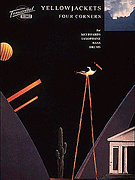
YELLOWJACKETS FOUR CORNERS Hal Leonard Transcribed Scores SPARTITI FERRANTE-JIMMY HASLIP

YELLOWJACKETS, FOUR CORNERS. TRANSCRIBED SCORE

Complete NOTE FOR NOTE Transcriptions For: 

KEYBOARDS, ACOUSTIC PIANO & SYNTHESIZERS

SAXOPHONE, SOPRANO & ALTO SAXOPHONES

BASS, FIVE STRING BASS & FRETLESS BASS

DRUMS & PERCUSSION

 
... Their MCA debut, SHADES, was recorded in '86 with a great deal of
improvisation and not a lot of sequencing or drum machine. This Lp
was definitely back in the jazz vein with the group's distinctive R&B
touches.
SHADES was on Billboard's charts for 30 consecutive weeks and garnered
the group its first Grammy Award for "Best R&B Instrumental
Performance." Also in '86, the group had a wonderful time contributing
musical compositions and performances to the motion picture "Star Trek
IV." At this point, Ricky Lawson left the band and Will Kennedy joined
at Russo's recommendation. Kennedy had played with Russo on many
Latin-jazz gigs, and had just the right amount of heavy jazz and taste of
rock background for the Yellowjackets. In 1987, they were named
"Contemporary Jazz Group of the Year" by Cashbox magazine.
Nominated for a Grammy in 1987 for "Best Jazz Fusion Performance"
and receiving a 4-star review in Downbeat, FOUR CORNERS with its
wealth of melodic and rhythmic ideas has "... a pinpointed direction,
more so than any of our former records," Haslip says. "We all grew up
hearing different music, and (now) we're trying to distill it down to a
cohensive statement - not a bit of this and that, but a group concept."
The upbeat mood of the band made the FOUR CORNERS sessions go
smoothly and easily. "We didn't labor at all," Russo noted. "In the past
we'd spend time refining things, but we didn't want to tamper with this.
It's much more spontaneous ... "
Ferrante agrees, "We're four musicians who have made the Yellowjackets
our top priority. We really wanted to figure out what felt good, what
our audiences liked, and what we liked. We all got in sync on this Lp -
nothing has jelled quite like this."
Will Kennedy feels that "...we're playing from our hearts ... this is positive
music that's fun to play."
A wealth of melodic and rhythmic ideas are found in FOUR CORNERS.
"Out O/Town" is an energetic piece featuring Russo's soaring
sax and Ferrante's inventive keyboard work, who feels this tune is
"...almost boogie or swing ... " While Haslip adds that" ... this takes us
back to our roots - we're swinging!"
"Wildlzje" has shifting polyrhythms influenced by guest percussionist
Alex Acuna. "This started out as just a mood and evolved into a full
song," says Kennedy. "Sightseeing" also highlights heated rhythms
from Kennedy and Acuna. ... 
 
1987 - GENEVA - Jimmy Haslip
1987 - INDIGO - Russell Ferrante, Jimmy Haslip, Marc Russo, William Kennedy,
1987 - MILE HIGH - Russell Ferrante, Jimmy Haslip, Marc Russo, William Kennedy, Bill Gable
1987 - OPEN ROAD - Russell Ferrante
1987 - OUT OF TOWN - Russell Ferrante, Jimmy Haslip
1987 - PAST PORTS - Russell Ferrante
1987 - POSTCARDS - Russell Ferrante, Jimmy Haslip
1987 -  ROOM WITH A VIEW - Russell Ferrante
1987 - SIGHTSEEING - Russell Ferrante, Jimmy Haslip
1987 - WILDLIFE - Russell Ferrante, Jimmy Haslip, Alex Acuna
Prezzo: €119,99
€119,99

A MODERN METHOD FOR GUITAR VOLUME 2 William Leavitt Berklee LIBRO CD EDIZIONE ITALIANO SPARTITI

A MODERN METHOD FOR GUITAR VOLUME 2. William Leavitt. senza Tablature. In italiano con CD 

LIBRO METODO DI MUSICA JAZZ CON CD.

SPARTITI PER CHITARRA CON:

ACCORDI E PENTAGRAMMA. 

LIBRO IN ITALIANO. 


Questo libro è la continuazione del I volume. La maggior parte della terminologia e delle tecniche rappresenta una diretta evoluzione del materiale presentato nel primo. Anche qui tutta la musica è originale ed è stata creata specificatamente per presentare e perfezionare ogni lezione.

È importante che il seguente materiale di studio venga affrontato nell'ordine in cui è presentato. L'indice a pagina 118 ha una pura finalità di riferimento e sarà utile per il ripasso o per lo studio mirato su tecniche specifiche.

Questo libro è la continuazione del I Volume del "MetodoModerno per chitarra". La maggior parte della terminologia e delle tecniche rappresenta una diretta evoluzione del materiale presentato in quello. Per esempio, con lo studio della scala in C maggiore in cinque Posizioni si percorre tutta la tastiera, e ciò grazie alla connessione delle quattro formule fondamentali di diteggiatura (tipi l, 2, 3, 4) e una derivata (tipo lA) cheè auspicabile siano state assimilate nel primo libro (la successione dei tipi di diteggiatura può variare da Posizione a Posizione lungo il manico, a seconda della tonalità). Si studi tutto il materiale nell'ordine presentato poiché ho cercato, per quanto possibile, di correlare tutte le novità tecniche (pratiche e teoriche) a cose già precedentemente imparate. Anche qui tutta la musica è originale edè stata creata specificamente per presentare e perfezionare ogni lezione. Voglioavvertire che le pagine riservate alla teoria non mirano a sostituire uno studio serio di questa materia sotto la guida di un insegnante competente, ma solo a stimolare lo studente più curioso e forse a gettare qualche raggio di luce nei misteriosi meandri della musica per i chitarristi in generale. Comeprima, buona fortuna e buon divertimento.

William G. Leavitt "Nei paesi di lingua anglosassone sono in uso sigle diverse dalle nostre per designare gli accordi. Potrà tornare utile conoscerne l'equivalenza:
A = La
B = Si
C = Do
D = Re
E = Mi
F = Fa
G = Sol
Per le varie specificazioni non vi sono differenze degne di nota.
Esempio: C7dim Fm6 = D07dim Fam6
B5+ = Si5+
D9 = Re9 etc."

Teoria - Relazioni Scala/Accordo PER IMPROVVISARE)
Accade raramente che una canzone rimanga armonicamente diatonica dall'inizio alla fine. Ogni accordo non conforme alle strutture diatoniche è in realtà una modulazione ad un'altra tonalità (o scala) per il tempo della sua durata. Talvolta, una serie di accordi non diatonici modifica completamente la tonalità per un certo tempo. È questa la ragione per la quale in alcuni discorsi che seguiranno sui rapporti scala/accordo, verranno fatti riferimenti alla "tonalità del momento". Poiché solitamente la melodia rimane pressoché diatonica lungo tutta una canzone, l'orecchio, quasi sempre, desidera il ritorno alla tonalità originale. Inoltre, si ricordi che "l'orecchio ha memoria ma non ha occhi", perciò il suono di ciò che si è già udito ha una certa influenza sul senso di appartenenza di taluni accordi a determinate scale in situazioni particolari (anche se ciò che sta suonando non ha alcuna relazione).

ACCORDI NON DIATONICI DI 7a MINORE E ACCORDI MAGGIORI
1) Ogni accordo di 7a minore fuori dalla tonalità (del momento) tende a suonare come un II7, quale che sia la tonalità di appartenenza della struttura di 2a diatonica (un accordo non diatonico di min.7a in effetti svolge la funzione di modulare* più efficacemente che gli accordi di dom.7a.). Impiegare la scala maggiore a partire da un tono sotto il nome dell'accordo non diatonico min.7a.

ACCORDO- C Cm7 Dm7
SCALA - Cmaj. Bbmaj Cmaj

(* La modulazione consiste nel cambiare la tonalità in una composizione o in un arrangiamento). 2) Ogni accordo maggiore fuori dalla tonalità (del momento), non preceduto da una modulazione, con una tonica non diatonica, tende a suonare come un accordo IV, quale che sia la tonalità di appartenenza della struttura di 4§.diatonica. Impiegare la scala maggiore sul 5° grado accordale dell'accordo maggiore con la tonica non diatonica.

ESEMPIO:
ACCORDO- C Eb(ma7) Dm7
SCALA - Cmaj Bbmaj Cmaj Ebmaj Abmaj Cmaj

3) Ogni accordo maggiore fuori dalla tonalità (del momento), non preceduto da una modulazione con una nota della scala per tonica, tende solitamente a suonare come un I (tonica). Impiegare la scala maggiore sul nome dell'accordo maggiore non diatonico sulla tonica della scala.

ESEMPIO:
ACCORDO- C E(ma7) G9susC G7
SCALA - Cmaj Emaj Cmaj
(Nota: La scala maggiore costruita sul 5° grado accordale può essere usata con qualsiasi accordo maggiore in qualunque momento, ma la relazione scala/accordo con quelli su toniche diatoniche risulterà meno perfetta e suonerà "più distante"). (Notare inoltre: Gli accordi di 7a minore sono talvolta accordi tonali mascherati, pertanto è bene non sottovalutare l'eventualità che un accordo non diatonico di 7a minore possa esser in effetti un IIm7 o VIm7 di un I (vedi pago71). 


(Parte I)
Quattro formule fondamentali di diteggiatura (spiegazione)
Scala ascendente in C maggiore - 5 Posizioni.
Scala discendente in C maggiore - 5 Posizioni.
"Getting Up There" (Duetto).
"Chord Etude n. 6" (Assolo)
Studio melodico-ritmico n. 2 (<re 2/4).
Triadi (Accordi di 3 note di C Maj. Min. Dim. Aug.)
Scala ascendente in F maggiore - 5 Posizioni.
Scala discendente in F maggiore - 5 Posizioni.
"Another Waltz for Two" (Duetto)
Figure accordali e Studio di velocità.
Triadi (Accordi di F Maj. Min. Dim. Aug.).
Tecnica ritmica della mano destra (414 e Tempo in 2).
"Chord Etude n. 7" (Assolo)
Scala ascendente in G maggiore - 5 Posizioni.
Scala discendente in G maggiore - 5 Posizioni.
"Sea-See-Si " (Duetto).
Figure accordali.
Triadi (Accordi di G) e esercizi di Finger Stretching.
Scala ascendente in D maggiore - 5 Posizioni.
Scala discendente in D maggiore - 5 Posizioni..
"MelodieRhythm Study n. 3" (Duetto).
Intervalli.
Triadi (Accordi in D; per traverso e lungo la tastiera)
Scala ascendente in A maggiore - 5 Posizioni.
Scala discendente in A maggiore - 5 Posizioni.
"Chord Etude n. 8" (Assolo)
Chitarra ritmica - La mano destra (Rock Style Ballad)
Figure accordali. 34
Figure accordali. 35
"Tranquility" (Duetto) 36
Triadi (Accordi di A; per traverso e lungo la tastiera).
Scala ascendente in Bb maggiore - 5 Posizioni.
Scala discendente in Bb maggiore - 5 Posizioni.
"Waltz in Bb" (Duetto)
"MelodieRhythm Study n. 4" (6/8)
Esercizi di Finger Stretching
Triadi (Accordi di Bb; per traverso e lungo la tastiera).
Scale pentatoniche ,
Studio Tremolo .
Scala ascendente in Eb maggiore - 5 Posizioni. .
Scala discendente in Eb maggiore - 5 POsizioni.. , .
Figure accordali.
Ripasso delle scale maggiori - Posizioni II, III, V .
Costruzione delle scale maggiori (spiegazione) .
Triadi (Accordi di Eb; per traverso e lungo la tastiera) .
Teoria - Triadi diatoniche nelle Tonalità maggiori (spiegazione) .
Triadi diatoniche - Tonalità di G maggiore (scale e arpeggi) .
Triadi diatoniche - Tonalità di F maggiore (scale e arpeggi) .
Triadi diatoniche - Tonalità di Bb maggiore (scale e arpeggi) .
Triadi diatoniche - Tonalità di Eb maggiore (scale e arpeggi) ,
"5th Position Study" (Duetto) .
Esercizio sulle Triadi maggiori (lungo la tastiera - tutte le corde) .
Esercizio sulle Triadi minori (lungo la tastiera - tutte le corde) .

(Parte II)

Triadi arpeggiate di una ottava (in G). "Glissando" (spiegazione) .
Scala minore "Real Melodic" o Jazz (spiegazione) .
C minore "Real Melodic" - 5 Posizioni.. .
Chitarra ritmica - La mano destra (ritmo "Shuffle") .
Studio di velocità .
Figure accordali. .
"Melodic Rhythm Study n. 5" (Duetto) .
Triadi arpeggiate di una ottava (in D e C) .
F minore "Real Melodic" - 5 Posizioni.. .
"5th Position Study n. 2" (Duetto) .
Triadi arpeggiate di una ottava (in A e F) .
Forme accordali e legature (spiegazione) '
Trillo (spiegazione) .
Teoria - Accordi di 7. diatonica nelle tonalità maggiori (spiegazione) .
Arpeggi - Settime diatoniche (in G) .
Arpeggi - Settime diatoniche (in C) .
G minore "Real Melodic" - 5 Posizioni. .
Figure accordali. .
Arpeggi di due ottave - C maggiore. Triadi sulla tonica .
"Chord Etude n. 9" (Assolo) .
"The Wanderer" (Duetto) .
Chitarra ritmica - La mano destra (Waltz) _
Arpeggi - Settime diatoniche (in F) .
Teoria - Relazioni scala-accordo. Strutture diatoniche (spiegazione) .
D minore "Real Melodic" - 5 Posizioni. .
Figure accordali - 3. al basso .
Arpeggi di due ottave - G maggiore. Triadi sulla 3 .
Arpeggi di due ottave - F maggiore. Triadi sulla 5 .
Chitarra ritmica - La mano destra (Jazz Waltz) .
Mordente e Mordente rovesciato (spiegazione) .
Arpeggi - Settime diatoniche (in Bb) .
A minore "Real Melodie" - 5 Posizioni .
Figure accordali.
Arpeggi di due ottave - Triadi in C minore sulla tonica .
Appoggiatura e Gruppetto (spiegazione) .
"Melodie Rhythm Study n. 6" (Duetto) .
Chitarra ritmica - La mano destra (Cha Cha Cha e Béguine) .
Arpeggi - Settime diatoniche (in Eb) .
Teoria - Relazioni scala-accordo (Min. 7 e Maj. Non Diatonico) .
"7th Position Study" (Duetto) .
"Solo in G" .
Bb "Real Melodie" - 5 Posizioni.. .
Figure accordali - 7 al basso .
"Chord Etude n. 11'' (Assolo) .
Arpeggi di due ottave - Triadi in G minore sulla 3 .
Arpeggi di due ottave - Triadi in F minore sulla 5 .
Alterazioni in chiave (spiegazione) .
Teoria - Moto degli accordi (breve esposizione) .
Scala Cromatica .
E minore "Real Melodie" - 5 Posizioni.. .
Figure accordali e "Chord Etude n. 12" (Assolo) .
Studio di velocità .
Arpeggi di due ottave - Triade diminuita in C sulla tonica .
G diminuito. Triade sulla 3. F diminuito. Triade sulla 5 .
"Melodie Rhythm Study n. 7" (Duetto) .
Scale a toni interi. .
Chitarra ritmica - La mano destra (Bossa Nova) .
Arpeggi di due ottave - Bb, F# e D, triadi aumentate .
Relazioni scala-accordo - (Teoria) - Non diatonico .
Accordi di 6, minore e di Dom.7 (non alterato) .
"Solo in D" .
Indice tematico . 


ARPEGGI
Triadi diatoniche
Triadi di 1 Ottava - In Posizione
7e diatoniche - Accordi a 4 parti -
In Posizione
Triadi di due Ottave (Attraverso e lungo la tastiera)

STUDI DI ACCORDI (Assoli) -
N.6, 7, 8, 9, lO, Il, 12
FIGURE ACCORDALI (Vedi anche Triadi)
Minor, Min. (ma 7), Min 6 e Minor,
Min (+5), Min 6 sequenze
Prima presentazione di figure con Fondamentali date
Generalità
3 al basso
7 al basso
Presentazione della notazione con accordo sul Basso
Dim.7 con gradi acuti (anche Dom.7b9)

ESERCIZIDI FINGER STRETCHING

FONDAMENTALI(Vedi anche Teoria)
Costruzione delle Triadi accordali e Rivolti.
Indicazioni di Tempo tagliato, Due Quarti, Tre Ottavi
Sei Ottavi.
Intervalli.
Studio tremolo
Glissando
Legato
Trillo
Mordente.
Acciaccatura, Appoggiatura, Mordente e Gruppetto
Alterazioni in Chiave 101

STUDI RITMO-MELODICI (DUETTI CON SINCOPI)
N. 3, 5, 6, 7

CHITARRARITMICA - LA MANO DESTRA
Quattro Quarti e Due Tempi.
Rock Style Ballad
Ritmo "Shuffle"
Valzer
Jazz Valzer
Cha Cha e Béguine
Bossa Nova

SCALE
Quattro formule fondamentali di diteggiatura
delle Scale Maggiori.
Studi sulle Scale Maggiori su 5 Posizioni
C, F, G, D, A, Bb, Eb
Pentatonico
Ripasso delle Scale Maggiori (Pos. II, III, V)
Scala Minore "Real Melodie" o Jazz - 5 Posizioni
C, F, G, D, A, Bb, Eb
Scala cromatica
Scala esatonale

ASSOLI E DUETTI (VEDI ANCHE STUDI DI ACCORDI E STUDI RITMO-MELODICI)
"Getting Up There"
"Another Waltz for Two"
"Sea-See-Si"
"Tranquility"
"Waltz in Bb"
"5th Position Study"
"5th Position Study n. 2"
"The Wanderer"
"7th Position Study"
"Solo in G"
"Solo in D"

STUDIDI VELOCITÀ
TEORIA
Costruzione delle Scale Maggiori.
Costruzione della scala minore "Real Melodie" (o Jazz)
Triadi diatoniche - Tonalità maggiori.
Accordi diatonici di 7.- Tonalità Maggiori.
Relazioni scale/accordi
Con strutture diatoniche
Con accordi Min.7 e Maj. non diatonici. f
Con accordi Min.6 e Dom.7 non diatonici. Il
Moto degli accordi.

TRIADI
Maj. Min. Dim. e Aug
Attraverso la tastiera
Maj. Min. Dim. e Aug
Attraverso e lungo la tastiera
Esercizi Maggiore e Minore
Su e giù per la tastiera E


I SUSSIDI AUDIO AI GRANDI METODI BERKLEE PER CHITARRA DI BILL LEAVITT
La validità dei testi per chitarra della Berklee verrà ulteriormente accresciuta con l'aggiunta di nuovi sussidi audio. Assoli, studi scelti, duetti e trii, tratti da cinque delle più note pubblicazioni della Berklee, sono stati registrati per creare queste avvincenti guide audio che rappresentano l'ideale "maestro sostituto" capace di guidare l'allievo nei suoi esercizi tra una lezione e l'altra. Per gli insegnanti di chitarra, i sussidi costituiranno un mezzo didattico di inestimabile valore, in grado di fornire per ogni allievo tutta l'attenzione necessaria al raggiungi mento graduale del dominio completo dello strumento.

Prezzo: €22,99
€22,99

WEATHER REPORT BEST OF TRANSCRIBED SCORE BOOK LIBRO SPARTITI TASTIERA SAX BASSO BATTERIA

WEATHER REPORT, BEST OF TRANSCRIBED SCORE. sheet music book for : KEYBOARD, BASS, SAX, DRUMS .

LIBRO DI MUSICA JAZZ FUSION.

SPARTITI DI OGNI STRUMENTO: Per Tastiere, Basso, batteria, Sax, e tutti gli altri strumenti. 

ACCORDI E PENTAGRAMMA. 

Series: Transcribed Score
Artist: Weather Report
A collection of 14 of their very best, 144 pages.
Table of contents:

Per Tastiere, Basso, batteria, Sax, e tutti gli altri strumenti.
La Tablature per basso c'è solo nel pezzo Procession.

Joe Zawinul
Wayne Shorter
Jaco Pastorius
Peter Erskine

Da qualche anno, in estate per una settimana, se siete a Rimini potrete ascoltare gratuitamente il chitarrista RANDY  BERNSEN che suona nei locali estivi, Bernsen è stato il chitarrista di Pastorius e ha suonato con Zawinul, che a Rimini ha fatto il suo ultimo concerto. Mentre Jaco dalla spiaggia di Rimini ha scaraventato il suo basso nel mare Adriatico e la sera poi è caduto (lo ha spinto uno del suo gruppo per la contesa di una donna) dal terrazzo del primo piano dell'hotel Holiday inn, con gravi conseguenze.  

" Naked on a motorcycle Jaco was arrested at one point during the 1982 tour for riding around Tokyo naked on a motorcycle.  In 1983, while on a tour with the septet version of the Word of Mouth band, Jaco plunged 25 feet from a balcony in Rimini, Italy, resulting in a broken left wrist and three cracked ribs. " 

Inventory #HL 00675520
ISBN: 9780793524150
UPC: 073999755206
Width: 9.0"
Length: 12.0"
144 pages


TITOLI: 

8:30
A Remark You Made
Badia/Boogie Woogie Waltz Medley
Birdland
Black Market
Brown Street
Mr. Gone
Mysterious Traveller
Night Passage
Palladium
Procession
Pursuit Of The Woman W/ Feather
Sightseeing
Young And Fine

144 pages

Prezzo: €26,99
€26,99

METHENY PAT BRIGHT SIZE LIFE GUITAR RECORDED VERSIONS TABLATURE CHITARRA LIBRO SPARTITI

METHENY PAT, BRIGHT SIZE LIFE. SHEET MUSIC BOOK WITH GUITAR TABLATURE. 

LIBRO DI MUSICA PER CHITARRA ROCK JAZZ FUSION. 

SPARTITI PER CHITARRA CON: 

ACCORDI, PENTAGRAMMA, TABLATURE. 


Note-for-note guitar transcriptions (carefully reviewed and approved by Metheny himself!) for all 8 songs from his highly acclaimed 1975 studio debut - which also features one of the earliest recordings of bass legend Jaco Pastorius. Contains jazz-style handwritten notation and tablature, a full-page photo of Metheny, and a Guitar Notation Legend. 214 Pages.

Bright Size Life
Midwestern Nights Dream
Missouri Uncompromised
Omaha Celebration
Round Trip/Broadway Blues
Sirabhorn
Uniquity Road
Unity Village

Prezzo: €27,99
€27,99

JAZZIZ CHRONICLES: THE GUITARISTS. A COLLECTION OF INTERVIEWS & FEATURES FROM THE AWARD-WINNING MAGAZINE (Book/CD)

JAZZIZ CHRONICLES GUITAR. Interviste a: George Benson, Les Paul, Herb Ellis, Larry Coryell, Sonny Sharrock, Al Di Meola, Bill Frisell, Pat Martino, John Scofield, Jim Hall, Pat Metheny, Wes Montgomery, Lee Ritenour, Kenny Burrell, Joe Pass and a host of others. Discover the history of the jazz guitar and enjoy JAZZIZ's top picks from its second talent search on the companion CD - Brian Hughes, Michael Gulezian, Rick Zunigar, Randy Bernsen, James Vincent, Dave Lowrey, George Simon, John Paul, Dave Onderdonk, Dave Occipinti, Bill Mize and Christopher Cortez. Includes great photos throughout. Non contiene pagine di musica. CD


A COLLECTION OF INTERVIEWS & FEATURES FROM THE AWARD-WINNING MAGAZINE

Foreword
What isJazz?
One day, not so long ago, I was flying from Florida to New York, listening to my Walkman. A gentleman sitting next to me on the plane asked what I was listening to. "Jazz," I replied. "I hate jazz," he said. A while later, I offered him my headphones, which he willingly donned. He listened for a moment. "Oh, but I like this," he said, loud enough to hear himself over the music.
Jazz means different things to different people. 20years ago, I came up with the concept and the name for my magazine - JAZZIZ- in response to this realization. I thought it would be worthwhile to eliminate some of the forbidding barriers that seem to surround jazz and that keep people from entering the inner sanctums of the jazz world. I recognized that the first problem most people have with jazz is figuring out exactly what it is. And that's forbidding. Most people want everything in their lives to be firmly and reliably defined, including their music. People are uncomfortable entering a world without apparent solidity, a world, that is, where nothing is clearly defined. Well,that's jazz: an ever-changing world that always manages to elude the best efforts to contain and define it. After publishing JAZZIZfor20 years, convincing people to overcome their fear of an uncertain and unpredictable music remains a difficult barrier to overcome. Still, I'm certain there's a huge potential audience for jazz out there. The bulk of that audience, I contend, harbors a less-than-satisfactory idea of what this art form is all about. The rich heritage of jazz begins with the musicians who forged a new musical language from fragments of old and disparate forms. Where the story of jazz ends is anybody's guess, as new young artists continue to emerge, invigorating and extending the music's vital legacy. For20 years, we've featured, interviewed, reviewed, profiled, and celebrated jazz artists, from the most popular to the most undeservedly obscure. Our JAZZIZ Chronicles book series - produced in conjunction with the fine folks at Cherry Lane - takes some of our best pieces, categorized by instrument, and presents them in single compilations. Essentially, these books chronicle our own contributions to the history of jazz, which basically amount to offering our insights into the talent behind the real contributors. Jazz is rich because it has so many great stories to tell. At JAZZIZ, we've always kept a sharp eye on the current scene. But we've also been mindful of the music's vivid past, as well as its promising future. The CDthat accompanies this book underscores the latter point. Over the years, we've conducted talent searches that were judged by some of the brightest names in jazz. With the CD,we present the winners to you. Think of them as a glimpse of the future history of jazz. We hope you enjoy. Michael Fagien Publisher and Editor-in-Chief JAZZIZ Magazine


RITENOUR
seven and was a precocious, young player with an ear for jazz, classical, and pop music. He studied feverishly, taking lessons from such jazz heroes as Joe Pass, Howard Roberts, Barnie KesselI, and Kenny BurrelI. But the teacher to whom he credits his first burst of inspiration was the late Duke Miller, head of the guitar department at USC. A studious sort, Ritenour pursued guitar at USC partly because the great classical guitarist Christopher Parkening was there as a teacher. He had already taken private lessons from the American virtuoso when Parkening lived in the ValIey,in Studio City - not far from the Baked Potato. "I remember going over for lessons sometimes and Pepé Romero, from the Romeros [legendary family of classical virtuosi], would show up and Àngel [Romero] would show up in his pink Cadillac. There was anice, serious amount of musicians - heavy guitar players – floating around in those days. I got very serious about the classical guitar, but I was no Christopher Parkening. My weight was still toward the electric guitar." In fact, Ritenour's interest in classical guitar was eclipsed by his growing passion for jazz and, specificalIy, the inspiration he felt in hearing – and copping licks from - Wes Montgomery. Still, it was more than just technique that a young Ritenour admired. "Ofthe guitar players, Wes was the first one who crossed over into more of a pop area in a contemporary field," he points out. "He had that sound that permeated things and is still as viable today as it was in 1960." Long before Ritenour did, Montgomery took criticism for his pop ventures. Says Rit, "Alot of the records of his that Creed Taylor produced were highly arranged and showed some terrific arranging and guitar playing. But they were recording simple pop songs, and a lot of them had almost syrupy arrangements. He definitely got a lot of flak. Unfortunately, he got so much flak for doing those commerciai records that people began to miss that he was, indeed, the greatest jazz guitarist of the 20th century. He just had that magic. My father took me to hear Wes at the Lighthouse in Redondo Beach when I was 16,and I was sitting about 10 feet away. l'Il never forget it." Ritenour also remembers being wowed by early exposure to the Mahavishnu Orchestra, who he saw at the Roxy as a big-eared teenager. By the time Ritenour kicked off his own career as a leader, settling into the Baked Potato and turning out albums, he was locked into the funk-intlected groove going around town. But his interpretation was lent clarity by his own welI-developed sound and was fortified with trace elements of the edgier stuff he heard in Mahavishnu. They called him Captain Fingers, the title of his second album. It's easy to forget, now, how marginai this more pop-oriented, L.A.branch of jazz-rock was in the 1970Smarketplace, before NACradio was a gleam in anyone's eye. Ritenour recalIs, "When I handed in my first record to Epic in 1976, I remember I gave it to the A&Rwoman and she said 'What is this? What is this called and what are we going to do with it?'" He laughs. "She just wanted to give it back. I knew I was in trouble right then. There was no radio, and there was no support from the record companies. "That's why Dave Grusin and Larry Rosen started GRPrecords. They were completely frustrated that there was no sounding board, no outlet for this kind of sound. There was no doubt that the Crusaders, with Larry Carlton and Joe Sample, were the cutting edge of this sound. Tom Scott was in there, and certainly Lee Ritenour and Dave Grusin. Dave had a big influence on a lot of people," Ritenour says, "more so than most people know because he's always been such a subtle creator. I realIy have to cite Dave as the biggest influence for my producer and arranger chops." You can hear that influence in Ritenour's streamlined productions. A second wave of marketable energy entered Ritenour's story in 1991. He teamed up with Bob ...


AL DI MEOLA
"My connection with Astor was due to the fact that we were both Italian and we'd had extremely similar experiences. Napoli, where mine and Astor's families hail trom, is the artisti c center of Italy. AlI the great painters and musicians and singers are fram there. The arts still thrive there to this day. Piazzolla said the origins of tango are in Napoli. The sound of the accordion is very much a symbol of that region. You feel in the sentimentality of his music and even the melancholy atmosphere it creates that this comes fram a person of the motherland." Di Meola's own upbringing also fed into his development. Bom and raised in Bergenfield, New Jersey, a teenaged Albert Di Meola would often cut classes to make the train in time for the first set at a popular Manhattan salsa club. Drawn to the rhythmic tension of the clave, he was soon inspired to play the drums. The guitar of Larry CoryelI was an even greater fascination, and Di Meola quickly progressed through lessons with local guitar teacher Bob Aswanian. Enrolling at Berklee, Di Meola shared a three-room apartment where he spent alI his time practicing ("I got the closet to practice in; I smelled like mothbalIs for two years"). A tape of a drug-warped gig reached Chick Corea, and a 19-year-old Di Meola was soon the guitar star of a quartet perched on the cutting edge of jazz. "I carne onto the scene so young. I had a lot of developing to do quite fast to be in that kind of company," says Di Meola. "I had to leam to stay afloat. If you want to get better as a musician, surround yourself with guys who will kick your butto That band was like the dream band of alI time for a guitarist. Nothing carne close." Di Meola telIs an unusual tale of how he gamered that fateful position with Return to Forever. "I didn't replace Bill Connors. I replaced Earl Klugh, who was the replacement for Bill Connors. I went to an early show expecting to see Bill Connors and out comes this guy wearing a little golf cap with a little beany on top, and he had on this Playboy bunny tee-shirt. What is this? It was definitely out of context. I knew that was my chance. "A friend of mine gave Chick a tape of me playing on New Year's Eve with Barry Miles at some club called Richard's Lounge in New Jersey. l've never been into drugs, but that night I did a hit of mescaline, and that put me on a different planet. That tape got me the job with Chick." Along with Piazzolla and Corea ("Theme of the Mothership" gets the Grange and Blue treatment), Di Meola cites Brazilian artists like Milton Nascimento, Caetano Veloso, and Egberto Gismonti as influences on his current work. "Less and less it's guitarists that influence me," he says, "more musicians like Astor and Milton Nascimento. I had met Milton in Brazil in 1974.I had absorbed a lot of that music long before a lot of people had ever heard of him." Di Meola wrote a 1992Musician article entitled "Why Has Music Become WalIpaper?" In other publications, he has scorned, name by name, the major label producers who tumed a deaf ear to his soonto- be-successful Kiss My Axe album. An artist with less girth could have become a footnote by now, but Di Meola has not only prospered against the odds, he's triumphed, as Grange and Blue clearly shows. And Di Meola still envisions a national radio culture where music is foremost - not false demographics or advertising dollars. Di Meola believes in the mixed bag. "With radio in the 199°5, there shouldn't be any problem with having a format where Hendrix follows Joshua Redman. Then Sting and Peter Gabriel and Joni MitchelI, even k.d. lang and Kenny G can work. I can't believe there isn't a huge listening audience for a format with real music. It doesn't have to be a nostalgie blast; it's music that works."

FRISELL
Frisell decided to try something entirely different. He gathered together three acoustic players – a trumpeter, Ron Miles; a trombonist, Curtis Fowlkes; and a violinist, Eyvind Kang - and no rhythm section at all. "I didn't want to just get another drummer, and then always be thinking, 'Oh, Iwonder what Joey would be doing.' So the quartet was kind of perfect. 'I just won't have any bass or drums.''' Since all three of the other players were essentially lead voices, Frisell was constrained to build the role of "rhythm section" into the arrangements or act as bass-and-drums himself. This may sound terribly limiting, but the best art often arises in response to odd or severe limitations; Frisell's new quartet ended up making the music he had been refining openly since 1993'sHave a Little Faith better, perhaps, than any previous configuration. The 1996 album Quartet, with its fresh vision and odd make-up, may well be the best solo record he's made. Another project that presented itself around this time was the brainchild of Frisell's record company, Nonesuch. One imagines most players walk in dread of the moment when the suits say, "Hey, listen, we've got a great idea ..." It's usually a money thing - at best, a mixed blessing; more often, painfully obvious or obviously wrong. Here's the germ of the idea: People keep saying that Frisell has this traditional American-music thing going, that he has this country sound coming through. Why not take that idea head on, surround him with a bunch of great bluegrass players and see what kind of music comes out of the cross-pollination? Frisell liked the idea immediately, and the universe (through his label and network of musician friends) conspired to make it happen. So a month after recording Quartet, a time when he could have been enjoying a well-deserved break, he was back in the studio with vocalist Robin Holcomb, doing the preliminary recordings for this other album (eventually to be called Nashville). They recorded a number of tunes, and three of them - Neil Young's "One of These Days," Hazel Dickens' odd gospel gem "Will Jesus Wash the Bloodstains From YourHands?," and Skeeter Davis' "End of the World" - made it onto the final, mostly instrumental, recording. It was another year before Frisell could get all the other musicians together, but the result is something lovely and rare. It's not so much Bill Frisell doing country or bluegrass as it is bluegrass springing up in a space cleared by Frisell the composer, then tended by Frisell the guitarist. Frisell's Nashville is no place in particular, certainly not the center of commercial country music. Rather, the recording comes across as a postcard from some wistful utopia, the perfect home you never had but long for nonetheless. The pace and ambiance ofNashville is very comfortable. It sounds not pat, by any means, but like it had a good chance to ripen before the mics and recorders were turned on. The narrative of its development, you might think, could be this: Frisell takes some time to let the idea percolate, gradually writes some tunes for the personnel he has selected or imagines, picks the best, lets the others settle out, structures some fairly detailed arrangements, then pulls everybody together for rehearsals; finally, the whole crew rolls into the studio, and they perform their most gorgeous versions of the music they are already well familiar with. That scenario could hardly be further from the truth. In fact, Nashville was yet another of Frisell's launches into the unknown, another instance in which he set himself in the arms of Music (and great musicians) and trusted in his instincts and abilities to pull disparate voices together into something coherent and compelling. "The second thing someone will say about my playing is that there's this country influence," says Frisell, "but I never really played the real thing. ...

Table of
Contents
BADI ASSAD - The Girl from Ipanema She's Not
By Mark Holston

KENNY BURRELL - Soaring with the Mystics
By Steve Matteo

CRAIG CHAQUICO - The Four Corners Converge
By Jonathan Widran

LARRY CORYELL - Call and Response -
An Interview with Larry Coryell
By Lucy Tauss

STEVE KHAN - Catching a Wave
By Mike Bieber

PAT METHENY - In Search of Pat Metheny
By Josef Woodard

MARC RIBOT - Swimming Upstream to Cuba 22
By Josef Woodard

LEE RITENOUR - Captain Fingers ...
and the Fully Baked Potato 24
By Josef Woodard

JOHN SCOFIELD - Defender of the Groove 29
By Tom Moon

JOE MORRIS - Melodic Morris Code 34
By Sam Prestianni

PAT MARTINO - Real Time 37
By Josef Woodard

BILL FRISELL - On the Road to Bill Frisell 42
By William Stephenson

WILLIE NELSON - You Were Always on My Mind 47
By Bill Milkowski

JIM HALL - Why They All Want to Play
with Jim Hall.

HARRIET TUBMAN - Josef Woodard
Harriet Tubman: A Kinder, Gentler Skronk
By Josef Woodard

RONNY JORDAN - Ronny Jordan: Not an Acid Trip 57
By Jonathan Wid ran

JOE PASS - Joe Pass - The Logical Extension
of the Bop-Oriented Masters 59
By Scott Yanow

HERB ELLIS - Don't Take Herb Ellis for Granted 62
By Scott Yanow

AL DI MEOLA - After the Tango 65
By Ken Micallef

STEV TIBBETTS - Seductive and Inscrutable .
By Josef Woodard

The Critics Pick the First
String Guitarists .
By JAZZIZ critics

Anatomy of the Guitar & Bass .
By Scott Yanow

SONNY SHARROCK - Sonny Sharrock - Gone Too Soon .
By Hank Bordowitz

JEAN-PAUL BOURELLY - A Blues Grit Crossbred with
Hip hop and Hard bop .
By Josef Woodard

WES MONTGOMERY - Ritenour's Wes Bound for New Ears .
By Mark Holston

Historic Guitars .
By Hank Bordowitz

MIKE STERN - Mike Stern's Class Reunion .
By Josef Woodard

JEFF GOLUP - Bell-Bottom Blues .
By Jonathan Wid ran

MARC ANTOINE - Running Deep, Stretching for Miles .
By Jonathan Widran

WAYNE KRANTZ - Fed Up and Hungry
By Josef Woodard

GEORGE BENSON - The Original “G" Hits the Spot Again .
By David Okamoto

LES PAUL - Ingenious - Les Paul, Unpatented .
By Hank Bordowitz

Expanding the Universe
A Jazz Guitar Spectrum - Part 1... .
By Josef Woodard

Expanding the Universe
A Jazz Guitar Spectrum - Part II .
By Josef Woodard

35 Burnin' Up:
BRIAN HUGHES
MICHAEL GULEZIAN
RICK ZUNIGAR
RANDY BERNSEN (che ogni anno viene a suonare a Rimini)
JAMES VINCENT
DAVID LOWREY
GEORGE SIMON
JOHN PAUL
DAVE ONDERDONK
BILL MIZE
CHRISTOFER CORTEZ

JAZZIZ Presents Guitars on Fire .
By R.Dante Sawyer and Eric W. Moya

CD Jewel Case Art .
Readers Poll: The Public's
Favorite Jazz Guitarists .
Compiled by Albert W. Starkweather, Jr.
Find Your Favorite Players.
 

CD
1. Brian Hughes - Casa Magica
2. Michael Gulezian - Slugbug
3. Rick Zunigar - Rhum Boogie
4. Randy Bernsen - Hope
5. James Vincent - Peaks
6. Dave Lowrey - Bass Face
7. George Simon - Watching Angels
8. John Paul - Heads Up
9. Dave Onderdonk - Eight Is Enough
10. David OcchiNIpinti - David Leaves
11. Mill Mize - Miasma
12. Christopher Cortez - Different Samples
Produced by Michael Fagien
Special thanks to Lee Ritenour, John Patitucci, and Jim Hall
Exclusive CD available only with this book, JAZZIZ
Chronicles: The Guitarists JAZZIZMagazine

Prezzo: €21,99
€21,99

JAZZ GUITAR STANDARDS BOOK CD TABLATURE CHITARRA LIBRO SPARTITI HAL LEONARD 00672356

JAZZ GUITAR STANDARDS. SHEET MUSIC BOOK FOR GUITAR WITH CD & TABLATURE.

LIBRO DI MUSICA JAZZ CON CD.

SPARTITI PER CHITARRA : 

ACCORDI, PENTAGRAMMA, TABLATURE. 


ARTIST TRANSCRIPTIONS

PLAY-ALONG BACKING TRACKS

HAL LEONARD 00672356

6 titoli :

-A Night In Tunisia, Billy Bauer

-Falling In Love With Love, Grant Green

-I've Got You Under My Skin, Jim Hall

-Stompin' At The Savoy, Charlie Christian

-Yardbird Suite, Joe Pass

-You Brought A New Kind Of Love To Me, Chuck Wayne. 

Prezzo: €39,95
€39,95

JAZZ GUITAR CHORD MELODIES Hal Leonard CD TABLATURE CHITARRA LIBRO SPARTITI

JAZZ GUITAR CHORD MELODIES. SHEET MUSIC BOOK WITH CD GUITAR TABLATURE. 

LIBRO DI MUSICA JAZZ CON CD.

SPARTITI PER CHITARRA CON :

ACCORDI, PENTAGRAMMA, TABLATURE.  

FINGERSTYLE

FINGERPICKING


12 Titoli: body and soul -black Orpheus -satin doll -all the things you are -bluesette -how insensitive (insensatez) moonlight in Vermont -my foolish heart -my one and only love -my romance -once I loved (amor em paz) -there will never be another you.

Jazz Guitar Chord Melodies
Series: Guitar Solo
Format: Softcover with CD
Composer: Dan Towey

This book/CD pack includes complete solo performances of 12 terrific standards, including: All the Things You Are • Body and Soul • My Romance • How Insensitive • My One and Only Love • and more. The arrangements are performance level and range in difficulty from intermediate to advanced.

Inventory #HL 00698988
ISBN: 9780793558278
UPC: 073999989885
Width: 9.0"
Length: 12.0"
64 pages


Every guitarist who learns to play jazz finds out, sooner or later, about solo jazz guitar, or chord-melody as it is commonly referred to. For those who venture to take up its demanding challenges, this type of playing is a beautiful and expressive art form. But as many find out, learning to create a good chord-melody can be a long, frustrating process. And to create an arrangement on the spot - nearly an insurmountable task. This book is one of the first publications to offer performance level arrangements of jazz songs for the solo guitarist. lWelve popular standards (with standard notation and TAB) are included, ranging in difficulty from intermediate to advanced in terms of both playability and understanding. However, with time, hard work, and dedication, nearly any guitarist with a few chops can work these up to playing speed and use the phrases and concepts in their own playing. The arrangements are written to represent a broad range of stylistic diversity. There is some acoustic (both steel and nylon string), plenty of electric, some aggressive tunes (check out "Satin Doll" with its country swinglTexas blues influenced licks), full lush piano-like chord songs (like "My One and Only Love"), and traditional swing tunes (a la jazz greats like Joe Pass and Herb Elllis). You will also find a variety of techniques such as harmonics, slurs, walking bass lines, octaves, and other idiomatic ideas. To help keep the music fresh and interesting (like most live solo performances) I've reworked some of the harmonies. The new harmonies are always written in parentheses below the standard harmonies (as I know them to be). I urge you to explore these songs from your own harmonic perspective as well. Providing both sets of chord changes should give you valuable insight to different rehamonization ideas. May you be blessed with sure fingers and great gigs! Peace and Happiness

Table of contents:

All The Things You Are - Music: Jerome Kern - Words: Oscar Hammerstein II - 1939
Black Orpheus - Luiz Bonfa - 1968
Bluesette - Music: Jean Thielemans - Words: Norman Gimbel - 1963
Body And Soul - Music: John Green - Words: Edward Heyman, Robert Sour, Frank Eyton - 1930 
How Insensitive (Insensatez) - Music: Antonio Carlos Jobim - Parole: Vinicius de Moraes - 1963
Moonlight In Vermont - Music: Victor Young - Words: Ned Washington - 1949
My Foolish Heart - Music: Victor Young - Words: Ned Washington - 1949
My One And Only Love - Music: Guy Wood - Words: Robert Mellin - 1952
My Romance - Music: Richard Rodgers - Words: Lorenz Hart - 1935
Once I Loved (Amor Em Paz) (Love In Peace) - Music: Antonio Carlos Jobim - Parole: Vinicius de Moraes - 1965
Satin Doll - Duke Ellington - 1953
There Will Never Be Another You - Musc: Harry Warren - Parole: Mack Gordon - 1942

Prezzo: €25,99
€25,99
Condividi contenuti