Italiano
 English
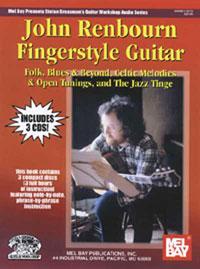
RENBOURN JOHN FINGERSTYLE GUITAR Folk Blues & Beyond Celtic Melodies & Open Tunings & The Jazz Tinge 3CD TABLATURE

RENBOURN JOHN, FINGERSTYLE GUITAR: Folk, Blues & Beyond; Celtic Melodies & Open Tunings; & The Jazz Tinge. SHEET MUSIC BOOK with 3CD & GUITAR TABLATURE .
LIBRO DI MUSICA FOLK CON 3 CD.
SPARTITI PER CHITARRA CON GUITAR TABLATURE.
Product Description:
This comprehensive Guitar Workshop Audio Series book/3-CD set brings together a variety of fingerstyle arrangements featured in three of John Renbourn's video lessons. Illustrates unique and exciting fingerstyle techniques in the performance of traditional ballads and other tunes, using standard and several alternate tunings. In notation and tablature. Includes an extensive discussion about the tunes in the collection. 120 PAGES
Format: Book/3-CD Set
... memorized because I'd learnt the tune simply to find out how the parts were worked. So then once I'd got an idea of how you approached the harmonization I found I couldn't resist playing them on the guitar and it fitted OK in D. It probably fits in may other keys as well. And the same thing with Bunyan's Hymn. I tackled that because I liked the melody and the time changes in it and I kind of reharmonized it to fit in open G deliberately.
STEFAN: How about I Saw Three Ships?
JOHN: I Saw Three Ships is also a traditional English tune and a very charming one. It's very simple but it seems to have great appeal. I really like the tune and I know a lot of other people that have a great fondness for it. It seems to me to be a really old tune, I can't say how old but it could easily fit in with the concept of medieval dance tunes that I've come across without very much change and it flows very nicely. It has a little refrain to it and hat also fits very nicely in that same tuning. So I play the two together and I throw in an number of other tradition English tunes in that medley.
STEFAN: How did you find The English Dance?
JOHN: Well I think I must have heard that also a long time ago being played by a man named Francis Bain, who was involved pretty early on in the revival of early music. He was before David Monroe. Before the kind of better, more wide spread groups that specialized in early music. I think I liked The English Dance because it features a repetitive melodic tune in a major key. I think the instrument that Francis Bain played was the fiddelle which was an old type of bowed instrument larger than a violi. The English Dance has a real punch to it when it's played on a bowed instrument because you can get top string drones against the descending patterns and I happen to like that. I found that it fitted nicely on the guitar in the open G tuning.
STEFAN: On stage you joke that it's one of the few English dances from that period of English music.
JOHN; Well, there have been quite a lot of manuscripts supposedly of English music. Lots are lodged in The British Museum but how many of them are actually English manuscripts to start, with I don't know. I think in fact, a great deal of the early dance tunes are probably northern Italian, but I think there is a chance that this one is English. Not that it matters a great deal but there we are you know - there's a certain national pride I suppose.
STEFAN: Let's talk about how you found the open G minor tuning that you use for several Celtic melodies.
JOHN: OK. There were quite a selection of tunings in the Ggroup that were handy. I used to often use a tuning with the second string up to Cwhich meant if I was playing medieval dance tunes - I used to playa tune called Trotto and another titled Salterello that both fitted quite nicely in that tuning - you could play low drones and still keep he melody going. The G minor tuning is just a variation: the second string tuned to the minor third rather than the 4th or the 2nd or whichever you like. I can't remember what I first used it for. I have an arrangement of The Moon Shines Bright which is quite a long elaborate piece. This uses the tuning and later on I used it for Nine Maidens.
STEFAN: Where did you find Owen Roe O'Neill?
JOHN: Owen Roe O'Neill is noted in the O'Neal's collection under the Carolan tunes and I wouldn't be surprised if it in Bunting's as well. In fact, I think it's in Bunting's with a harmonization by Bunting, but I took mine from the op line and harmonized it. It fits pretty nicely on the guitar in the open G minor tuning.
STEFAN: And Mist Covered Mountains Of Home?
JOHN: Mist Covered Mountains Of Home is a tune I learned from a fiddle player who I think got it from Jody Stecher. It's a highland pipe tune and it's an unusual one. Someone some time back sent me a harmony part for a second bagpipe part. I don't know of many tunes that have two bagpipes in close harmony but apparently this one as been arranged that way. I've always imagined that it's was a song but I've never actually heard complete verses s ng to it. ...
Song Title: Composer/Source:
Abide With Me/Great Dreams From Heaven - John Renbourn
Anji - John Renbourn
Buffalo - John Renbourn
Bunyan's Hymn - John Renbourn
Cherry - John Renbourn
I Saw Three Ships - John Renbourn
Judy - John Renbourn
Lament For Owen Roe O'neill - John Renbourn
Lindsay - John Renbourn
Little Niles - John Renbourn
Lord Franklin - John Renbourn
My Dear Boy - John Renbourn
My Sweet Potato - John Renbourn
Sandwood Down To Kyle - John Renbourn
The Blarney Pilgrim - John Renbourn
The English Dance - John Renbourn
The Mist-Covered Mountains Of Home - John Renbourn
The Orphan - John Renbourn
The South Wind - John Renbourn
Tramps And Hawkers - John Renbourn
Transfusion - John Renbourn
Watch The Stars - John Renbourn
White House Blues - John Renbourn