Italiano
 English
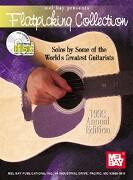
FLATPICKING COLLECTION,1998 ANNUAL EDITION. CD TABLATURE

FLATPICKING COLLECTION, 1998 ANNUAL EDITION. CD TABLATURE
Solos by Some of the world's greatest guitarists
Introduction
Flatpicking Guitar Magazine, in conjuction with Mel Bay Publications, is proud to bring you this sampler of flatpicking guitar music from twenty-two of the best bluegrass guitar players in the business. This CD project, the second in an annual series, originally grew out of requests we received from our readers regarding an audio reference for the material we present in the magazine. AlI of the tunes on this CD have been transcribed in both standard music notation and tablature within the pages of the second volume of the magazine (six issues).
After we produced the first flatpicking CD sampler in 1997, Bill Bay of Mel Bay Publications approached us about publishing a book that would include all of the transcriptions as well as some information about each of the artists on the CD. That book, published in 1998 by Mel Bay Publications, Flatpicking Collection: 1997 Annual Edition, contained all of the transcriptions as they appeared in our magazine during our first year of publication.
That first book and CD were so well received, we decided to make it an annual event. What you are holding in your hands is the second in this flatpicking series.
On the majority of the cuts on the CD the artists play more than one break to each song, however, in most cases you will only find one of those breaks transcribed here. For the most part, the biographical material presented in this book was extracted from more complete articles that were published about these artists in Flatpicking Guitar Magazine.
Please support the artists that appear on this sampler by purchasing the source CDs. If you have any trouble finding these CDs, give us a call and we will help. We owe a special thanks to all of the artists on this CD for their time, effort and talent; their record companies for allowing us to use this material; Mel Bay Publications for publishing the book, and Bill Wolf for mastering the CD.
I dedicate this book in memory of my friend, mentor, and teacher, Charles Sawtelle. After a five year struggle with leukemia, Charles passed away on March 20, 1999. He was an outstanding guitar player and an extraordinary human being.
Dan Miller Flatpicking Guitar Magazine
Book Contents:
20 Title - Artist
Lonesome Reuben - James Alan Shelton
The Girl ILeft Behind Me - Dan DeLancey
God Rest Ye Merrie, Gentleman / Joy to the World - Dan Crary
Roan Mountain Rag - Richard Bennett
Shady Grove - Charles Sawtelle (with Hot Rize)
Big Sciota - Russ Barenberg
Cross the Bridge - Sean Watkins (with Nickel Creek)
Danny Boy - Larry Sparks
Luke's Rainbow - Richard Starkey &: Mark Cosgrove
Shenandoah Valley Breakdown - Luke Bulla
I Don't Remember - Craig Vance (with The McKrells)
Whing-Ding - Adam Granger
Black Eyed Susie - Jimmy Haley
Saturday Night Ramble - Jeff Autry
Nashville Blues - Chris Jones
Take Me Back to Tulsa - Orrin Star
Sally Goodin - Jim Nunally & Dix Bruce
Belfast - John McGann
Santa Fe Railroad Line - Mike Maddux
Keep a Light on in the Window - Joe Carr &: Alan Munde
Dan DeLancey ..
The Girl ILeft Behind Me
Written by Dan Miller
Kansas City native Dan Delancey says that he likes to think of himself more as an "arranger" than a "hot lick" player. Listening to him play at the flatpicking guitar competition at Rocky Grass in 1997, it was certainly evident that arrangement is something he does very well. His arrangements were interesting, exciting, tasteful, and well performed. The fact that he did not win the contest that year was not of great concern to Dan (he did come back and win it in 1998). He likes the experience of the contest and he likes the interaction with the other pickers. A veteran of about fourteen Winfield competitions, he says, "I started going to contests because I didn't have anybody to compare my playing with at home. I would go to the contests just to see what the other guys were doing and where they were learning their stuff. I would pick up their licks and see what they thought of me. I just wanted to compare myself." He continues, "I don't believe that contests always judge a persons talent fairl. You win some and you lose some." With the release of his new CD Flatpick Guitar - A Few Favorites, Dan is ready to see what the rest of the flatpicking world thinks about his playing.
Dan says that he didn't have a "big" interest in the guitar until he was about fourteen years old and his parents bought him his first "good" guitar (a Yamaha FG-160). However, prior to that time he had bought a "cheap" guitar by himself, using money he earned mowing lawns, and had taught himself a few chords. Dan had been exposed to bluegrass music because his uncles, on his mother's side played bluegrass and his grandmother kept a stack of bluegrass records. He said he would spend six or seven hours everyday in the summer, during his junior high school years, playing rhythm to records at home. Dan says, "There was a great fiddle player in Kansas City named Lyman Enloe. He cut about three albums and I learned to play back-up to every tune on those albums. That really helped
my timing when I started flatpicking."
Dan's interest in flatpicking lead guitar breaks was sparked when, bored one summer day while sitting around the house, he was flipping through the radio dial and landed on a public radio station that played Doc Watson's "Black Mountain Rag" followed by Dan Crary playing "Huckleberry Hornpipe." Dan was hooked. He says, "When I heard that I knew that I wanted to play more than just chords on the guitar."
Dan says that back during the seventies there were not many books or tapes available for learning how to flatpick the guitar. He states, "I had a local guy show me how to flatpick one tune. Once I had that foundation, I went from there and figured out how to do it. I listened to Norman Blake, Doc Watson, Dan Crary and had all of the albums. Sometimes I would spend a whole year trying to learn a tune off of the record." Dan also says that he ordered one of Russ Barenberg's early Homespun lessons and learned some things from those tapes that also helped him.
From the time he was a teenager in the 1970s up until about five years ago, Dan says that everything he had learned on the guitar had been pretty much self-taught. It was at a workshop in Elkins, West Virginia, that he first met Steve Kaufman. Dan spent a week there and says "Steve took me under his wing and really payed a lot of attention to me that week. I came home with a good direction, a lot of good ideas, and a better guitar player." Since then, Dan has taken a number of private lessons with Steve and has attended the first two of Kaufman's flatpicking camps. In 1997 Dan placed second in the camp's first flatpicking guitar contest.
When asked about the most valuable lessons he learned from Kaufman, Dan replied, "The single thing he helped me with the most was arrangement. He taught me to first get the basic melody down and then work out variations that flow into each other. He taught me how to create passages and runs which connect variations together smoothly." Dan says that it might take him a full year to put three or four variations to a tune together.
After playing on the Yamaha guitar for a number of years, Dan saved his money and bought a new Martin D-18, after that he bought a 1979 Martin HD28, and then he played a Mossman guitar for a number of years. Last year he bought a 1957 Martin D-21 which was restored by Marty Lanham of the Nashville Guitar Company. When he bought the guitar, the entire top from the bridge forward (on both sides of the soundhole) was covered with an enormous pick guard. Dan has pictures of the guitar when he bought it and this pickguard would make Lester Flatt's and Larry Sparks' pickguards combined look tiny in comparison. Dan says, "Marty Lanham took the guitar apart, put it back together, and made it like new. He put it in good shape."
Dan says that over the years he has spent quite a bit of time working on his tone and technique. When asked to elaborate on his experiences he says, "I discovered early on that the way you hold the pick, the way the pick strikes the string, the way the pick rolls over the string, it all effects the tone of the guitar immensley. If you strike the string with the flat of the pick it is a crisper sound, I like the mellower sound, so I tilt the pick forward."
Another interesting discovery Dan made was that the use of jumbo frets on his guitar helped with his speed and economy of motion in his left hand. He says, "The large fret keeps the flesh on the end of your finger from touching the fingerboard. Your finger never touches the wood." By allowing the player to
Dan Crary ..
God Rest Ye Merrie, Gentleman / Joy To The World
Dan Crary is an imposing figure-both literally and figuratively. At over six feet tall, his eyes peering out behind tinted glasses, his thinned gray hair pulled back into a tight, small pony tail and his gray beard neatly trimmed, Crary speaks with a resonant baritone voice that commands attention. It's fitting then, that, until his retirement last year, Crary had spent much of his time teaching Communication Sciences at Cal State Fullerton.
As a guitarist, Crary, indeed casts a giant shadow. In 1970 Crary released the first bluegrass album built around the guitar aptly called Bluegrass Guitar. In the liner notes to the CD reissue of Bluegrass Guitar, Tony Rice states: " ...the idea of lead guitar standing alongside mandolin, banjo and fiddle is relatively new and Dan (Crary) along with Doc Watson, Clarence White, Norman Blake, Larry Sparks, and others, made it happen ...Crary's direct approach makes for a wonderful sound and fully developed aesthetic all it's own."
Crary's influence as a guitarist reverberates with any guitar tune picked at ajam session. As Rice so simply stated, Crary is among the founders of the form. Crary is one of the architects of flatpicking guitar. Listen to Bluegrass Guitar and one is struck with the selections-virtually all standards today. Many of them, "Gold Rush," for example, presented as guitar pieces for the first time.
One measure of Crary's influence might be the legion of fans he commands. In a recent concert, Pat Flynn, (formerly of the New Grass Revival and an award winning studio guitarist), dedicated a hot fiddle tune to Dan Crary and Doc Watson describing them as "two of the guys on the Mount Rushmore of bluegrass guitar." Steve Kaufman, himself an astounding guitarist who has also helped put the language of fiddle tunes in the hands of guitarists worldwide, credits Crary with "talent, genius and a genuinely kind soul" in his eloquent notes to the re-release of Crary's Lady's Fancy.
Talking to Crary, you get the feeling that his college lectures are as dynamic and fluid as his guitar playing. A passionate guitar advocate, Crary readily shares his opinions which are always carefully worded and constructed, and well thought out (much like his guitar playing). Crary has combined his academic background with his passion for guitar in his educational work, both at college and his workshops. He has contributed to various music publications and has researched the role of music as communication in society. He is fond to recall a Bill Monroe story about watching a circa '68 hippie and redneck jam on a fiddle tune. Good music bridges barriers. One hopes Crary will devote some time to a book, sharing his accumulated knowledge about the guitar and music in general. He has stories to tell.
In workshops-and as a Taylor endorsee, he's done many-Crary recounts his growing up in the musical void of Fifties era Kansas City. He animatedly covers the rise of the guitar, crediting Elvis Presley to the dominant position the instrument holds worldwide today.
Crary possesses a midwestern work ethic and the need for social responsibility. He will talk guitar with anybody and love it. Crary prefers not to teach a specific version of one of his solos. Instead, he tells students, with a nod to Segovia, that they are all self taught. He then goes on to cover ways we can better teach ourselves. His main refrain is how to best structure a practice.
With concepts and the emotional delivery of a sales training or motivational seminar, Crary advises to define attainable goals for each practice session and write them down. Then go ahead and tackle the challenge-it can be the rhythm, the way you finger a particular note- virtually any of the actions that create your music. Just running through repertoire does not constitute practicing Crary emphasizes.
Once you've reached a particular goal, Crary recommends you share your success with someone for positive reinforcement then define your next goal. He readily admits that this method was the way he finally over came some problems working out his famed version of "Lime Rock." The reasoning is simple, it's easier to conquer small hills than giant ones, and success feels good. Sounds trite, but it's true.
Dan Crary is a unique man, not just for his dual career path, but for the sheer power of his conviction and faith in the guitar and music and for the humility with which he views his role in the history of guitar, "That's for other's to decide," he says flatly.
This cut, "God Rest Ye Merrie, Gentleman/Joy To The World," is from Dan's Sugar Hill Release Holiday Guitar (SHCD-3871).
CD Contents
1. Lonesome Reuben - James Alan Shelton
Traditional
Source CD: Road To Coeburn· James Alan Shelton
1997. Copper Creek Records (CCCD-0154). P.O Box 3161, Roanoke, VA 24015
James Alan Shelton - guitar. Ralph Stanley II - rhythm guitar, John Rigsby - mandolin,
Ben Isaacs - bass. Steve Sparkman - banjo. James Price - fiddle
2. The Girl I Left Behind Me - Dan DeLancey
Traditional
Source CD: Flatpick Guitar: A Few Favorites· Dan Delancey
1997, OED 1097
Dan Delancey, 7911 Hunter, Raytown, MO 64138 (816) 356-1879
Dan Delancey - guitar, Scott TIchenor· mandolin, Ronnie Delancey - bass
3_ God Rest Ye Merrie, Gentleman/ Joy to the World - Dan Crary
English 18CITraditionai
Source CD: Holiday Guitar-Dan Crary
1997. Sugar Hill (SHCD-3871). Sugar Hill Records. P.O. Box 55300, Durham, NC 27717
Dan Crary. guita.r
4. Roan Mountain Rag - Richard Bennett
Richard E. Bennen, Indian Gap Music· BMI
Source CD: Walking Down The Line - Richard Bennett
1997, Rebel Records (REB-CD-1738) Rebel Records, P.O. Box 3057, Roanoke, VA 24015
Richard Bennett - guitar
5. Shady Grove - Hot Rize (Charles Sawtelle - guitar)
Traditional, arr. Wernick
Source CD: Hot Rize in Concert· Hot Rize
1984, Fiying Fish Records (FF 70107)
Flying Fish Records, 1301 W. Schubert, Chicago, Il 60614
Charles Sawtelle - guitar, TIm O'Brien - mandolin and vocal, Nick Forster - bass and vocal,
Pete Wernick - banjo
6. Big Sciota - Russ Barenberg
Traditional
Source CD: Skip, Hop, & Wobble· Douglas, Barenberg, & Meyer
1993. Sugar Hill (SHCD-3817), Sugar Hill Records, P.O. Box 55300. Durham, NC 27717
Russ Barenberg - gullar. Jerry Douglas - dobra, Sam Bush - mandolin,
Edgar Meyer- bass
7. Cross the Bridge - Nickel Creek
(Sean Watkins - guitar)
Traditional
Source CD: Here to There - Nickel Creek
1997, Nickel Creek, 1205 Doran Rd. Murray, KY 42071
Sean Watkins - guitar, Sara Watkins - fiddle, Chris Thile - mandolin, Scott Thile - bass
8. Danny Boy - Larry Sparks
Traditional - Arr. Larry Sparks
Source CD: Blue Mountain Memories - larry Sparks
1996, Rebel Records (REB-CD-1726) Rebel Records, P.O. Box 3057. Roanoke. VA 24015
larry Sparks - guitar, mandolin
9. Luke's Rainbow - Richard Starkey and Mark Cosgrove
Richard Starkey
Source CD: Richard Starkey and Mark Cosgrove
1998. Richard Starkey. 174 Newport Ave, Nazareth. PA 18064
RIchard Starkey - lead and rhythm guitar. Mark Cosgrove - lead and rhythm guitar
10. Shenandoah Valley Breakdown - The Bullas (Luke Bulla - guitar)
Bill Monroe/Champion Music, BMI
Source CD: Set Apart - The Bullas
1997, Dominion Records, PO Box 179. Northport, WA 99157
luke Bulla - guitar & fiddle. Brad Bulla - banjo. Jenny Anne Bulla - mandolin,
Carol Bulla - bass
11. I Don't Remember - The McKrells (Craig Vance - guitar)
Kevin McKrell, ASCAP
Source CD: Better Days - The McKrelis
1997. Woods End Music Group, Greenfield Center. NY 12833 (518) 584-4431
Craig Vance - guitar & vocai, Kevin McKrell - lead vocal & rhythm guitar, Rick Bedrosian -
bass, Chris Leske - banjo, mandolin, Joyce Anderson - fiddle & vocal
12. Whing-Ding - Adam Granger
Adam Granger (BMI)
Source CD: Of Mice and Men - Adam Granger
1998, Jeep Records (JEEP-T42), Box 26115, Shoreview, MN 55126 (800) 575-4402
Adam Granger - guitar
13. Black Eyed Susie - Baucom, Bibey, Graham & Haley (Jimmy Haley - guitar)
Source CD: Baucum, Bibey, Graham & Haley
1998. Rebel Records (REB-CD-1743) Rebel Records, P.O. Box 3057.
Roanoke, VA 24015 Jimmy Haley - guitar, Terry Baucom - banjo,
Alan Bibey - mandolin, Randy Graham - vocai & bass
14. Saturday Night Ramble - Jeff Autry - gutiar
Joe Maphis (Silver Hill MuSIC - BMI)
Source CD: Bluegrass '98
1998, Pinecastle Records (PRC 1079), PO Box 456, Orlando, Fl 32802
Jeff Autry - guitar, Scott Vestal - banjo, Aubrey Haynie - fiddle, Mark Schatz - bass
Wayne Benson - mandolin, Randy Kohrs - resophonic guitar
15. Nashville Blues - Chris Jones
Alton and Rabon Delmore (Unichappell MusicNidor Pub - BMI)
Source CD: Follow Your Heart· Chris Jones
1998, Rebel Records (REB-CD-1749) Roanoke, VA 24015
Chris Jones - guitar, Mike Compton - mandolin, Ron Block - banjo, Paul Brewster - tenor
vocals, Ron Stewart - fiddle, Darrin Vincent - bass
16. Take Me Back To Tulsa - Orrin Star & the Sultans of String
Bob Wills and Tommy Duncan - Anne-Rachel Music, BMI
Source CD: Sultans Live! - Orrins Star & the Sultans of String
1998, Good Ear Music, (800)
Orrin Star - guitar and lead vocal, Bob Green - fiddle and harmony vocals,
Greg Vongas - bass and harmony vocals
17. Sally Goodin - Jim Nunally & Dix Bruce
Traditional
Source CD: Untitled 2nd CD from Dix Bruce & Jim Nunally
1998, Musix, PO Box 231005, Pleasant Hill, CA 94523
Jim Nunally - lead guitar, Dix Bruce - rhythm guitar
18. Belfast - John McGann
John McGann and Chris Moore, luminous Bloom Music, ASCAP
Source CD: Rust Farm
1998, Daring Records (CD 3032), PO Box 793. Marblehead. MA 01945
John McGann - guitar, Chris Moore - mandolin, Jim Whitney' bass
19. Santa Fe Railroad Line - Mike & Bertye Maddux
B. MadduxlLittie Birdie Music, BMI
Source CD: Banjo - Mike & Bertye Maddux
1997, T-GAP Records, PO Box 3097, Colorado Springs. CO 80934
Mike Maddux - guitar and vocal, Bertye Maddux - mandolin and vocal
Phile Easterbrook - banjo, Rick Desko - bass
20. Keep a Light on in the Window - Joe Carr & Alan Munde
Ed Marsh/Mountainside Music, Inc . 8MI
Source CD: Welcome To West Texas - Alan Munde & Joe Carr
1998, Rounder Records (CD FF 669), One Camp St. Cambridge, MA 02140
Joe Carr - guitar. mandolin, lead vocal, Alan Munde - banjo, Ed Marsh - bass and fiddle