PRIVATE LESSONS

Acoustic Guitar Private Lessons BLUEGRASS GUITAR ESSENTIALS, LEARN TO PLAY BASS RUNS, FIDDLE TUNES, BLUESY SOLOS, AND MORE. CD TABLATURE

Acoustic Guitar Private Lessons BLUEGRASS GUITAR ESSENTIALS, LEARN TO PLAY BASS RUNS, FIDDLE TUNES, BLUESY SOLOS, AND MORE. CD TABLATURE

Series: String Letter Publishing
Publisher: String Letter Publishing
Softcover with CD - TAB
Author: Scott Nygaard

Learn the fundamentals of bluegrass by exploring its various styles and the masters who defined the genre: Doc Watson, Clarence White, and Norman Blake. The book includes background information, instruction and 12 classic songs, including: Greenback Dollar - Kingdom Come - Lonesome Old River - Midnight on the Stormy Deep - Up the Creek - Whiskey Before Breakfast, and more. The CD includes demos of the exercises and songs. 72 pages.

Billy In The Lowground
Black Mountain Rag
Cuckoo's Next
Down In The Valley To Pray
Greenback Dollar
Kingdom Come
Lonesome Old River
Midnight On The Stormy Deep
Paddy On The Turnpike
Sugar Baby Blues
Up The Creek
Whiskey Before Breakfast


Contents


Introduction

Tune-up

Music Notation Key 5


FUNDAMENTALS

Bass Runs

  Greenback Dollar

Fiddle Tunes

  Paddy on the Turnpike

  Cuckoo's Nest

Bluesy Bluegrass

  Sugar Baby Blues

Bluegrass Kickoffs


EXPLORING BLUEGRASS STYLES

Crosspicking

  Midnight on the Stormy Deep

Going Beyond I-IV-V

  Up the Creek

New Directions in Flatpicking

Solo Flatpicking

  Kingdom Come


BLUEGRASS GUITAR MASTERS


Doc Watson

  Black Mountain Rag

Clarence White

  Billy in the Lowground

Norman Blake

  Whiskey Before Breackfast


MORE SONGS TO PLAY

Down in the Valley to Pray

Lonesome Old River


About the Author

Acknowledgments 

Prezzo: €19,95
€19,95

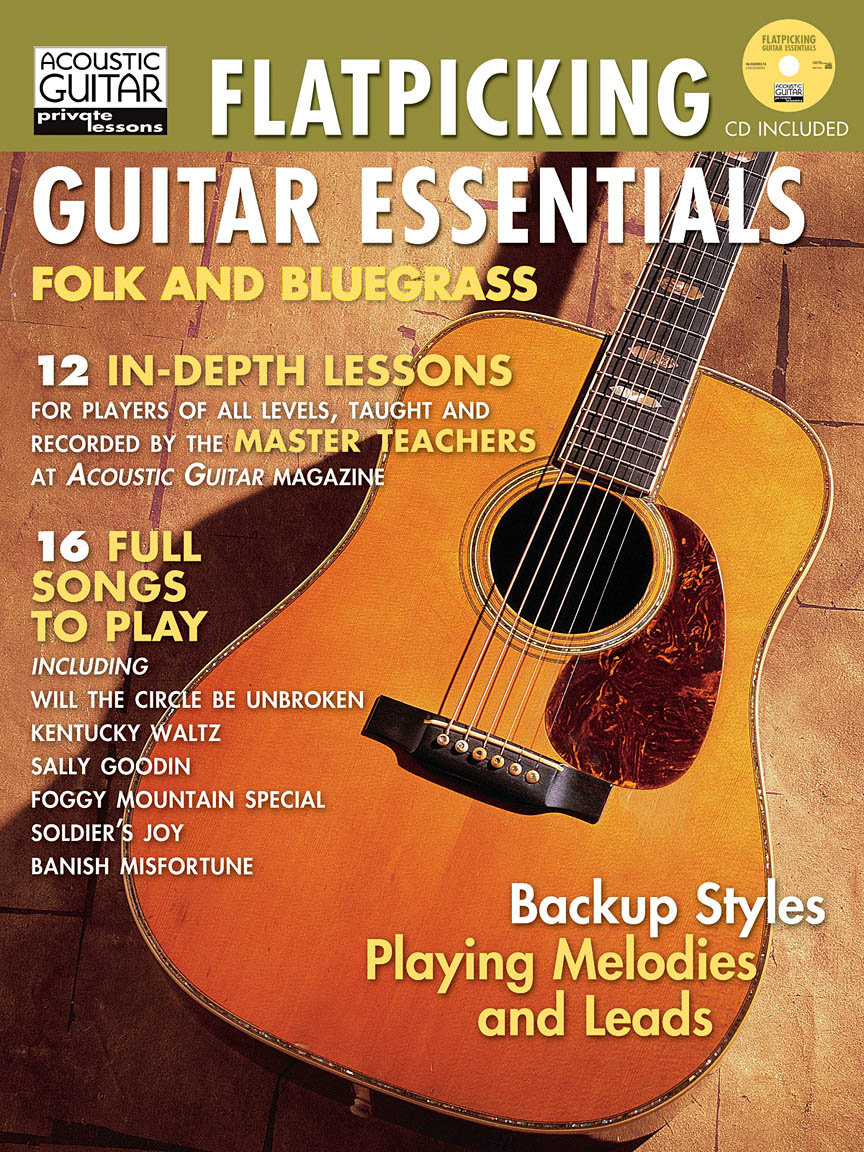
Acoustic guitar MAGAZINE, FLATPICKING GUITAR ESSENTIALS. CD TABLATURE

Acoustic guitar magazine, FLATPICKING GUITAR ESSENTIALS. 12 lessons, 16 songs. CD TABLATURE

Series: Guitar Collection
Publisher: String Letter Publishing
Medium: Softcover with CD
Author: Various Authors

Learn bluegrass and folk with this book/CD pack featuring lessons by Acoustic Guitar assistant editor Scott Nygaard, award-winning guitarist Dix Bruce, legendary guitarist Happy Traum, and many others. Includes 16 complete songs to play, 96 pages.

Banish Misfortune
Bury Me Beneath The Willow
Carroll Country Blues
Foggy Mountain Special
Humphrey's Hornpipe
Jesse James
Kentucky Waltz
Mama Don't 'Low
Morrison's Jig
Pretty Peggy
Roll In My Sweet Baby's Arms
Sally Goodin
Sandy River Belle
Soldier's Joy
Star Of Munster (Irish)
Will The Circle Be Unbroken

While guitarists in such diverse genres of music as jazz, rock 'n' roll, blues, new age, pop, world, and folk have been known to wield a flatpick, the word flatpicking is most often used to describe a style of guitar playing that evolved from early country music and bluegrass. Musicians such as Riley Puckett, Mother Maybelle Carter, Doc Watson, George Shuffler, Jimmy Martin, Tony Rice, Clarence White, and hundreds more have contributed to a style that allows its practitioners to produce a driving or subtle rhythm and clear, fluid, virtuosic solos. Flatpicking is the ideal style for acoustic guitarists in bands that include instruments with more natural volume than the acoustic guitar. It's also a great technique for solo singers who want a powerful rhythmic accompaniment. In this book, we bring you 12 lessons that explore the roots and branches of flatpicking, taught by Acoustic Guitar magazine's master teachers. Each lesson introduces an essential technique and illustrates it with musical examples from folk, bluegrass, old-time, and Celtic music that you can use immediately. The book is divided into two sections, "Backup Styles" and "Playing Melodies and Leads," each of which begins with basic techniques before delving into flatpicking's more refined subtleties. If you're unfamiliar with any terms or techniques used, check the music notation key. Whether you're new to the flatpick or guitar and want to get started on the right track, or an old hand who's either in search of new ideas or a review of fundamentals, you're sure to find inspiration and fuel for perspiration here.
Scott Nygaard, Assistant Editor, Acoustic Guitar

Exercises, licks, and full songs to play

Standard notation, Tablature, and chord diagrams

CD with music played by the teachers slowly and up to tempo


contents

CD Track List

Introduction

Music Notation Key

About the Teachers


BACKUP STYLES

Strum and Bass Note Patterns LARRY SANDBERG

Jesse James

Will the Circle Be Unbroken


Bluegrass Rhythm Guitar SCOTT NYGAARD

The standard bluegrass strum
Chord Variations
Joining the band
Bluegrass Bass Runs
Playing a Range of Tunes
Rhythm is a group effort
 

The Lester Flatt G Run HAPPY TRAUM

Roll in My Sweet Baby's Arms

Mama Don't 'Low

G-RUN BOOGIE

Rhythm Essentials JOHN McGANN
using a metronome
driving rhythm guitar
cross-picking
Celtic accompaniment


Fiddle Contest Accompaniment JIM WOOD

Sally Goodin, Completo di accompagnamento 

Kentucky Waltz - 1942- Bill Monroe

Simple Irish Backup PAUL KOTAPISH

Strumming Reels, Alternate chords, accompanying Jigs

The Star of Munster

Morrison's Jig


PLAYING MELODIES AND LEADS

Flatpicking Fiddle Tunes SCOTT NYGAARD

Fiddle tune basics, Pull-offs and Slide, 

soldier's Joy

Sandy River Belle


Bluesy Bluegrass STEVE POTTIER

Adding the Blues Notes, The Flatted Seventh chord, usings slurs, seventh chord, using Blues Shuffle

Cross·Picking SCOTT NYGAARD

Bury Me beneath the Willow


Variations on a Theme SCOTT NYGAARD

Carroll County Blues


Transcribing Solos DIX BRUCE

Foggy Mountain Special

Banjo and bass solos, 

Celtic Flatpicking DYLAN SCHORER

The Reel, The Jig, The Air, The Strathspey, Ornaments

Pretty Peggy

Banish Misfortune

Humphrey's Hornpipe

Prezzo: €20,99
€20,99

ACOUSTIC GUITAR FINGERSTYLE METHOD David Hamburger 2 CD LIBRO TABLATURE CHITARRA SPARTITI

THE ACOUSTIC GUITAR FINGERSTYLE METHOD. LIBRO CON 2 CD E TABLATURE

LIBRO METODO DI MUSICA,  CON 2 CD.

SPARTITI PER CHITARRA FINGERPICKING :

ACCORDI, PENTAGRAMMA E TABLATURE.

The Acoustic Guitar Fingerstyle Method introduces you to the two most essential fingerstyle approaches for playing American roots music: Travis picking and the steady-bass style. In each lesson, you’ll learn new techniques, concepts, and chord voicings and ways to practice and get them under your fingers. Then you’ll use what you’ve just learned to play a classic song or solo break from the blues, ragtime, folk, country, and ragtime traditions. 18 In-Depth Lessons: Travis Picking Basics - From Backup to Melody - Switching Chords - Eighth Notes and Syncopation - The Steady-Bass Blues - Steady Bass from Chord to Chord - Triplet Feel - Picking Pattern Fills - Descending Bass Lines and Chord Substitutions - Quicker Chord Changes - Double Stops - Seventh Chords up the Neck - Walking Bass Lines - Doin’ that Rag - Chord Anticipations and Early Jazz - Dropped-D Tuning - Swinging the Blues - Open-D Tuning 15 Songs to Play: - John Henry - Since I’ve Laid My Burden Down - Delia - St. James Infirmary - Nobody’s Fault but Mine - Houston Blues - Down in Navasota - Alberta - Hazleton - The Uptown Lowdown - Rag Mama - I Ain’t Got Nobody - St. Louis Blues - The Blunn Creek Slow Drag - Battle Hymn of the Republic

Spice up your fingerstyle blues with this melodic technique. With audio examples.
Full song lyrics
Essential listening suggestions for classic recordings of every songs
Arrangements
complete guitar parts

Whether you are studying with a techer or on your own, let the acoustic guitar method be your guide to joys and pleasures of playing guitar. This comprehensive approach with graded lessons and supplementary songs, is the one tool you need to get started. On the companion CDs you'll hear clear performances of all the music in the book. 

Welcome to the Acoustic Guitar Fingersty/e Method. This book focuses on the two most essential fingerstyle approaches for playing American roots music, Travis picking and the steady-bass style. In each lesson, you'll be introduced to new techniques, concepts, and chord voicings and shown ways to practice them and get them under your fingers. Then you'll use what you've just learned to play a new song or solo break. If you mostly play and sing, these lessons will give you the tools to spice up your guitar accompaniment as well as add instrumental breaks, intros, and outros. Ifyou'd sooner dance down the street in your underwear than sing, this book will give you lots of ways to make cool and complete-sounding music all by yourself without ever opening your mouth. Either way, by the end of this book, you'll have a whole new repertoire of tunes to play and a big handful of new chops to play them with. The Acoustic Guitar Fingersty/e Method picks up where the Acoustic Guitar Method left off, and assumes that you're familiar with picking patterns and with at least a dozen essential open-position chords. However, in case you're starting from scratch with this fingerpicking thing, or could just use a little brushing up, in the first lesson we'll review simple picking patterns and how to apply them to chords. (Speaking of which: for a detailed discussion of the theory, construction, and naming of chords, you might check out the Acoustic Guitar Chord Book, written by the very same quirkily handsome and surprisingly coherent gentleman who has the privilege of your attention at the present moment.) So if you think you've already got all these preliminaries in the bag, proceed directly to Lesson 2. Youmay pass Go, but alas, there is no $200 waiting for you. On the flip side, you won't have to sit on your hands for most of the book waiting for Mississippi John Hurt to hit your hotels on Boardwalk or Park Place ... 


Chapter 1 - Introduction.
CD Track: Tune Up

Chapter 2 - Travis Picking Basics.

Chapter 3 - From Backup to Melody.
CD Track: John Henry

Chapter 4 - Switching Chords.
CD Track: Since I've Laid My Burden Down

Chapter 5 - Eighth Notes and Syncopation.
CD Track: Delia

Chapter 6 - The Steady-Bass Blues.
CD Track: Nobody's Fault but Mine

Chapter 7 - Steady Bass From Chord to Chord.
CD Track: Houston Blues

Chapter 8 - Triplet Feel.
CD Track: Down in Navasota

Chapter 9 - Picking Pattern Fills.
CD Track: Since I've Laid My Burden Down

Chapter 10 - Descending Bass Lines and Chord Substitutions.
CD Track: Delia

Chapter 11 - Quicker Chord Changes.
CD Track: St. James Infirmary

Chapter 12 - Double Stops.
CD Track: Alberta

Chapter 13 - Seventh Chords Up the Neck.
CD Track: Hazleton

Chapter 14 - Walking Bass Lines.
CD Track: The Uptown Lowdown

Chapter 15 - Doin' That Rag.
CD Track: Rag Mama (Versions 1 and 2)

Chapter 16 - Chord Anticipations and Early Jazz.
CD Track: I Ain't Got Nobody

Chapter 17 - Dropped-D Tuning.
CD Track: St. Louis Blues

Chapter 18 - Swinging the Blues.
CD Track: The Blunn Creek Slow Drag

Chapter 19 - Open-D Tuning.
CD Track: Battle Hymn of the Republic

By David Hamburger.
Published by String Letter Publishing
Book/2 CDs

Prezzo: €31,99
€31,99

ETHNIC RHYTHMS FOR GUITAR Musicians Institute Jean Marc Belkadi LIBRO CD TABLATURE CHITARRA SPARTITI

ETHNIC RHYTHMS FOR GUITAR, MUS. INST., Belkadi. CD TABLATURE

5 Continents · 27 Countries · 2 Hands
Series: Musicians Institute Press
Publisher: Musicians Institute Press
Softcover with CD - TAB
Author: Jean Marc Belkadi

Acclaimed guitarist Jean Marc Belkadi takes you on a musical expedition around the world from Europe to Africa, South America, Asia, and the Middle East. You'll discover a huge variety of unusual and inspiring ethnic rhythms, riffs, and licks in this creative book and CD pack. The accompanying CD contains 81 demo tracks of all the music in the book. 40 pages.


ETHNIC

Acclaimed guitarist Jean Marc Belkadi takes you on a musical expedition around the world. You'll discover a huge variety of unusual and inspiring ethnic rhythms, riffs, and licks in this creative book and CD pack. The accompanying CD contains 81 demonstration tracks of all the music in the book.
Standard Notation and Tablature.
Middle East
Asia
South America
Europe
Africa
Exotic Rhythms,
Riffs, and Licks
Book WITH CD


Introduction
The traditional music of every country has its own unique sociological and cultural characteristics. The rhythmic form, harmonic movement, melodic sense, and personal sounds are elements that identify each musical composition. On a larger perspective, we may notice that each continent has its own musical identity, but there are still cultural differences from one country to another.
The music of Eastern Europe (Russia, Romania, Bulgaria, etc.), for example, is quite unique and differs significantly from the countries of Western Europe (Spain, France, Germany, etc.), but the overall European identity is drastically different from the sound of Africa, South America, and Asia. This book covers ethnic rhythms from many countries to provide you with new inspiration and ideas.
Play these samples, change them, create some of your own, and use them in your own music. Then the objective of this book will be achieved.

Jean-Marc Thanks to:
All at Hal Leonard Corporation
Ernesto Homeyer (for transcribing these examples)
Jordan Kent Ramey (for recording, engineering, and editing)
Danny Osuma (for mastering the audio recording)
Beth Marlis, from Musicians Institute
Steve Blucher, from Dimarzio
Joseph lacobellis, from Everly Strings
Jude Gold, from Guitar Player
Dory Lobel
Jimmy Rosen
Khoa Truong


Europe
Bulgaria
Romania
Spain
France
Celtic
Africa
Morocco
Algeria
Tunisia
Sierra Leone
Mali
Guinea
Congo
Zimbabwe
South America
Brazil
Argentina
Colombia
Jamaica
Cuba
Asia
Russia
Vietnam
India
Pakistan
Middle East
Saudi Arabia
Iraq
Turkey
Syria
Egypt

Prezzo: €18,99
€18,99

EXOTIC SCALES & LICKS FOR GUITAR Musicians Institute Jean Marc Belkadi LIBRO CD TABLATURE CHITARRA

EXOTIC SCALES & LICKS FOR GUITAR, MUSICIANS INSTITUTE, Belkadi. CD TABLATURE

LIBRO DI SPARTITI PER CHITARRA CON CD E TABLATURE. 

16 Tantalizing Scales & 80 Great Ways to Use Them
Series: Musicians Institute Press
Publisher: Musicians Institute Press
Softcover with CD - TAB
Author: Jean Marc Belkadi

Expand your lead lines and scalar vocabulary with a whole book packed full of unusual scales and interesting ways to play them. The accompanying CD contains 80 demonstration tracks of all the licks in the book. Scales include: Prometheus, enigmatic, Hebrew, Hungarian Gypsy, Hindu, Neapolitan Major, Neapolitan Minor, East Indian, Romanian, double harmonic minor, Persian, double augmented, 8-Tone Spanish, Byzantine, overtone, harmonic major, and more. 40 pages


EXOTIC SCALES & LICKS

16 TANTALIZING SCALES
80 GREAT WAYS TO USE THEM

Introduction
The exotic scales in this book can be thought of as scales that are not related to the standard major or minor scales. Most of them have seven notes, but a few have more or less. They provide an excellent source for technical improvisation/composition and work in many styles, such as rock, jazz, funk, pop, and R&B.
This book contains a total of 80 examples (five for each exotic scale), and its purpose is to show you how to use these scales in any chord combination from the harmonized scale. Each exotic scale is harmonized with its respective chord on each scale degree, giving you a better understanding of the scale's sound and its possible harmonies.
The examples are recorded over grooves featuring a full rhythm section, so you'll have a good overview of how to use the scales in your own music. Each example is repeated at tempo a few times, after which it's played very slowly so you can hear each and every note. The licks don't progress in any particular order, so feel free to skip around to the ones you like. Enjoy. Jean-Marc

Thanks to:
All at Hal Leonard Corporation
Ernesto Homeyer (for transcribing these examples)
Danny Osuma (for mastering the audio recording)
Beth Marlis, from Musicians Institute
Steve Blucher, from Dimarzio
Joseph lacobellis, from Everly Strings
Jude Gold, from Guitar Player


Table of Contents:

Prometheus Scale
Enigmatic Scale
Hebrew Scale (Ahavoh Rabboh)
Hungarian Gypsy Minor Scale
Hindu Scale
Neapolitan Major Scale
Neapolitan Minor Scale
East Indian Scale (Raga Todi)
Romanian Scale
Double Harmonic Minor Scale
Persian Scale
Double Augmented Scale
Eight-Tone Spanish Scale
Byzantine Scale
Overtone Scale
Harmonic Major Scale


SCALES:
Prometheus
Enigmatic
Hebrew
Hungarian Gypsy Minor
Hindu
Neapolitan Major
Neapolitan Minor
East Indian
Romanian
Double Harmonic Minor
Persian
Double Augmented
Eight-Tone Spanish
Byzantine
Overtone
Harmonic Major
Many Licksin Different Styles
Scale Spellings & Harmonizations
Standard Notation and Tablature

Expand your lead lines and scalar vocabulary with a whole book packed full of unusual scales and interesting ways to play them. The accompanying CD contains 80 demonstration tracks of all the licks in the book.
 

Prezzo: €25,99
€25,99

PROGRESSIVE TAPPING LICKS 75 EXTREME GUITAR TAPPING IDEAS Musicians Institute Belkadi LIBRO

PROGRESSIVE TAPPING LICKS, 75 EXTREME GUITAR TAPPING IDEAS, MUSICIANS INSTITUTE. PRIVATE LESSONS. Jean Marc Belkadi. BOOK WITH CD & GUITAR TABLATURE

LIBRO METODO DI MUSICA ROCK, CON CD.

SPARTITI PER CHITARRA CON: 

ACCORDI, PENTAGRAMMA, TABLATURE. 

TECNICA TAPPING, STUDIO, MANUALE, 


Lessons and Tab for 75 Extreme Guitar Tapping Ideas
Series: Musicians Institute Press
Publisher: Musicians Institute Press
Softcover with CD - TAB
Author: Jean Marc Belkadi

Tackle tapping one-on-one in this Private Lesson with MI instructor Jean Marc Belkadi! He covers: blues and classic tapping licks; scalar tapping licks; triads and arpeggios; advanced tapping licks; string skipping, multi-finger tapping, tapped bends, pedal points, open strings and other devices; and so much more. The book is in standard notation and tab, and the accompanying CD contains 75 demo tracks for listening. Each example is played at full tempo, and most are repeated at half speed. 40 pages.


Introduction

Though the birth of tapping is largely associated with the eighties decade, players had begun experimenting with it as early as the mid-to-Iate seventies. Namely among them are session whiz Larry Carlton and the inimitable Jeff Beck. It was only a matter of time before someone would truly exploit the technique and harness the potential it possessed. Eddie Van Halen almost singlehandedly
introduced the technique to the guitar world with the release of Van Hafen near the turn of the decade. Rock guitar players everywhere jumped on the bandwagon, and within a few years a new breed of tappers emerged with their own style. Players such as Greg Howe, Steve Lynch, Reb Beach, and Jennifer Batten twisted and reinvented the technique, achieving unprecedented results. More recently in the nineties, fusion and contemporary guitarists Stanley Jordan and T.J. Helmerich took it to the next level, in many instances getting rid of the pick all together.
The objective of this book is to provide some different ways of using the tapping technique. The licks presented here draw from the styles of all the above-mentioned masters. Therefore, a great variety of techniques will be covered. It is hoped that you'll find many ideas in this book that you'll be able to incorporate into your own playing. Good luck and enjoy.

About the Audio
Throughout this book, the numbers below the audio symbols ~ indicate the CD track number where
each example will be found on the accompanying CD.
Each example is played at full tempo, and most are repeated at half speed. In addition, short introductory phrases (which are not transcribed in the examples) are sometimes included to provide a better sense of context and to maintain an improvisational feel.

- Blues and Classic Tapping Licks
- Scalar Tapping Licks
- Triads and Arpeggios
- Advanced Tapping Licks
String Skipping, Multi-Finger Tapping, Tapped Bends, Pedal Points, Open Strings, and Other Devices

Standard Notation and Tablature

The accompanying CD contains 75 demonstration tracks for listening. Each example is played at full tempo, and most are repeated at half speed.


MUSICIANS INSTITUTE PRESS
is the official series of Southern California's
renowned music school, Musicians Institut
MI instructors, some of the finest musicians
in the world, share their vast knowledge an
experience with you no matter what your
current level.
Whether your instrument is guitar, bass,
drums, vocals, or keyboards, MI PRESS
offers the finest music curriculum for highe
learning through avariety of series:

Essential Concepts – designed from MI core curriculum programs

Master Class-designed from MI
elective courses

Private Lessons - tackle a variety of topics "one-on-one" with MI faculty instructors

Video-in-depth lessons with many of Ml's well-known instructors


Table Contents
Introduction .
About the Audio .

CHAPTER 1 - Blues and Classic Tapping Licks .
CHAPTER 2 - Scalar Tapping Licks
CHAPTER 3 -Triads and Arpeggios
CHAPTER 4 - Advanced Tapping Techniques
Acknowledgments
About the Author  

Prezzo: €21,99
€21,99

SLAP & POP TECHNIQUE FOR GUITAR 52 LICKS AND LESSONS Musicians Institute by Jean Marc Belkadi CD TAB

SLAP & POP TECHNIQUE FOR GUITAR. 52 LICKS AND LESSONS Musicians Institute. Jean Marc Belkadi. SHEET MUSIC BOOK with CD & GUITAR TABLATURE .


LIBRO METODO PER CHITARRA, CON CD :

ACCORDI, PENTAGRAMMA, TABLATURE .


Series: Musicians Institute Press
Publisher: Musicians Institute Press
Softcover with CD - TAB
Composer: Jean Marc Belkadi

This one-on-one lesson with MI instructor Jean Marc Belkadi applies the slap bass techniques popularized by Louis Johnson, Marcus Miller, Victor Wooten and others to the guitar. Covers basic slap and pop techniques in funk, rock, R&B, Latin and reggae styles. The book includes standard notation and tab, and the accompanying CD features 52 full-band demo tracks. 24 pages .


Introduction


The purpose of this book is to provide a fresh perspective on the subject of funk guitar. For years, I played funk the way most guitarist do-with a pick. This sound is certainly a staple of funk music and a must-learn for all serious funk guitarists. After becoming increasingly interested in funk bass players and the techniques they used, however, I began experimenting with slap and pop techniques (commonly used with bass) in my guitar playing. Influenced by players such as Louis Johnson, Yanic Top, Marcus Miller, Stanley Clarke, Victor Wooten, and Kevin Eubanks, I began imitating the sounds I heard from them on my guitar. Years later, I've found that, although funk is an obvious choice, this technique can be applied to many styles. Throughout this book, we'll also see it applied to R&B, Motown, Reggae, and Latin styles. We'll also cover odd meters and straight-ahead funk-rock grooves. When it's all done, you'll have a new vocabulary of techniques to incorporate into your own playing.


Technical Performance Notes

In order to best digest the information in this book, it's probably necessary to discuss a few techniques

that aren't commonly found in guitar notation. Below is a list of abbreviations and explanations

that pertain to the musical figures found in this book. You may recognize many of these from

conventional bass notation.

T - Strike or "slap" the string with the right-hand thumb.

P - Snap or "pop" the string by pulling upwards with the index finger of your right hand and quickly

releasing it.

L - Slap the strings on the fretboard with your left-hand fingers laid flat, creating a muted percussive

effect.

I - Strum with your right-hand index finger (downstroke) as if it were a pick.

$- Hammer or "tap" the fret indicated with one of the fret-hand fingers.

F - Strum with the nail of your right-hand thumb (upstroke).

Though the "slap" technique is very familiar to most bass players, guitar players have usually not experimented

with this before. Try different positions along the string to ensure that you are not producing a

harmonic with your slap. Also, try to keep your right arm parallel to the strings.


About the Audio

Throughout this book, the numbers in the audio symbols ( • ) indicate the CD track number

where each figure will be found on the accompanying CD.


Table of the Contents:

Page CD Tracks

Introduction

Technical Performance Notes

About the Audio

Chapter 1:Funk Figures

Chapter 2:Funk-Rock Figures

Chapter 3:R&B and Motown Figures

Chapter 4:Latin and Reggae Figures

Chapter 5:Technical Exercises

Acknowledgments

About the Author


Note: Use Track 53 to tune up.

Prezzo: €59,99
€59,99

HARMONICS, LESSONS Musicians Institute Jamie Findlay CD TABLATURE Guitar Lenny Breau Ted Greene Ralph Towner

HARMONICS. PRIVATE LESSONS, Musicians Institute Jamie Findlay. CD TABLATURE

La mappa segreta per il tesoro dell'isola degli armonici. 

Harmonics
Guitar in the Style of Lenny Breau, Ted Greene, and Ralph Towner
Series: Musicians Institute Press
Publisher: Musicians Institute Press
Format: Softcover with CD - TAB
Composer: Jamie Findlay

This pack covers: harp harmonics and natural harmonics; combining harmonics with hammers and pulls; using harmonics over chord progressions; and more. The CD includes 30 full-demo examples.

Inventory #HL 00695169
ISBN: 9780793580439
UPC: 073999951691
Width: 9.0"
Length: 12.0"
16 pages


MUSICIANS INSTITUTE

PRIVATE LESSONS
HARMONICS
by Jamie Findlay

CONTENTS

Tuning
CHAPTER 1: Harp Harmonics
CHAPTER 2: Natural Harmonics
CHAPTER 3: Combining Harmonics with Hammers and Pulls
A Melodic minor over Am6
D Harmonic minor (4th mode) over A7b9
A Harmonic Minor (7th mode) over Am (maj7)
E Melodic Minor over A7 (Lydian-dominant)

CHAPTER 4: Using Harmonics over Chord Progressions
Appendix: list of Artists/Albums with Use of Harmonics
Guitar Notation legend

"This book is dedicated to the memory of Lenny Breau"
ISBN 0-7935-8043-9
HAL-LEONARD CORPORATION 

Prezzo: €14,99
€14,99

MODES FOR GUITAR-MUSICIANS INSTITUTE Tom Kolb CD TABLATURE dorico-frigio-misolidio-eolio-locrio

MODES FOR GUITAR, MUSICIANS INSTITUTE Tom Kolb. CD TABLATURE

LIBRO METODO DI MUSICA PER CHITARRA.

SPARTITI CON ACCORDI, PENTAGRAMMA E TABLATURE. 

IN ITALIANO


Per un solismo completo

Pattern

Progressioni armoniche

Lick

e molto altro


LEZIONI PRIVATE

UN APPROCCIO PRATICO ED EFFICIENTE AI MODI SPIEGATI ACCURATAMENTE!


Ionico, dorico, frigio, lidio, misolidio, eolio e locrio

Scale minore melodica, minore armonica e blues

Esecuzione di soli su progressioni diatoniche e modali

Superimposizione dei modi

Pattern, progressioni, lick e altro

Il CD comprende 83 tracce suonate da un 'intera band


I modi della scala maggiore sono da tempo un argomento affascinante per i chitarristi, ma allo stesso tempo possono diventare una notevole fonte di confusione. In questo libro Tom Kolb, insegnante del prestigioso Musician Institute, accompagna il lettore, con gradualità e numerosi esempi pratici, nel mondo della musica modale. La trattazione, snella ma allo stesso tempo precisa ed esauriente, risponde alle domande: "cosa sono i modi?", "cos'è una progressione modale?", "in che modo è possibile sfruttare le nozioni proposte per creare fraseggi, assoli, riff?", "che sonorità offre ciascun modo e quali sono i suoi principali ambiti di applicazione?", "come ottenere attraverso la superimposizione di determinati modi tensioni e sonorità dissonanti?". A ciascuno dei modi derivati dalla scala maggiore (ionico, dorico, frigio, lidio, misolidio, eolio, locrio) è dedicato un intero capitolo, mentre l'ultima parte del testo didattico offre un'ampia panoramica sui principali modi derivati dalla scala minore melodica, dalla minore armonica e dalla pentatonica. Tutti gli esempi sono proposti sia in partitura che in intavolatura, e ne può essere ascoltata l'esecuzione dell'autore nel CD allegato. Sono infine presenti diverse basi, sfruttabili per sperimentare l'applicazione pratica delle indicazioni didattiche proposte, anche nell’improvvisazione.   Per ciascuna, l'autore fornisce la chart degli accordi, nonché consigli circa gli strumenti solisti di volta in volta a disposizione del musicista.


Come definiresti esattamente il concetto di modo e come utilizzeresti i modi nell'improvvisazione e nella composizione?
Se hai saputo rispondere alla domanda sopra in modo esaustivo e sicuro fai parte di una piccola percentuale dei chitarristi che suonano musica moderna.
Per la maggior parte di essi i termini modo, ionico, dorico, frigio, lidio, misolidio, eolio e locrio non significano nulla, o, peggio, corrispondono a una serie di preconcetti confusi e imprecisi. Le cose vanno in genere ancora peggio quando si parla di scala alterata, locrio #2, lidio di dominante, modi della scala blues e così via.
L'origine di questa confusione va ricondotta da un lato alla complicatezza dell'argomento, che si presta facilmente a fraintendimenti e incomprensioni, dall'altro alla difficoltà di reperire materiale didattico chiaro ed esaustivo sul tema in oggetto. Nonostante queste difficoltà, i modi restano un ambito della teoria musicale che il chitarrista moderno di livello intermedio o avanzato non può permettersi di ignorare.
I Modi per la Chitarra risponde perfettamente alle esigenze del musicista che, dopo aver completato la prima fase del percorso formativo (tecnica di base, competenze teoriche come note, intervalli, scale, accordi, tonalità, lettura dell'intavolatura e preferibilmente - ma non necessariamente - dello spartito), vorrebbe ampliare le proprie conoscenze avvicinandosi ai modi.
La trattazione parte dalla domanda fondamentale "cosa sono i modi?", e prosegue con una breve trattazione delle modalità di applicazione degli stessi. Seguono quindi sette capitoli, dedicati ciascuno a uno dei modi della scala maggiore (ionico, dorico, frigio, lidio, misolidio, eolio e locrio). Di essi viene indicata la formula intervallare, la categoria (che distingue tra modi maggiori e minori), i gradi della scala particolarmente significativi, gli accordi su cui vengono applicati, le progressioni più diffuse basate su di essi, i pattern per eseguirli sulla chitarra, una descrizione del tipo di sonorità. Seguono diversi fraseggi d'esempio dettagliatamente analizzati, che utilizzano il modo in oggetto su un singolo accordo, e poi su progressioni armoniche più elaborate. Conclude ciascun capitolo una base su cui improvvisare. In chiusura, una decina di pagine è dedicata ai principali modi della scala minore melodica (scala alterata, locrio #2, lidio di dominante), della scala minore armonica (frigio di dominante) e della scala blues (scala bluegrass).
Dopo avere studiato I Modi per la Chitarra non avrai più dubbi sulla teoria e sull'applicazione pratica dei modi. Avrai migliorato nettamente le tue capacità nell'ambito dell'improvvisazione e della composizione. Ti sarai aperto le porte nel migliore dei modi ad un campo di studio e sperimentazione pressoché infinito.
Oltretutto, gli esempi proposti nel corso del libro sono sempre fraseggi piacevoli e musicali, non esercizi fine a se stessi. Studiandoli non solo prenderai confidenza con i modi, ma migliorerai anche la qualità dei tuoi assoli.


Contenuti

Introduzione 

Riguardo alla registrazione
 Note per l’accordatura
 La teoria dei modi 
 Ionico 
 Dorico 
 Frigio 
 Lidio 
 Misolidio 
 Eolio 
 Locrio 
 Altri Modi 
Legenda relativa alla notazione per chitarra
Note del traduttore 
 
Introduzione
I modi della scala maggiore sono da lungo tempo un argomento affascinante per i chitarristi. Ma, allo
stesso tempo, essi possono diventare una grande fonte di confusione e fraintendimenti. Il proposito
di questo libro è quello di dipanare i misteri dei modi e guidarti attraverso il mondo delle loro
applicazioni. Osserveremo in profondità come i modi possano essere utilizzati in diverse situazioni
soliste, come fonte per creare dei riff e come strumento per scrivere progressioni armoniche uniche.
Ogni capitolo contiene suggerimenti riguardo ai pattern da usare sulla tastiera, lick ed esempi
musicali, ma anche preziosi approfondimenti circa lʼapplicazione di ogni singolo modo. Ogni esempio è
fruibile nel CD in allegato. Per ogni modo cʼè anche una traccia play-along su cui suonare, in modo da
permetterti di far pratica applicando i modi in un contesto improvvisativo. Come bonus, nellʼultimo
capitolo, esploreremo alcuni dei modi di altre scale molto conosciute.
Sebbene sia fortemente raccomandato che tu parta dallʼinizio di questo libro e che affronti con
ordine i diversi argomenti sino alla fine del testo, se preferisci puoi passare direttamente ad un punto
qualsiasi, specialmente se hai già familiarità con uno o due modi. Puoi sempre fare riferimento al primo
capitolo, “La teoria dei modi” se ti sembra di star facendo confusione.
Buttati nella lettura e divertiti! Tom Kolb
 
A proposito del CD
Ogni esempio musicale contenuto in questo libro è dimostrato nel CD allegato. Le tracce sono
suonate due volte – una volta a velocità normale e quindi di nuovo a velocità dimezzata
Negli esempi a velocità normale, la chitarra è mixata completamente a destra. Ciò permette di
suonare sull'intero mix o, azzerando il volume del canale destro, sulla sola sezione ritmica.
Non dimenticare - c'è una traccia su cui esercitarsi per ogni modo, quindi puoi far pratica
applicando ciò che hai imparato improvvisando sulla base. Puoi lavorare sulle parti soliste lungo tutto il
manico utilizzando i vari pattern forniti, sperimentare con gli esempi musicali presentati nel testo, e
infine applicare i concetti proposti nelle sezioni “Ultimi consigli” alla fine di ogni capitolo.
Usa la traccia 1 del CD per accordare la tua chitarra.
La prima esecuzione comprende la sezione ritmica completa; la seconda, a velocità dimezzata, è eseguita dalla sola chitarra, ntd. 
Nota bene Prima di iniziare a utilizzare il metodo vi consigliamo di leggere le “Note del traduttore” a pagina 5

L’Autore

Tom Kolb è un insegnante del Musician Institute (G.I.T.) dal 1989, quando si diplomò con i
massimi onori e ottenenne il premio di “studente dellʼanno”. Insegna in corsi di importanza
fondamentale, come improvvisazione sulla singola corda, chitarra ritmica, laboratorio di
sezione ritmica, ma anche in popolari corsi non obbligatori, come quello di solismo melodico e come il
laboratorio di performance dal vivo relativa allʼambito del rock classico. Tom è editore associato e cura
una rubrica per la rivista Guitar One; ha inoltre lavorato alla realizzazione di più di una dozzina di video
didattici per Star Licks e Hal Leonard.
Veterano con alle spalle oltre 4000 tra esibizioni dal vivo e sessioni di registrazione in studio, Tom ha
fatto tournèe negli Stati Uniti e in Europa, in qualità di musicista di supporto e/o di direttore musicale
per artisti prestigiosi o suonando con la sua band, i Gurus. Attualmente continua ad avere unʼagenda
ricca di impegni tra date dal vivo e sessioni in studio di registrazione; ama coltivare la sua carriera di
musicista/insegnante/compositore nellʼarea di Los Angeles.
 
Ringraziamenti
Vorrei ringraziare mia moglie Hedy e mia figlia Flynnie per il loro amore e supporto
incondizionato, mia madre e mio padre per avermi incoraggiato nella mia carriera musicale,
tutti alla Hal Leonard Corporation, a Guitar One e alla Star Licks, il Musician Institute, e ultimi
ma non per importanza i miei studenti, senza i quali probabilmente mancherei della spinta continua a
migliorare come musicista.
Crediti per la produzione del CD
Chitarre, basso e tastiere: Tom Kolb
Programmazione generale e delle parti di batteria: Dale Turner
Registrato presso Intimate Audio


Publisher: Musicians Institute Press

In this one-on-one lesson, MI instructor Tom Kolb unravels the mystery of the modes, giving guitarists a complete approach to soloing and a thorough, hands-on explanation of Ionian, Dorian, Phrygian, Lydian, Mixolydian, Aeolian and Locrian. He also covers: melodic minor, harmonic minor and the blues scale; soloing over diatonic and modal progressions; superimposing modes; patterns, progressions, licks; and much more. The accompanying CD includes 83 full-band tracks.

The theory of the modes

what are modes?

The name of the Modes

The parent Scale

How Modes are Used

Modes and diatonic progresses

Modes and Modal Progression

Modes as altered Scales


IONIAN

The "Fundamental" Major Mode.

Ionian liks and the Five-Pattern System.

Using Ionian in Key Center Playing

More Ionian Phrasis

Odds and Ends.

Play-Along Progressing


DORIAN

The "Kinder, Gentler" minor mode

Dorian Licks

Dorian Applications

Dorian Progressions

The IV Chord in Minor

Play-along Progressions


PHRYGIAN

The "Exotic" Minor Mode

Superimposing Phrygian

Phrygian Progressions and Riffs


LYDIAN

The "Dreamy" Major Mode

Borrowing from the Parent Scales


MIXOLYDIAN

The "Hip and Funky" Dominant Mode

Mixolydian and The Blues


AEOLIAN

The "Romantic" Minor Mode

Minor Scale Harmony

Using Aeolian in Key Center Playing


LOCRIAN

The "Eccentric" Diminished Mode


OTHER MODES

Melodic Minor and its Modes

Harmonic Minor and its Modes

The Blues Scale and its Modes


The modes of the major scale have long been a fascinating subject for guitarists. But at the same time, they can be a great source of confusion and misunderstanding. The purpose of this book is to unravel the mysteries of the modes and to guide you through the world of their applications. We'll take an in-depth look at how modes can be used in various soloing situations, as a source for creating riffs, and as tools for writing unique chord progressions. Each chapter contains suggested fretboard patterns, licks, and musical examples, as well as valuable insights into each mode's unique application. Each example is demonstrated on the accompanying CD. There is also a jam track featuring a "play-along progression" for each mode, so you can practice applying the modes in an improvisational setting. As a special bonus, in the final chapter, we'll explore some of the modes of other popular scales. Although it's highly recommended that you start at the beginning of this book and work your way through to the end, if you prefer, you can jump in anywhere, especially if you're already familiar with a mode or two. You can always refer back to the first chapter, "Theory of the Modes," if you find yourself getting confused. Every musical example in this book is demonstrated on the accompanying CD. Tracks with a full rhythm section are played twice-once at normal speed and then again at half speed. For the normal-speed examples, the featured guitar is mixed hard right. This allows you to play along either with the entire mix, or, by adjusting the balance to the left, with just the rhythm section. Don't forget-there's a jam track for each mode, so you can practice applying what you've just learned in an improvisational setting. You can work on soloing all over the neck with the various finger patterns provided, experiment with the musical examples presented in the text, and apply the concepts presented in the "Odds and Ends" section at the end of each chapter. Use Track. of the CD to tune your guitar.

Prezzo: €18,99
€18,99

THE GUITAR LICK TIONARY Musicians Institute CD TABLATURE Dave Hill Rock- Blues-Jazz-Country-Pop-Acoustic-Fusion Styles

THE GUITAR LICK TIONARY, Musicians Institute. CD TABLATURE

Composer: Dave Hill. Learn the essential lines and techniques of the world's greatest guitarists with this super cool book/CD pack from Musicians Institute! Set up like a dictionary, it provides clear, concise instruction and application tips in standard notation and tab for licks in all styles of music, including rock, blues, jazz, country, pop, acoustic and fusion. The accompanying CD features 99 demo tracks so you can hear how each lick should sound. 72 pages.

The Guitar Lick·tionary
Series: Musicians Institute Press
Publisher: Musicians Institute Press
Format: Softcover with CD - TAB
Composer: Dave Hill

Learn the essential lines and techniques of the world's greatest guitarists with this super cool book/CD pack from Musicians Institute! Set up like a dictionary, it provides clear, concise instruction and application tips in standard notation and tab for licks in all styles of music, including rock, blues, jazz, country, pop, acoustic and fusion. The accompanying CD features 99 demo tracks so you can hear how each lick should sound.

Inventory #HL 00695482
ISBN: 9780634014710
UPC: 073999896435
Width: 9.0"
Length: 12.0"
72 pages

INTRODUCTION
Music is a language, and each language has its own vocabulary. Whether you're speaking
Spanish, French, German, or playing blues, rock, country, or jazz, the richer your
vocabulary, the more creative you can be in expressing your thoughts and ideas. This book
is a tool to help you expand your music vocabulary and provide some insight into the vast variety of
phrases (licks) that make up different styles.
Of course, learning vocabulary alone doesn't teach you the grammar of a language. The skill of
developing and connecting phrases in a spontaneous and inspired way requires a study of the music.
No "one-stop shopping lick book" can substitute for a lot of listening, a lot of transcribing, and a lot of playing. This book, however, can be a great resource, opening your ears to the stylistic tricks and
techniques that can sometimes be elusive.
The Guitar Licktionary will expand your appreciation of music and styles while inspiring new ideas
that will ultimately become your own unique language. Good luck, and enjoy the journey!

HOW TO USE THIS BOOK
Each lick is described and notated alphabetically, and recorded on the accompanying CD, so you
can hear and understand the concepts behind it. Throughout this book, the numbers in the
audio symbols (.) indicate the track where each lick will be found on the CD. (Because of
audio constraints, most licks are doubled up-two to a track.) You can go through them all, find specific licks alphabetically, or use the index to find licks in a specific style.

Learn the Essential Lines and Techniques of The World's Greatest Guitarists
- CD Includes 99 Demo Tracks
- Rock, Blues, Jazz, Country, Pop, Acoustic, and Fusion Styles
- Clear, Concise Instruction and Application Tips
- Standard Notation and Tab

INDEX OF LICKS BY STYLE
Rock
Lick Track
Bach Rock
Blues-Rock
British Blues
Clapton-esque
Classic Metal
Doubled Pentatonic
Early Rock 'n' Roll
Electric Rock
Fast Rock Riff
Flashy Blues
Fours in Threes
Fusion Rock
Fusion Rock
Gigantic Sound
Gain' Off
Hard Rock
Heavy Rock
Heavy Rock
Hendrix-esque
High-Tech Rock
Insane Pentatonic
Interval Idea
Korn-Like
Latin Rock
Metal
Modern Rock
Pentatonic Shifting
Position Shifter
Progressive Rock .
Psychedelic .
Quirky Rock .
Rapid Bends .
Rhythmic Rock .
Rhythmic Rock .
Riffs .
Surf
Technical Rock
Triplet Rock
Two-Hand Tapping
Van Halen-esque
Vintage Rock
Yardbirds
Y2K Rock
Zone Doubles
ZZ Top


Jazz
Lick Track
Altered
Altered Triads
Bebop
Chromatic Jazz
Dorian
Dorian
Dorian Interval
Extended Arpeggio
Extended Dominant
Ending Lick
Ionian Arp
Jazz Altered
Jazz-Blues Turnaround
Jazz Sweep
Legato
Major ii-V-I
Martino-Like
Melodic Minor
Melodic Minor
Metheny-Like
Minor ii-V-I
Minor Seventh
Pattern for Dorian .
Sax Sounds
Swing
Utility Jazz
Wes-Like
Wes-Like ii-V-I
West Coast Blues
West Coast Cool
Whole Tone
Whole Tone
Whole Tone Riff
X-Tended Major 7th


Fusion
Acid Jazz
Altered Sequence
Altered Trick
Ascending Lydian
Blues Mixolydian
Chromatic Altered
Controlled Bends
Diminished Rock
Diminished Symmetry
Funky Blues
Fusion
Fusion Rock
Groups of Fives
Harmonic Minor
Holdsworthian
Hybrid Picking
Inside Outside
Lydian Arpeggio
Nearly Dorian .
Ninth-Chord Run .
Outside Loop .
Phrygian .
Quirky Blues .
Sco Sounds
Smooth and Fast
String Slider
Suspended Dom. Arp
Symmetry
Tritonal
Two Triads
Unidentified Flying Fingers
Very Smooth
Wide Open Spaces
X-Tended Dominant
X-Tending Scale Shapes


Blues
B.B.-ish
Below-the-Box Blues
Blues
Blues Break
Blues Turnaround
Bouncy Blues
British Blues
Chicago Blues
Down Home Blues
Down Home Blues
Fancy Blooze
Fast and Funky
Jump Blues
Louisiana Blues
Modern Blues
Nearly Blues .
Question & Answer Lick .
Quick Lick .
Retro .
Rock Blues
Rootsy Rock
Slick Blues
Soulful Bending
Texas Blues
Triplet Blues
Unusual Bending
Vaughan-Like
Vaughan, Stevie Ray


Country
Bluegrass .
Chicken Pickin' .
Classic Country .
Country .
Country .
Country .
Country Ending .
Country Rock .
Country Rock .
Fast Country .
Fingers and Pick .
Mixolydian Mix .
Pedal Steel .
Rockabilly .
Southern Rock .
Tri-Tone Twang .
Twangy Thirds .


Rhythm Guitar
Chord Punches .
Cropper-ish .
Dance .
Dom. Chord Inversions .
Motown Rhythm .
Power Pop .
Quartal Chord Lick .
Reggae .
Rock 'n' Roll Rhythm .
Ska .
World Beat .


Acoustic / New Age
Celtic .
Folk Rock .
New Age .
New Age .
New Age Acoustic .
Open Sounds .
Open String Ending .
Ragtime .
Travis Picking .


Slide
Slide Melody
Slide Melody
Slide Melody


Pop
Benson-esque .
Sliding and Bending .
Smooth Jazz .
Smooth Slides .
Soulful R&B .
Utility R&B .
 

Prezzo: €21,00
€21,00
Condividi contenuti