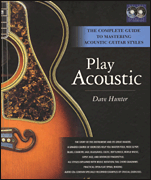
PLAY ACOUSTIC, The Complete Guide to Mastering Acoustic Guitar Styles. 2CD TABLATURE
LIBRO PER CHITARRA CON 2 CD, TABLATURE.
Series: Book
Publisher: Backbeat Books
Softcover with CD - TAB
Author: Dave Hunter
The acoustic guitar is the instrument of the people and Play Acoustic tells the people how to play it. This detailed and beautifully illustrated book explores the history of the acoustic guitar, from the jazz age to the folk revolutions of the early 1960s and late 1990s to the current rebirth of bluegrass and the singer-songwriter boom of the past decade. Skilled professional musicians and experienced tutors coach the reader through 11 styles, using exercises suitable to novice players new to each style and working up to full pieces and advanced techniques. Entire chapters are devoted to folk, rock and pop, blues, country, bluegrass, jazz, and more, with detailed guidance through both musical notation and tablature, diagrams, and explanatory text. An accompanying CD also offers listening examples of the most crucial of these exercises, to help players master each style. 252 pages.
... few have survived in great playing condition. Gretsch flat-tops didn't fare much better in
the quality stakes, though some have become collectible fot aesthetic or historic reasons,
such as the G-btanded Rancher of the 1950s.
GYPSY JAZZ GUITARS
The continuing, even booming popularity of guitarist Django Reinhardt and the sprightly,
melodic 'Gypsy jazz' style of which he long formed the centre, has spawned a perhaps
surprising cottage industry building a type of guitar that has only really excelled at this
single style of playing. Rob Aylward, John Le Voi, Maurice Dupont and Shelly Parks all offet
instruments in the apptoximate Selmer-Maccaferri design, as pioneered more than 75 years
ago, and taken up by Reinhardt almost immediately after its arrival on the scene.
Maccaferri was an Italian-born luthier and concert (classical) guitarist, whose relatively
radical design ideas were taken up by London music store manager Ben Davis and promoted
to Henri Selmer, head of the enormous French saxophone maker, as a sound basis for a guitar
of the same brand. The Selmer factory in France began limited production of the instruments
in late 1931, and the first models arrived for sale in London in 1932. They were taken up
mostly by jazz players, although Maccaferri himself favoured the gur-stting variants, as did
a few other classical players of the day. But the steel-string models were unlike anything the
majority of jazzers were strumming at the time. They were - and remain - a different breed
of guitar entirely.
Selmer-Maccaferri instruments are large-bodied, flat-top guitars, often with aD-shaped
or round soundhole placed under the strings and a deep, 'flattened' looking cutaway. Many
models were originally built with circular wooden 'resonators' mounted under their tops,
intended to aid projection and volume. If anything, these usually damaged the tone of the
guitars to which they were fitted, and players simply removed them, or custom-ordered new
Selmers without resonators. The sreel-string Orchestre is the real classic of the early years of
the Selmer-Maccaferris, but others existed, such as the cutaway-less Hawaien, and gut-string
models such as the Concert (with the cutaway), Espagnol, and C1assique. All - both steel and
gut models - were made with laminated back and sides, not as a cost cutting exercise, but
for well-defined tonal considerations researched by Maccaferri.
In 1933, only shorrly before rhe instrumenr's mosr famous endorser took up rhe brand,
Maccaferri parted ways with Selmer after a contracr dispute. He rerurned briefly to his
playing career, which itself was cut short after he fractured his wrist in a swimming accident.
For a time he took up the manufacture of reeds for musical instruments, and dabbled in
other rypes of guitar design, before being hooked by the possibilities of injection-moulded
plastic instruments. Experiments with plastics led ro his founding of Mastro Industries,
which introduced a plastic ukulele in 1949, and the famous Maccaferri plastic guitars in the
early 1950s. Despite their appearance and rheir general perception today, instrumenrs such
as the Maccaferri G-30 flat-top and G-40 atchcop - moulded from a material called Dow
Styron - were presented as serious instruments, and were even taken up by a number of pros
in their day.
The plastic image could never quite cur it credibility-wise, however, and Maccaferri gave
up applying the process co 'serious' instruments just a few years into the effort. Mastro
continued co offer a number of downscaled plastic guitars through the 1960s, but these were
no longer intended as professional-grade players' instruments. In the 1970s and 1980s Mario
Maccaferri occasionally returned co lutherie, and even produced his Selmer-style wooden
Gypsy jazz guitars again, first as the CSL Gypsy (in parrnership with Englishman Maurice
Summerfield, and manufactured in Japan at the Hoshino faccory, where Ibanez guitars were
made), and later in collaboration with high-end New York maker John Monteleone.
Maccaferri died in 1993 at the age of 92.
Freddie Green, guitarist with Count Basie.
pictured in 1968 with his Gretsch 5ynchromatic 400.
PLASTIC GUITAR
A plastic Maccaferri Romancer from 1960 and a 1955 advertisement for the revolutionary instrument.
CD TRACK LISTS &. NOTES
The exercises on rhe cwo CDs packaged wich chis book are all played and recorded by che authors themselves, except for che Latin and African senions of che 'World Music' chapcer, which were performed and recorded by Rod Fogg. In all cases, che musical examples are che copyrighc of che auchocs of che respeccive chapters (excepct of course for che occasional non-copyriglued Tradicional' runes used, where che aurhors have copyrighc in the arrangements). Click cracks, count-ins and chychm cracks were nor used excepc where noced. To make che best use of che space on che CD, we have chosen co supply music cracks mainly foe che exercises chac you ceally need to hear played co undersrand fully. Each liscing begins wich che crack number, followed by che section and exercise number that the music relates to. Addicional nores for some tracks come aftec that, in italic type.
GETTING STARTED
ROCK & POP
RITCHIE BLACKMORE
4 NOTE CHORDS
JIMMY PAGE
BLUES
A SERIES OF BLUES TURNAROUNDS PLAYED IN SUCCESSION
BOTTLENECK - PETE MADSEN
THE RIFF FROM PLAYED WITH RHYTHM GUITAR BACKING
COUNTRY - LEE HODGSON
BLUEGRASS - ERIC THOMPSON
JAZZ - CARL FILIPIAK
JAZZ, MINOR BLUES
JAZZ, RHYTHM CHANGES
GYPSY JAZZ - MICHAEL HOROWITZ
CELTIC
PENNYWHISTLE MELODY
WORLD MUSIC
LATIN - NESTON GARCIA
SON CLAVE -
RUMBA
CASCADA TIMBALE
SPECIFIC RHYTHM
PLAYED AGAINST RHYTHM
AFRICAN
SIKYI RHYTHM ON BELL, CABASA AND CONGA
KLEZMER
ADVANCED FINGERSTYLE - TEJA GERKEN
DADGAD TUNING
MOVING BASSLINES
MOVING AROUND THE FINGERBOARD
NATURAL HARMONICS
SLAPPED HARMONICS
RIGHT-HAND FRETTING
D MINOR TUNING
BEHIND THE NUT BENDS
CLASSICAL STYLE TREMOLO
MIDLE FINGER SNAP
ACOUSTIC TAPPING

 Italiano
 English