HAL LEONARD

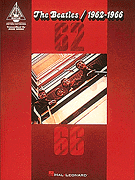
BEATLES 1962-1966 Guitar Recorded Versions TAB 2nd EDITION TABLATURE BOOK

BEATLES, 1962-1966. SHEET MUSIC BOOK with GUITAR TABLATURE .


LIBRO DI MUSICA ROCK.

SPARTITI PER VOCE E CHITARRA : 

ACCORDI, PENTAGRAMMA, TABLATURE .


The Beatles – 1962-1966 – 2nd Edition
Guitar Recorded Versions TAB
Series: Guitar Recorded Versions
Format: TAB
Artist: The Beatles
 
This updated edition features all-new engravings of 26 classic Beatles songs: All My Loving • Can't Buy Me Love • Drive My Car • Eleanor Rigby • Help! • In My Life • Michelle • Nowhere Man • Paperback Writer • She Loves You • Yellow Submarine • Yesterday • and more.
 

Series: Guitar Recorded Version

Product Details
Inventory: #HL 00694929
ISBN: 9780793534562
UPC: 073999949292
Width: 9.0"
Length: 12.0"
Page Count: 152 Pages
 
Prices and availability subject to change without notice.


Over 20 classics, including :

All My Loving
And I Love Her
Can't Buy Me Love
Day Tripper
Drive My Car
Eight Days A Week
Eleanor Rigby
From Me To You
Girl
A Hard Day's Night
Help!
I Feel Fine
I Want To Hold Your Hand
In My Life
Love Me Do
Michelle
Norwegian Wood (This Bird Has Flown)
Nowhere Man
Paperback Writer
Please Please Me
She Loves You
Ticket To Ride
We Can Work It Out
Yellow Submarine
Yesterday
You've Got To Hide Your Love Away

152 pages

Prezzo: €39,99
€39,99

BACHMAN RANDY COLLECTION Guitar TABLATURE LIBRO-American Woman-Takin' Care Of Business

BACHMAN RANDY, COLLECTION. GUITAR TABLATURE

LIBRO DI MUSICA ROCK,

SPARTITI PER VOCE E CHITARRA ,

ACCORDI, PENTAGRAMMA E TABLATURE. 


Series: Guitar Recorded Version TAB
Artist: Randy Bachman, Bachman Turner Overdrive, The Guess Who

21 classics, including songs from Bachman Turner Overdrive and The Guess Who. Songs include: American Woman - No Sugar Tonight - No Time - Takin' Care Of Business - These Eyes - You Ain't Seen Nothin' Yet , and more. 112 pages

American Woman
Four Wheel Drive
Hey You
I Wanna Shelter You
It's Only Money
Laughing
Let It Ride
Looking Out For Number One
No Sugar Tonight
No Time
Overworked And Underpaid
Prairie Town
Rock Is My Life And This Is My Song
Sledgehammer
Stayed Awake All Night
Tailspin
Takin' Care Of Business
These Eyes
Undun
You Ain't Seen Nothin' Yet

Prezzo: €29,99
€29,99

AEROSMITH PUMP GUITAR RECORDED VERSION TABLATURE BOOK CHITARRA SPARTITI LIBRO

AEROSMITH, PUMP. SHEET MUSIC BOOK WITH GUITAR TABLATURE.

GUITAR RECORDED VERSION.

LIBRO DI MUSICA ROCK.

SPARTITI PER VOCE E CHITARRA CON: 

ACCORDI, PENTAGRAMMA, TABLATURE. 


Contiene

  - Don't Get Mad, Get Even
  - F.i.n.e.
  - Going Down/Love in an Elevator
  - Hoodoo / Voodoo Medicine Man
  - Janie's Got A Gun
  - Monkey On My Back
  - My Girl
  - The Other Side
  - What it Takes
  - Young Lust

Prezzo: €39,99
€39,99

THE ROOTS OF SLIDE GUITAR Fred Sokolow CD TABLATURE Come On in My Kitchen Robert Johnson-SPARTITI LIBRO

THE ROOTS OF SLIDE GUITAR. Fred Sokolow. Metodo per suonare e cantare il blues con 3 titoli acustici e 2 elettrici.

LIBRO DI MUSICA BLUES CON CD. 

SPARTITI PER VOCD E CHITARRA CON:

ACCORDI, PENTAGRAMMA, TABLATURE.


THE SONGS AND LICKS THAT MADE IT HAPPEN 
A SURVEY OF SLIDE GUITAR, ITS PIONEERS, AND HOW IT DEVELOPED


This book/CD pack is a complete survey of slide guitar, its pioneers, and how it developed. It includes: 6 note-for-note transcriptions of famous slide tunes :

-Come On in My Kitchen (Robert Johnson)

-Motherless Children (Mance Lipscomb)

-Roll and Tumble Blues ("Hambone" Willie Newbern)

-You Can't Lose What You Ain't Never Had (Muddy Waters)

-You Gotta Move ("Mississippi" Fred McDowell)

-You Shook Me (Earl Hooker with Muddy Waters);

instruction in the essential playing styles; the history and the development of slide guitar; biographies of its representative artists; and recordings on CD of the songs, exercises and licks.


You gotta move -come on in my kitchen -motherless children -roll and tumble blues -you can't lose what you ain't never had -you shook me. CD TABLATURE


HOW TO USE THIS BOOK AND RECORDING
It swoops, wails, whines, moans and growls: slide guitar sings. It's a crowd pleaser, and it reaches people because it conveys naked emotion-especially when playing the blues. And most slide guitar heard today, whether in a blues, rock or country song, is played in a style derived from early Mississippi Delta blues.
Modern blues and rock slide guitar evolved from traditional acoustic styles. This book is about the guitarists who made that evolution happen. It takes you to the roots of slide guitar. Each of the six classic blues tunes transcribed here demonstrates a particular style and tuning. Every song is preceded
by information, exercises, scales, licks and chords that are needed for that style.
Timing is such a major part of slide guitar that it's almost impossible to learn from the printed page alone. Listen to the recording that comes with this book before playing a note. Once you know how a tune sounds, then it's time to check out the tablature and/or music notation.
If you want to learn any style of music, it helps to imitate the masters. Whether you're a beginner or an experienced player who wants to get back to the roots, here is the essential guitar stuff. This is an introduction to and an appreciation of great vintage music, and it's a foundation on which you can build your own style.

." Fred Sokolow
All guitars and vocals on the recording that comes with this book are by Fred Sokolow. Bass, drums, piano and horns are by Dennis O'Hanlon, and it was recorded at O'Hanlon Recording.


MUSICAL INTRODUCTION

A LOOK AT THE ROOTS OF SLIDE GUITAR
Most musical historians trace slide guitar to Hawaii, but Johnny Shines, friend and accompanist of Robert Johnson, is one of many who claim that blues-style slide developed in Africa, along with open-chord tunings. The first literary mention of blues slide was W. C. Handy's famous 1903 sighting of a singer at a Mississippi train depot who used a knife to slide on his guitar strings. Like most Mississippi blues players, he made his guitar sing and mimic his voice.
Early players slid on the strings with pocket knives or beef bones, and some held the guitar on their lap, Hawaiian-style, but by the 1930s, most blues players held the guitar upright and used a brakenoff bottleneck or a sawed-off length of pipe for a slide. This was a major stylistic development, because if you hold a knife in your left hand, it's impossible to fret the strings with your fingers; fitting a slide on the ring finger or little finger frees up two or three fretting fingers. Most slide players tuned the guitar to a major chord, usually 0, E, G or A, and used the slide to play major chords, as well as individual notes.
There was a blues craze in the 1920s, and by the middle of that decade, major labels began recording blues guitarist/singers. The first crap of slide players who recorded included Sylvester Weaver, Barbecue Bob, Hambone Willie Newbern and Sam Butler. Following them were the Mississippi bluesmen Son House, Charlie Patton, Bukka White, Kokomo Arnold, Sam Collins and Robert Johnson. They played a raw, very rhythmic, emotional style of blues and sang and wailed with passionate intensity. Texans Blind Willie Johnson and B. K. Turner (the Black Ace) were influential early slide blues players, as were Tampa Red and Furry Lewis, who boasted a polished, gentler slide style.

THE COUNTRY CONNECTION
Hawaiian guitarists developed a lap style of playing: the guitar lies in your lap, strings facing up, and you hold a steel bar down on the fretboard. This technique migrated to the mainland and, in the 1920s, with the help of Cliff Carlisle, Jimmie Tarlton and slide players who accompanied Jimmie Rodgers, it became an essential part of country music. By the '30s, Hawaiian and country pickers began using electric, fretless "lap steels." These evolved over the years: they grew legs, more strings, twin and triple necks (in different tunings), and foot pedals and knee levers to bend notes while playing.
Thus was born the pedal steel guitar that is now a signature country sound. But country pedal steel and lap steel bear little stylistic resemblance to blues or rack slide playing.
In the early '50s, the acoustic lap style slide guitar (see Dobro picture, below) began appearing in bluegrass bands. The wooden, acoustic whine of the Dobra is also heard in contemporary country music. Usually played in a bluesy style in open tunings, country Dobra is more related to bottleneck guitar than is its cousin, the pedal steel.
All-metal Dobro
Wooden-bodied squaredneck Dobro


BLUES SLIDE PLAYERS PLUG IN
Before instruments were amplified, it was hard for a guitarist to be heard over a piano, horn or even a banjo. In the late '20s, the National Company answered this need by making all-metal guitars, fitted inside with convex aluminum resonators, like speaker cones. Sounds crazy, but it worked: the guitars were louder, with more sustain, and they rapidly became popular with jazz, country and blues players. Lap style players used the square-necked models with a nut that lifted the strings high off the fretboard (better for the metal slide), but bottleneckers favored the round-necked National that could be played like a normal guitar. To this day, the all-metal National and its cousin, the Dobro, are favored by many an acoustic slidester. The Dobro company also makes a wooden, square-neck guitar with a metal resonator fitted into its body (it looks like someone stuck a hub cap over a guitar's soundhole) that bluegrass players use.
However, even the National or Dobro could not cut through drums, saxophones and electric guitars. By the mid-'40s, many Mississippi players had relocated in Chicago, and a new kind of blues was brewing. Elmore James and Muddy Waters led full electric bands, playing screaming, amplified slide.
It was loud and distorted, and single-note solos became the norm-with a whole band for backup, a guitarist didn't need to fingerpick or play chords. You could wail with one note, like a sax or trumpet.
Waters' and James' styles were clearly rooted in the Delta, and so was the playing of electric slide pioneers J. B. Hutto and Hound Dog Taylor. But Robert Nighthawk and Earl Hooker began playing electric, single-note style in standard tuning, which was a new direction for bottleneckers.

THE '60S BLUES REVIVAL AND BEYOND
During the '60s, white blues fans, many of whom had learned to play by studying old blues records, sought out the first-generation blues artists. Legendary players whose careers had petered out were rediscovered and brought into the limelight, and many excellent artists who had never played outside their own county recorded and performed all over the world. Folk festivals, concerts and coffee houses featured acoustic and electric blues.
American and European audiences loved the aging but passionate blues legends, and by the mid· '60s a blues revival was in full swing on both continents. Besides giving players like Muddy Waters and Howlin' Wolf a bigger audience, the revival encouraged young players to form new blues bands, and to use blues techniques in rock and pop bands. After playing with John Mayall's blues band, enthusiastic blues disciple Eric Clapton brought blues guitar skills to his rock and pop bands (Cream, Derek and the Dominoes, Bonnie and Delaney). While still playing with the Butterfield Blues Band, guitarist Mike Bloomfield backed up Bob Dylan on one of his first electric albums. And slidemaster Duane Allman used his blues chops with the Allman Brothers Band and, as a studio player, infused all kinds of pop recordings with the blues.
In the '70s and '80s, pop audiences were introduced to slide sounds by Johnny Winter, George Thorogood, Eric Clapton, Duane Allman, George (post-Beatles) Harrison, Bonnie Raitt, Little Feat's Lowell George, Ry Cooder, David Lindley and the Rolling Stones. Many Southern rock bands had slide guitarists, and they influenced a new crop of country stars who, in the '90s, used slide on Nashville hits. Slide is heard more and more in movie and television soundtracks. Fortunately, as its audience grows, slide guitar has retained its down home character.


MUDDY WATERS
Often called the "father of electric blues," Muddy Waters was the leading force in the post-war
Chicago blues scene and an important figure in the development of rock and roll. The roster of players who learned their craft playing in his band reads like a "who's who" of blues legends: Little
Walter, Junior Wells, Otis Spann, James Cotton and Jimmy Rogers are just a few. While T-Bone
Walker and B.B. King, with their big-band sound, urbanized and streamlined the blues, Waters
brought it back to its funky Delta roots with a small but powerful band whose lineup (two guitars,
piano, harp, bass and drums) would evolve to become the typical rock band format.
Born McKinley Morganfield of sharecropper parents in Rolling Fork on the Mississippi Delta, April 4, 1915, Muddy Waters built his own guitar when he was seventeen. Robert Johnson and Son House
were his main influences; he watched Son House in action when House came to Clarksdale,
Mississippi. House taught him riffs, open tunings and songs, and showed him how to break off and
flame-smooth a bottleneck.
In '41, folklorists Alan Lomax and John Work came to Clarksdale and recorded Waters for the
Library of Congress. In '43, ready for bigger things, Waters moved to Chicago. Though his style of
choice was rough and old-fashioned compared to the reigning blues artists like Tampa Red and
Lonnie Johnson, (of whom he could do a simple imitation) Big Bill Broonzy helped Waters get his
start playing in clubs. In '44, his uncle gave him his first electric guitar, and by the following year he
had teamed up with guitarist Jimmy Rogers. In the next few years, he started to develop his electric
sound and began recording for the Chess brothers.
In 1950, with the release of "Rollin' Stone," (backed with a Robert Johnson-derived version of
'Walking Blues"*), Waters' career was in high gear. In the next several years he had a series of
regional and national R&B hits. He was Chicago's reigning king of the blues, working every night, his style imitated by other bands, and even some of his sidemen had hit records! He recorded blues
classics like "Hoochie Coochie Man," "Honey Bee" and "I Just Want To Make Love To You."
In the mid-'50s, when rock and roll came roaring onto the charts, Waters' record sales dwindled. Still, he held his Chicago fans and his legend grew. In '58 he played in England and then was a hit at
Carnegie Hall and the Newport Jazz Festival. The early '60s British invasion brought him wider
recognition, as the Rolling Stones (who took their name from the Waters tune), John Mayall, the
Beatles and others sang his praises ... and his songs! In the blues revival that ensued, Waters was
acknowledged as the founding father by the British and by American guitar heroes like Mike
Bloomfield, Steve Miller, Johnny Winter and Jimi Hendrix. He played festivals, college concerts and clubs, was filmed for television in England and the U.S., did world tours, starred at the Montreaux Festival, and played stadiums and arenas.
In the late '70s and early '80s, Waters won three Grammys, played for the White House Staff Party,
appeared in the movie The Last Waltz, and toured with Eric Clapton. On April 30, 1983, he died
peacefully in his sleep at his suburban Chicago home.
78 and 45 rpm singles had an "A side" (the featured tune) and, when you flipped them over, a "6 side," or backup song.
 

Prezzo: €39,99
€39,99

ELECTRIC SLIDE GUITAR David Hamburger LIBRO CD TABLATURE TUNINGS-Ry Cooder-MUDDY WATERS-ELMORE JAMES

ELECTRIC SLIDE GUITAR. Hamburger.

LIBRO DI MUSICA PER CHITARRA SLIDE CON CD E TABLATURE

This book/audio method explores the basic fundamentals of slide guitar: from selecting a slide and proper setup of the guitar, to open and standard tuning. Plenty of music examples are presented showing sample licks as well as backup/rhythm slide work. Each section also examines techniques and solos in the style of the best slide guitarists, including Duane Allman, Dave Hole, Ry Cooder, Bonnie Raitt, Muddy Waters, Johnny Winter and Elmore James. CD TABLATURE

Series: Guitar Educational
Softcover with CD - TAB
Author: David Hamburger

This book/audio method explores the basic fundamentals of slide guitar: from selecting a slide and proper setup of the guitar, to open and standard tuning. Plenty of music examples are presented showing sample licks as well as backup/rhythm slide work. Each section also examines techniques and solos in the style of the best slide guitarists, including Duane Allman, Dave Hole, Ry Cooder, Bonnie Raitt, Muddy Waters, Johnny Winter and Elmore James. 80 pages


INTRODUCTION
The aim of this book is to present you with the essential techniques required to play electric
slide guitar, while providing a hands-on understanding of the variety of slide styles that exist within
the blues idiom. The book begins with the open G tuning, proceeds to open E tuning, and concludes
with playing in standard tuning. While there is material at a variety of levels throughout the book,
important matters of technique are introduced chapter by chapter. E tuning is not "harder" than G tuning,
or vice versa, but as the chapters on open E tuning come later in the book, that is the point at
which more advanced techniques are discussed, whereas basics of right and left hand technique are
covered in the earlier chapters on G tuning.
A Note About the Tunings
There are four tunings that are considered standard for the electric slide guitar: open G, open
D, open A, and open E. Open G and open A offer essentially the same sound as one another, a whole
step apart (open G= D, G, D, G, B, D; open A= E, A, E, A, C#, E, low to high). Open D and open E
likewise offer essentially the same sound as one another, a whole step apart (open D= D, A, D, F#, A,
D, open E= E, B, E, G#, B, E, low to high). For this book, I have chosen to present all of the examples
(except for those in standard tuning) in either open G or open E tuning, rather than distinguish
between various artists' use of G or A tuning, and D or E tuning. I have done this for two reasons. The
first is to enable you to compare examples from different styles of playing within a given chapter
quickly and easily, without having to retune or capo by a whole step, or transpose in your head. The
second reason is that G and E tunings share some familiar fret positions and bar chord locations with
standard tuning. This makes orientation to each of these open tunings a little easier. More importantly,
it makes it much easier to translate what you have learned in open tunings back into standard tuning,
should you wish to play without t::hanging to an open tuning-for instance, if you use a slide for just
part of a song.
Electric slide guitar is at the heart of electric blues, from the pioneering postwar recordings of
Muddy Waters and Elmore James to the blues-rock of Duane Allman, Johnny Winter and Lowell
George, from timeless, genre-busting originals like Earl Hooker and Ry Cooder to contemporary
artists like Bonnie Raitt, Roy Rodgers and Dave Hole. The diversity among slide players is remarkable.
Far from being limited to the generic sound stereotyped in every bar band's version of "Dust My
Broom," the world of electric slide guitar is as broad, deep, and eclectic as the blues itself.


CONTENTS
Introduction

Chapter 1 Slide Essentials
Choosing a Slide .
Guitar Set-Up .
Left Hand Damping .
Left Hand Exercises .
Right Hand Muting .
Fingerstyle .
Right Hand Exercises .
More Right Hand Practice .
Playing with a Pick .
Vibrato .

Chapter 2 Open G TIming
Tuning Up .
The Fretboard in Open G Tuning .
Scales .
Damping/Muting Exercises on One String .
Major and Minor Pentatonic Licks .
Call and Response .
Combining Major and Minor Pentatonic Scales .
The Blues Form .

Chapter 3 Improvising in Closed Position
Closed Position Scales in G .
Precision Exercises .
Blues Vocabulary .
Transposing: Blues in G .
Combining Open and Closed Positions, ala Muddy Waters .
The Upper Extension: Adding Notes above the 12th Fret .
Transposing the Upper Extension: Blues in C .
The Dorian Mode

Chapter 4 Backup in Open G
The Style of Muddy Waters .
Changing Keys-Using a Capo .
The Style of Bonnie Raitt .
The Style of Ry Cooder .
The Style of Johnny Winter .
The Style of Dave Hole .

Chapter 5 Open E TIming
Tuning Up .
The Fretboard in Open E Tuning .
Scales .
Exercises .
The Style of Ry Cooder .
The Style of Johnny Winter .

Chapter 6 Broom Dusters, House Rockers, and the Closed Position
Scales .
The Style of Elmore James .
The Style of Hound Dog Taylor .
The Style of Duane Allman .
Pulldowns, Escape Notes, and Gradual Slides .
Duane's World .
High Energy Blues/Rock: the Styles of Johnny Winter and Dave Hole

Chapter 7 Backup in Open E
The Style of Elmore James-Elmore's Shuffle .
The Style of Hound Dog Taylor .
The Style of Ry Cooder .
Beyond the Key of E .
Stop Time Boogie .
Double Stops .

Chapter 8 Standard TIming
Translating Open G Tuning to Standard Tuning .
Translating Open E Tuning to Standard Tuning .
Standard Tuning .
Adapting Classic Open Tuning Licks to Standard Tuning .
Combining the Open and Closed Positions in Standard Tuning .
The Style of Robert Nighthawk .
The Style of Earl Hooker .
Standard Tuning Licks .

Chapter 9 What to Do Next .
A Selected Discography
About the Author .
Notation Legend .
 

Prezzo: €20,99
€20,99

PASTORIUS JACO SIGNATURE LICKS LIBRO CD BASS TABLATURE-Bright Size Life-Continuum-Donna Lee

PASTORIUS JACO, SIGNATURE LICKS. CD TABLATURE

LIBRO DI MUSICA, SPARTITI PER CHITARRA BASSO CON CD E TABLATURE. 

Birdland -Bright Size Life -Come On, Come Over -Continuum -Donna Lee -God Must Be A Boogie Man -Kuru -Liberty City -Night Passage -Palladium -Port Of Entry -Portrait Of Tracy -Rockin' In Rhythm -Talk To Me -Teen Town. CD TABLATURE

A Step-by-Step Breakdown of the Styles and Techniques of the World's Greatest Electric Bassist
Series: Signature Licks Bass
Softcover with CD - TAB
Author: Dan Towey
Artist: Jaco Pastorius

Learn the trademark grooves and solos of the man who revolutionized bass guitar. This book/CD pack will help you take a closer look at Jaco's rich body of work through the structural, theoretical, and harmonic analysis of these classic recordings, 56 pages
Birdland
Bright Size Life
Come On, Come Over
Continuum
Donna Lee
God Must Be A Boogie Man
Kuru
Liberty City
Night Passage
Palladium
Port Of Entry
Portrait Of Tracy
Rockin' In Rhythm
Talk To Me
Teen Town

Prezzo: €29,99
€29,99

PASTORIUS JACO ESSENTIAL BASS TABLATURE CHITARRA BASSO Blackbird-Chicken-Chromatic Fantasy

PASTORIUS JACO, THE ESSENTIAL. Amerika -Birdland -Blackbird -Chromatic Fantasy -Come On, Come Over -Continuum -Donna Lee -Invitation -Liberty City -Opus Pocus -Portrait Of Tracy -River People -Soul Intro -Teen Town -The Chicken -Word Of Mouth. TABLATURE

LIBRO DI MUSICA JAZZ PER CHITARRA BASSO
SPARTITI CON TESTI DELLE CANZONI, ACCORDI, PENTAGRAMMA E TABLATURE.

Series: Bass Recorded Versions TAB
Artist: Jaco Pastorius

Note-for-note transcriptions with tab of Jaco's brilliant bass work on 16 songs, 104 pages

Amerika
Birdland
Blackbird
The Chicken
Chromatic Fantasy
Come On, Come Over
Continuum
Donna Lee
Invitation
Liberty City
Opus Pocus
Portrait Of Tracy
River People
Soul Intro
Teen Town
Word Of Mouth

Prezzo: €26,99
€26,99

FUNK BASS Liebman LIBRO CD TABLATURE PLAYING Slapping Technique-Popping-BENDING-TRILL-SLIDE

FUNK BASS. Jon Liebman. THE BEST SINGLE SOURCE FOR PLAYING FUNK AND SLAP-STYLE BASS.
SHEET MUSIC BOOK WITH CD & BASS TABLATURE. 


LIBRO METODO PER BASSO CON CD.

SPARTITI PER BASSO : 

ACCORDI, PENTAGRAMMA, TABLATURE. 


Funk Bass

Series: Bass Instruction
Format: Softcover with CD - TAB
Artist: Jon Liebman

FORWARD BY: JOHN PATITUCCI

Critically acclaimed as the best single source for the techniques used to play funk and slap-style bass! Includes a foreword by John Patitucci and is endorsed by Rich Appleman of the Berklee College Of Music, Will Lee, Mark Egan, Stuart Hamm and many others! Features several photos and a special section on equipment and effects. A book for everyone - from beginners to advanced players! Includes a 58-minute audio accompaniment. CD TABLATURE

Inventory #HL 00699348
ISBN: 9780793516209
UPC: 073999993486
Width: 9.0"
Length: 12.0"
96 pages
 

INTRODUCTION
The goal of this book is to introduce the contemporary bassist to the funk style of playing. Many books of this type miss the point of what is required of a bass player. Being able to execute a bunch of fast funk licks may dazzle your friends and relatives, but it won't make your phone ring off the hook from contractors and record producers calling you with work. In the real world, you'll be hired according to how well you understand your role as a bass player and how well you do your job. This book will guide you toward those goals in a logical, step-by-step "real-world" approach.
Chapter I, A Word On Practicing, emphasizes the importance of proper practice habits. It includes discussions on metronomes, drum machines, live drummers, tape recorders, utilizing recordings, attending live concerts and maintaining a music notebook.
Chapter 2 begins illustrating the fundamentals of funk bass playing - how to "slap" and "pop." The emphasis here is on precision and proper execution. The exercises in this chapter are developed into some basic funk patterns in Chapter 3.
Chapter 4 introduces some stylistic elements, such as the "hammer-on," the "pull-off," the slide, the trill, the shake and the bend (no, it's not a dancing lesson!). These are the so-called "tricks of the trade" that will make your playing sound funkier.
The focus in Chapter 5 is on establishing a groove - the most important element of playing the bass. If you're going to get anything at all out of this book, get this: GROOVE IS EVERYTHING, AND EVERYTHING MUST GROOVE! I can't overemphasize the importance of this statement. It holds true for all musicians, but especially for the bass player and the drummer, because they're the ones that really lay down the time and make the music "feel" good.
Once you understand this concept and are comfortable (honestly!) with Chapters 2 through 5 of this book, feel free to have fun with the licks I have included in Chapter 6. They are intended to illustrate different possibilities of the funk style, help you develop your technique and give you ideas for creating your own funk lines. Remember, your job is to groove and support the band. These licks are to be used at your discretion as your taste and musicality dictate. They can work very well as fills within the groove or, of course, for your solos.
It is crucial to be able to play in an keys. Many students of funk bass can really "get down" in one or two keys, but are practically helpless when they have to play for a singer whose song is not in "E" or "A" but in some "weird" key. Because this is so important, I have made sure to include plenty of exercises and licks (and grooves!!!) in all twelve keys. Where other books simply suggest, "try these licks in a few different keys," I felt it was important enough to actually write them out. Of course, you are encouraged to transpose anything in this book into any or all twelve keys. It's good for you! It will help your reading, too.
What's more, the key of"a"is not the same as "J)l.," nor is "Fl" the same as "0," nor "B" the same as "0." By the time you get through this book, you'll be able to read and play in any key. Granted, certain keys (like "E" and "A") lend themselves to greater ease and facility on the bass, because of the nature and tuning of the instrument. Also, some keys may be harder to read, but easier to play in, and vice versa. When you come right down to it, there are no such things as "easy" or "hard" keys, only "familiar" keys and "unfamiliar" keys.
The Appendix, Your Equipment, provides an overview of the equipment common to funk bass players. It includes information on types of basses, strings, amplifiers, speakers and effects. It is intended to "de-mystify" the myriad of products available to musicians today, and offers insights into how to invest carefully in the proper tools that will best suit your needs.
At the end of this book I have included a Discography, which is by no means exhaustive, but offers a cross section of some of the greatest funk bassists in music today. It's important that you listen to as much of this music as possible so you understand just exactly what we're trying to do here. If you get a chance to see any of these guys live, don't you dare miss them!


Chapter 1
A Word On Practicing
"Practice doesn't make perfect. Perfect practice makes perfect."
- Vince Lombardi These words, by the late, internationally renowned coach of the Green Bay Packers, are profoundly true. Whether you're talking about music or football, Mr. Lombardi's philosophy still applies. Even if you spend eight hours a day in the woodshed, you could be wasting your time if you don't have proper practice habits. In this chapter, we'll look at what distinguishes "good" practicing from "bad" practicing, and how to make the most efficient use of the hours you spend honing your funk bass skills.
"Did you say bad practicing?" "Does it really exist?"
Absolutely! Do you ever just "wander" around the bass, aimlessly, playing lick after lick? Do you often find yourself charging ahead through bass lines and solos that you already can play inside out? When you practice a part, do you think only of the bass, without considering the interplay between you and the other musicians (the drummer, for one)? Do you practice without a metronome or a drum machine? Or in front of the TV? If you answered yes to any of these questions, you may be found guilty of "bad practicing" and could be subject to eternal banishment from all that's hip, and forced to tap your toes on "one" and "three" for the rest of your life!
When you practice, it's serious business. Create an environment that's conducive to study. Keep distractions out of sight.
Find a time when you won't be disturbed. Convince yourself that you're not hungry or thirsty, and get in the proper frame of mind.
My teacher used to have me keep a log of my practice sessions, which was a great help. Get a calendar, in which you'll record nothing but your practice schedules. Every day, take into account how many hours you're going to spend practicing and what you need to work on, then budget your time accordingly. Write down, for example, 30 minutes for scales and arpeggios, 20 minutes for sight-reading, etc. When the time alloted for each segment expires, move on to the next one, checking things off as you go. That way you're constantly chipping away at everything every day, and won't have to worry about three weeks going by without playing any Stu Hamm finger taps, or whatever else may be on your agenda.
At the end of the week, take a look at your calendar and see how much practicing you're actually doing, versus how much you think you're doing. The results may surprise you.
"Time is of the essence." I don't know who first uttered those words, but they couldn't hold more truth for bassists.
When you're practicing by yourself, always use a metronome, or, better yet, a drum machine. Remember: they're your friends! Concentrate not only on playing in time, but with a good time feel. A GREAT time feel. So what if you know the right changes to 40,000 tunes? Who cares if you can play eighty-bizillion sixteenth notes a minute, or have the "baddest" setup this side of Osaka. THE MOST IMPORTANT JOB YOU HAVE AS A BASS PLAYER IS TO GROOVE WITH A GREAT TIME FEEL. You may think you're playing in time, but the metronome and drum machine will keep you "honest," so use them.
Another way to work on your time feel is to get together with a good drummer and groove. For hours. Don't just fool around, though. Concentrate on "takin' care0' business." Oh, sure, you can still work on your solo chops, but spend most, if not all, of the time on the time. Pick several grooves that you want to work on, and practice them one at a time, over and over, without stopping. Be sure to play in all twelve keys, too. You may want to have your drummer friend program a few grooves into your drum machine, for you to practice with when you're by yourself.
So far, we've got three friends: a metronome, a drum machine and a real live warm body behind the drums. Let's add one more friend to our list: the tape recorder.
Back we go, once again, to the "honesty" category. You think you know what your playing sounds like? Try laying it down on tape and see (hear) if you're right. "Tape recorders don't lie." Recording your playing may reveal many flaws and bad habits of which you may not have been aware. It lets you really zero in on the attack and release of each note, as well as your sustain, intonation, time feel and overall sound. A tape recorder can be an invaluable practice tool.


ACKNOWLEDGMENTS
Sure, I'd like to take all the credit for writing this book. Truth is, though, I had help. A lot of people went out of their way to help me make this project (and it was a project!) move more smoothly, easily and efficiently. I'd like to take this opportunity to acknowledge these people's generosity.
Thanks to the musicians who took the time to talk with me, read my manuscript and actually come up with good things to say about my book:
- John Patitucci: I don't know where you found the time to hang out, John, but I sure do appreciate it. Even though I did have to sit and watch you rehearse your incredible band while waiting to talk to you, really, I didn't mind! Thanks for putting up with all the trans-global phone calls and faxes (what an age we live in!). Thanks for going so far out of your way to help me. Much luck and continued success to you.
- Rich Appleman: A true pedagogue! Thanks for your support and encouragement. Berklee is lucky to have you.
- Brian Bromberg: Glad the word finally got out about what a great player and writer you are. Hell, I've known that for years! Thanks, man.
- Bob Cranshaw: I admire your meticulous, no-nonsense, down-to-business approach. Thank you.
- Mark Egan: I didn't mind sitting through your rehearsal, either! Thanks.
- Stuart Hamm: I am truly honored to have been the one chosen to transcribe the music for your Hal Leonard book.
Throughout the ordeal, though, you quickly went from being my mentor to my tormentor! Seriously, I appreciate all the time we got to spend working together. Now let's go eat!
- Neil Jason: What can I say, Neil? You helped me make the phone company rich! Thanks for all your suggestions, and thanks for being a great guy!
- Will Lee: You sure are hard to get a hold of, but it was definitely worth the effort! Thank you!
Thanks to all my friends, "consultants" and experts in their respective fields:
- Alexis Sklarevski, Dale Titus and everyone at the Bass Institute of Technology, Hollywood, California
Don Coffman, Director of Jazz Bass at the University of Miami Schoor of Music, Coral Gables, Florida
- Tim Emmons and Todd Ferguson at the Dick Grove School of Music, Van Nuys, California
- Dennis Tini, Matt Michaels, Gary Leach and Dan Pliskow of the Jazz Studies Department at Wayne State University, Detroit
- Sid Beshkin: The world's foremost authority on print technology!
- Steve Carryer, Cliff Cohen and Tom Hollyer: three of the most amazing Macintosh wizards on the planet!
- "Dr. Jazz" of Dr. Jazz Operations, Oak Park, Michigan
- Mike "Friedbaum" Friedman. He's my "Mr. Drummer Friend" (see Chapter 1). Thanks for working out all those grooves with me, dude.
- Abe Laboriel: A great inspiration and a true gentleman (and what a bass player!). Thanks for your help and encouragement.
- Herb Mickman: Hey, Herb. Did you hear the one about...?
- Steve Shepard and everyone at Scorpion Systems Group (the "Sybil" people)
- The staff of the Specs Howard School of Broadcast Arts, Southfield, Michigan
- The staff of PM Productions, Southfield, Michigan
Thanks to my merciless proofreaders: Marty Liebman (yo, Bro!), Tom Profit and Rey Sanchez.
Thanks to John Cerullo, Joff Jones and everyone at Hal Leonard Publishing Corporation.
Thanks to Sammi and Josh.
Special thanks to Rey Sanchez (see merciless proofreaders, above). Actually, I don't know whether to thank him, or to blame him! If it weren't for Rey, it never would have occurred to me to write a book (thanks a lot!). That night in Bogota, Colombia - was it just a suggestion when you said, "Hey, man, you ought to write a book. A funk book. Yeah, that's it. A funk book," or was it a dare? Well anyway, here it is! Thanks for the huge hand you've had in my success - all the gigs, all the tours, all those times in the studio. Thanks for introducing me to Jaco. Thanks for your friendship. Where are we going, next?
 

TABLE OF CONTENTS
Notation Legend .
Foreword by John Patitucci .
Introduction .
Chapter I A Word on Practicing .
Chapter 2 Getting Started .
The Slapping Technique .
The Popping Technique : .
Chapter 3 Some Basic Funk Patterns .
Chapter 4 Style Elements .
The Hammer-on .
The Pull-off .
The Slide .
The Trill .
The Shake .
The Bend .
Chapter 5 Establishing a Groove: .
Chapter 6 Building a Vocabulary For Funk Soloing .
Epilogue .
Appendix: Your Equipment. .
Your Bass .
Your Strings ,
Your Amplifier and Speakers .
Your Effects ,
Discography .
Acknowledgments .
About the Author .
Endorsements .
 

Prezzo: €26,99
€26,99

BASS METHOD COMPLETE EDITION 1-2-3 ED FRIEDLAND 3 CD TABLATURE rake-Scale-Right-Hand Technique

BASS METHOD COMPLETE EDITION 1, 2, 3. BY FRIEDLAND. 3CD TABLATURE

Hal Leonard Bass Method - Complete Edition
The critically acclaimed Hal Leonard Electric Bass Method – Second Edition in a handy composite edition! Contains 3 books and 3 CDs for Levels 1, 2 and 3.

Inventory #HL 00695074
ISBN: 9780793563838
UPC: 073999950748
Width: 9.0"
Length: 12.0"
144 pages

HAL LEONARD

Books 1, 2 and 3 Bound Together in One Easy-to-Use Volume!
Series: Bass Method
BOOK W/CD - TAB
Author: Ed Friedland

The critically acclaimed Hal Leonard Electric Bass Method - Second Edition in a handy composite edition! Contains 3 books and 3 CDs for Levels 1, 2 and 3. 144 pages,


TUNING
TUNING TO THE CD
To tune your bass, adjust the tuning pegs. Tightening a peg will raise the pitch
of a string, loosening a peg will lower it.
On CO Track 1, each string is played four times. The first string you'll hear is
the G (1st) string. Check your string with the CD; if it sounds lower than the
recording, tighten the tuning peg until you get closer to the pitch on the CD. If
your string is higher, then loosen the peg. Once the G string is in tune, repeat
this process with the 0, A, and E strings (2, 3, and 4).

USING AN ELECTRONIC TUNER
Electronic tuners have become very affordable, so it's a good idea to have one.
There are generally two types available: a "bass" (or "guitar") tuner, which will
only read the open strings of your instrument, or a "chromatic" tuner, which
will read any pitch. Either will do the job. Plug your bass into the input of the
uner and play your open G string. The tuner will read the pitch and tell you if
he string is sharp (too high) or flat (too low). Adjust the tuning peg until the
tuner indicates you are in tune. Repeat the process with the 0, A, and E strings.

TUNING TO A KEYBOARD
Use the appropriate key on a piano/keyboard to check your open strings.

G 4th string
D 3rd string
A 2nd string
E 1st string

RELATIVE TUNING

Here's another way to tune your bass. It is less accurate, as it assumes that your starting string is in tune-and it is harder for
he ear to hear the low pitch of the bass as well as a tuner can-but this method works when there are no other alternatives.
It's also a good way to check your tuning.
• Start with your open G string. If there is an accurate G available, use it; otherwise, assume the G string is tuned to
the correct pitch.
• Play the 0 string at the 5th fret, and see if that note matches the open G. Tune the 0 string up or down until the
two notes match.
• Play the A string at the 5th fret; compare it to the open O. Tune the A string up or down until the two notes match.
• Play the E string at the 5th fret; compare it to the open A. Tune the E string up or down until the two notes match.
nut 5th fret
This is called relative tuning because the strings are tuned relative to one another.


BOOK 1

The Electric Bass
The Bass Amp
Tuning
Playing Positions
Musical Symbols
Right-Hand Technique
Fingerstyle
Pick Style
left-Hand Technique
The 1-2-4 Fingering System
Open-String Exercises
The Rake
Notes on the E String
Little Rock
Kinda Folky
More Notes on the E String
lookin' Sharp
The Shift
Notes on the A String
You Go, Slav
Repeat Sign
One More Time
Cattle Crossing
More Notes on the A String
The Finger Roll
Roll It
Rolly
12 -Bar Blues
A Little Heavy
Notes on the D String
Private Eye
Minor league
D-Lite
More Notes on the D String
Three-String Review
Crossin'Three
The Octave
Octa Gone
Notes on the G String
Gee Whiz
All Right
More Notes on the G String .
All Four One .
FiX .
More Octaves .
Octave Blues .
Ties .
Taiwan On .
3/4 Time & the Dotted Half Note .
Three's a Crowd .
Tell It. .
Changin' Times .
Rests .
Rock 'n' Rest .
D.C. al Fine .
Three Play .
Eighth Notes .
Movin' 8's .
Eight Ball .
Eighth Rests ,
Rok Gruv ,
Bop Bop ,
D.C. al Coda ,
Coda Pendant. .
Dee Dee .
Using a Metronome .
The Classic Rhythm .
Down Home .
Raitt On .
Minor's Tale .
A Classic Variation .
Classic Blues .
Petty Thief .
Third Posi~on .
3rd Watch .
Flying leap .
oand 3 .
Shifty .
Shift-Crazy Blues .
Stones-y .
Etude Brute .


BOOK 2
The Box Shape
E.A & B Box
Box Lunch
Box-E Blues
Movable Boxes
Your Move
Move It
Movie Star
5th Position
On the G String
Shift Practice
Shifty Henry
On the D String
Dee Gee
5-3-1
Dig It.
On the A String
Introducing Tablature
Tab Hunter
Pay the Tab
On the E String
Open/Closed
Da Blues
All Together Now
Swing lime
One Finger Per Fret
The Major Scale
Scale Sequence #1
Scale Sequence #2
Key Signatures
Universal Fingerings
Scale Sequence #3
Scale Sequence #4
Pasta Mon
D-Lish
A-Flat lire
Open E
G3
B-Flat Jump
The Classic Blues Line
Gee Blues
Aay, Blues! .
Low Down
Understanding Bass Lines
Syncopated Eighth Notes
Off Beat.
Funky Soul Groove
That '70s Thing
The Major Triad .
Tri Again
Funky Li'l Blues .
The Minor Scale .
Minor Scale Sequence .
Relative Minor and Major
House 0' Horror
Noir
Jazz Minor
Modulation
Minor Modulation .
Mod Crazy
Minor Triads
Bogey Man
Roots
Gypsy Swing
Room-ba with a View
Eighth-Note Triplets
The '50s
12/8 Time
Bumpin' .
The Shuffle Rhythm
Old Days
One- and Two-Measure Repeats
Bad Bone
Uptown Down
Classic Flat 7
Rollin' .
Go On


BOOK 3
The Chromatic Walkup
Open Up
Staccato
Double Up
Rez-Q.
Curtis
Kickin' It.
Sixteenth Notes
One Drop
Dada Dadat
Jog Wheel
Sixteenth Rests
Layin' Back
Nazz-T
Plutonic
Funky16th-Note Syncopation
Ookachu Wha?
Groove
Combo
Minor Glitch
Do It Now
Soul Groove
D-Troit
Seventh Chords
Floaty
Vanilla
L'il Thing
Funk lime
Little M
Shufflin'
Middle Man
On the Verge
Slides
Slippin' & Slidin'
Minor Pentatonic
Venture Forth
Deja View
Hammer-Ons & Pull-Offs
Hammer Head
X-Tender
Major Pentatonic
Just Like My Girl
N' awlins Beat
Playing Off Chord Symbols .
Just Roots .
Roots & 8ths .
Jumping Octaves .
Your Turn .
Adding the 5th .
Use the 5 .
5By8 .
Root-5-8 .
You Got It .
Chromatic Approach .
Chromatic R-5-8 .
It's Up to You .
Scale Approach .
Scale R-5-8 .
All Yours .
Dominant Approach .
Dominant to the 5th .
You Go, Hugo .
Using Triads to Create Bass Lines .
Walking Triads .
Walk This Way .
Simple Triads .
On Your Own .
Triads & Dotted Quarters .
Uh Huh .
Locking In to the Groove .
Groove Jam .
lime 2 Groove .
Slap Funk .
Slap This .
Pent Up .
The Pop .
Combining Slap and Pop .
Octave Slap .
Chromatic Octaves .
Gritty .
The Pressure Roll .
Dead Notes .
Dead End .
Keep It Together .
It's an Eyeful! . 

Prezzo: €23,99
€23,99

JUMP 'N' BLUES BASS KEITH Rosier LIBRO CD TABLATURE Willie Dixon-Duck Dunn-Tommy Shannon

JUMP 'N' BLUES BASS. Keith Rosier. Esempi da Willie Dixon, Blues Brothers, e tanti altri bassisti blues. 22 play along. CD TABLATURE

LIBRO METODO DI MUSICA BLUES / SWING, CON CD.  

SPARTITI PER CHITARRA BASSO CON:

ACCORDI, PENTAGRAMMA E TABLATURE.

TECNICA, MANUALE, 

Series: Bass Builders
Softcover with CD - TAB
Author: Keith Rosier
Essential jump/swing and modern blues bass lines for electric and upright players. Includes lessons and music in the style of Willie Dixon, Larry Taylor, Edgar Willis, Duck Dunn, Tommy Shannon, and more! The CD includes a lives blues band with over 20 play-along tracks. 56 pages.

Prezzo: €19,99
€19,99
Condividi contenuti